
Join Our JEE Preparation Group
Prep with like-minded aspirants; Get access to free daily tests and study material.
Sign in
Please select an account to continue using cracku.in
↓ →
Join Our JEE Preparation Group
Prep with like-minded aspirants; Get access to free daily tests and study material.
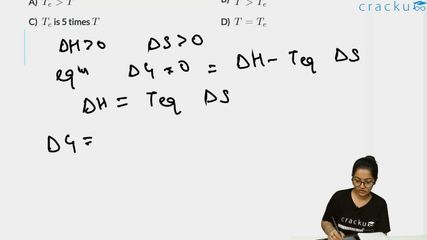
For a particular reversible reaction at temperature $$T$$, $$\Delta H$$ and $$\Delta S$$ were found to be both $$+ve$$. If $$T_e$$ is the temperature at equilibrium, the reaction would be spontaneous when
For any process, the criterion of spontaneity at constant $$T$$ and $$P$$ is the sign of Gibbs free-energy change
$$\Delta G = \Delta H - T\Delta S$$
At equilibrium the reaction is reversible and $$\Delta G = 0$$, so for that temperature $$T_e$$
$$0 = \Delta H - T_e \Delta S \;\;\Longrightarrow\;\; T_e = \frac{\Delta H}{\Delta S}$$
The data given are $$\Delta H \gt 0$$ and $$\Delta S \gt 0$$, hence $$T_e$$ is a positive quantity.
Now consider a temperature $$T$$ different from $$T_e$$.
Put $$T$$ in the Gibbs equation:
$$\Delta G = \Delta H - T\Delta S = \Delta H - \bigl(T_e + (T-T_e)\bigr)\Delta S = (\Delta H - T_e \Delta S) - (T-T_e)\Delta S$$
Since $$\Delta H - T_e \Delta S = 0$$ (by definition of $$T_e$$), this simplifies to
$$\Delta G = - (T - T_e)\Delta S$$
Because $$\Delta S \gt 0$$, the sign of $$\Delta G$$ is controlled solely by the factor $$(T - T_e)$$:
Therefore the reaction becomes spontaneous only at temperatures higher than the equilibrium temperature $$T_e$$.
Option B which is: $$T \gt T_e$$
Was this solution helpful?
Click on the Email ☝️ to Watch the Video Solution
Create a FREE account and get:
_1.webp)

Educational materials for JEE preparation

Ask our AI anything

AI can make mistakes. Please verify important information.
AI can make mistakes. Please verify important information.
