
Join Our JEE Preparation Group
Prep with like-minded aspirants; Get access to free daily tests and study material.
Sign in
Please select an account to continue using cracku.in
↓ →
Join Our JEE Preparation Group
Prep with like-minded aspirants; Get access to free daily tests and study material.
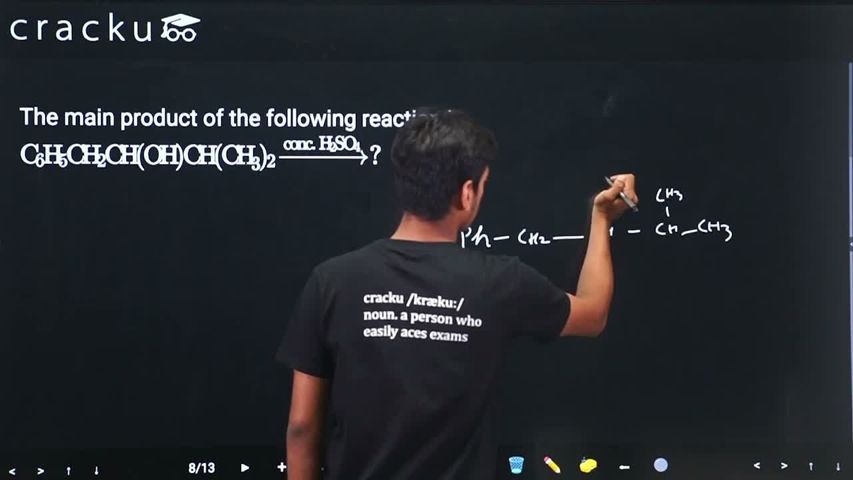
The main product of the following reaction is $$\text{C}_6\text{H}_5\text{CH}_2\text{CH(OH)CH(CH}_3)_2 \xrightarrow{\text{conc. H}_2\text{SO}_4} ?$$
Step-1 Protonation of the alcohol
Under conc. $$H_2SO_4$$ the lone pair on the -OH group picks up a proton to give $$-OH_2^+$$, a good leaving group:
$$C_6H_5CH_2CH(OH)CH(CH_3)_2 + H^+ \rightarrow C_6H_5CH_2CH(OH_2^+)CH(CH_3)_2$$
Step-2 Formation of the carbocation (rate-determining E1 step)
Water leaves to generate a benzylic secondary carbocation:
$$C_6H_5CH_2CH^{+}CH(CH_3)_2 + H_2O$$
The positive charge on $$C_2$$ is stabilised by resonance with the benzene ring, making rearrangements unnecessary.
Step-3 β-elimination to give the alkene
The carbocation can lose a β-hydrogen either from the benzylic carbon (C1) or from the isopropyl carbon (C3).
Case 1: Loss of a proton from C1
Elimination of $$H^+$$ from the benzylic $$CH_2$$ produces
$$C_6H_5CH=CHCH(CH_3)_2$$
This double bond lies conjugated with the aromatic ring (a styrene-type system), giving extra resonance stabilisation.
Case 2: Loss of a proton from C3
Elimination from the isopropyl carbon would give
$$C_6H_5CH_2CH=C(CH_3)_2$$
Although this alkene is trisubstituted, it is not conjugated with the benzene ring and is therefore less stable than the conjugated alkene obtained in Case 1.
Step-4 Selection of the major product
In E1 dehydration the most stable alkene (lower ΔG°) predominates. Conjugation with an aromatic ring provides greater stabilisation than mere alkyl substitution, so the product from Case 1 is the chief product.
Therefore the main product is
$$\boxed{\,C_6H_5CH=CHCH(CH_3)_2\,}$$
Option A which is: $$C_6H_5CH=CHCH(CH_3)_2$$
Was this solution helpful?
Click on the Email ☝️ to Watch the Video Solution
Create a FREE account and get:
_1.webp)

Educational materials for JEE preparation

Ask our AI anything

AI can make mistakes. Please verify important information.
AI can make mistakes. Please verify important information.
