
Join Our JEE Preparation Group
Prep with like-minded aspirants; Get access to free daily tests and study material.
Sign in
Please select an account to continue using cracku.in
↓ →
Join Our JEE Preparation Group
Prep with like-minded aspirants; Get access to free daily tests and study material.
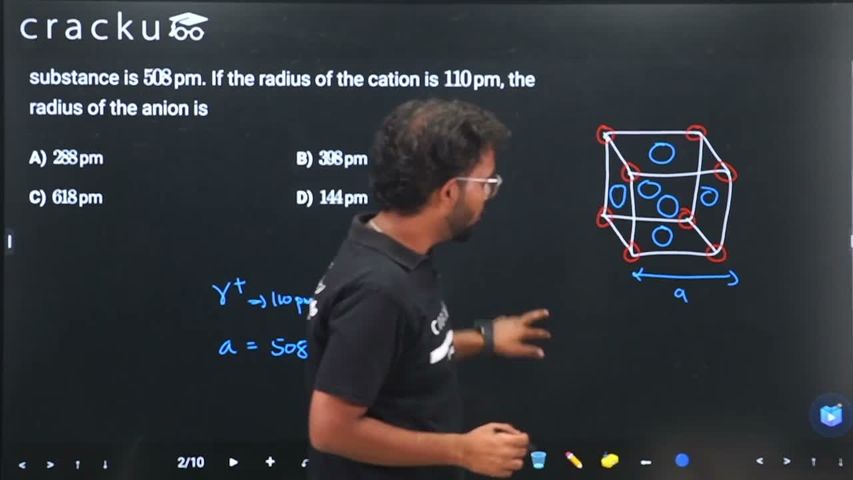
The edge length of a face centered cubic cell of an ionic substance is $$508$$ pm. If the radius of the cation is $$110$$ pm, the radius of the anion is
The data given are typical of an NaCl-type lattice.
In the NaCl structure the anions (Cl−) occupy the lattice points of a face-centred cubic (fcc) cell, while the cations (Na+) sit in all the octahedral voids (edge centres and body centre).
Consider one edge of the cube. Along this edge we encounter: corner anion → edge-centre cation → next corner anion. Hence the sequence of touching spheres is
anion + cation + anion.
The distance between the centres of the corner anion and the edge-centre cation equals half the edge length.$$ \frac{a}{2} $$. Because the two ions are in contact along this line, the separation of their centres also equals the sum of their radii: $$r_{-}+r_{+}$$.
Therefore $$ r_{-}+r_{+}= \frac{a}{2}\qquad -(1)$$
The edge length is given as $$a=508\text{ pm}$$ and the cation radius is $$r_{+}=110\text{ pm}$$. Substituting in (1):
$$ r_{-}= \frac{508}{2}-110 = 254-110 = 144\text{ pm}$$
Hence the radius of the anion is $$144\text{ pm}$$.
Option D which is: 144 pm
Was this solution helpful?
Click on the Email ☝️ to Watch the Video Solution
Create a FREE account and get:
_1.webp)

Educational materials for JEE preparation

Ask our AI anything

AI can make mistakes. Please verify important information.
AI can make mistakes. Please verify important information.
