
Join Our JEE Preparation Group
Prep with like-minded aspirants; Get access to free daily tests and study material.
Sign in
Please select an account to continue using cracku.in
↓ →
Join Our JEE Preparation Group
Prep with like-minded aspirants; Get access to free daily tests and study material.
If sodium sulphate is considered to be completely dissociated into cations and anions in aqueous solution, the change in freezing point of water $$(\Delta T_f)$$, when $$0.01$$ mol of sodium sulphate is dissolved in $$1$$ kg of water, is ($$K_f = 1.86$$ K kg mol$$^{-1}$$)
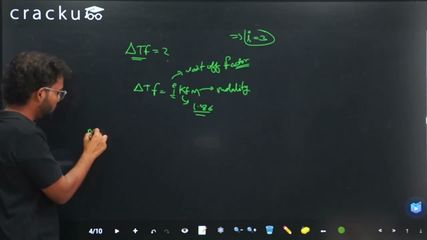
The freezing point depression of a solution is given by the formula $$\Delta T_f = i\,K_f\,m$$ where
$$i$$ = van’t Hoff factor (total particles produced per formula unit),
$$K_f$$ = cryoscopic constant of the solvent, and
$$m$$ = molality of the solution (moles of solute per kilogram of solvent).
1. Calculation of the van’t Hoff factor.
Sodium sulphate dissociates as $$Na_2SO_4 \rightarrow 2\,Na^+ + SO_4^{2-}$$.
Total ions formed per formula unit = $$2 + 1 = 3$$, so $$i = 3$$.
2. Molality of the solution.
Given $$0.01$$ mol of $$Na_2SO_4$$ dissolved in $$1$$ kg of water:
$$m = 0.01 \text{ mol kg}^{-1}$$.
3. Substitute into the formula.
$$\Delta T_f = 3 \times 1.86 \,\text{K kg mol}^{-1} \times 0.01 \,\text{mol kg}^{-1}$$.
4. Perform the multiplication:
First, $$1.86 \times 0.01 = 0.0186$$.
Then, $$3 \times 0.0186 = 0.0558$$.
Hence the change in freezing point is $$\Delta T_f = 0.0558 \text{ K}$$.
Option B which is: $$0.0558 \text{ K}$$.
Was this solution helpful?
Click on the Email ☝️ to Watch the Video Solution
Create a FREE account and get:
_1.webp)

Educational materials for JEE preparation

Ask our AI anything

AI can make mistakes. Please verify important information.
AI can make mistakes. Please verify important information.
