
Join Our JEE Preparation Group
Prep with like-minded aspirants; Get access to free daily tests and study material.
Sign in
Please select an account to continue using cracku.in
↓ →
Join Our JEE Preparation Group
Prep with like-minded aspirants; Get access to free daily tests and study material.
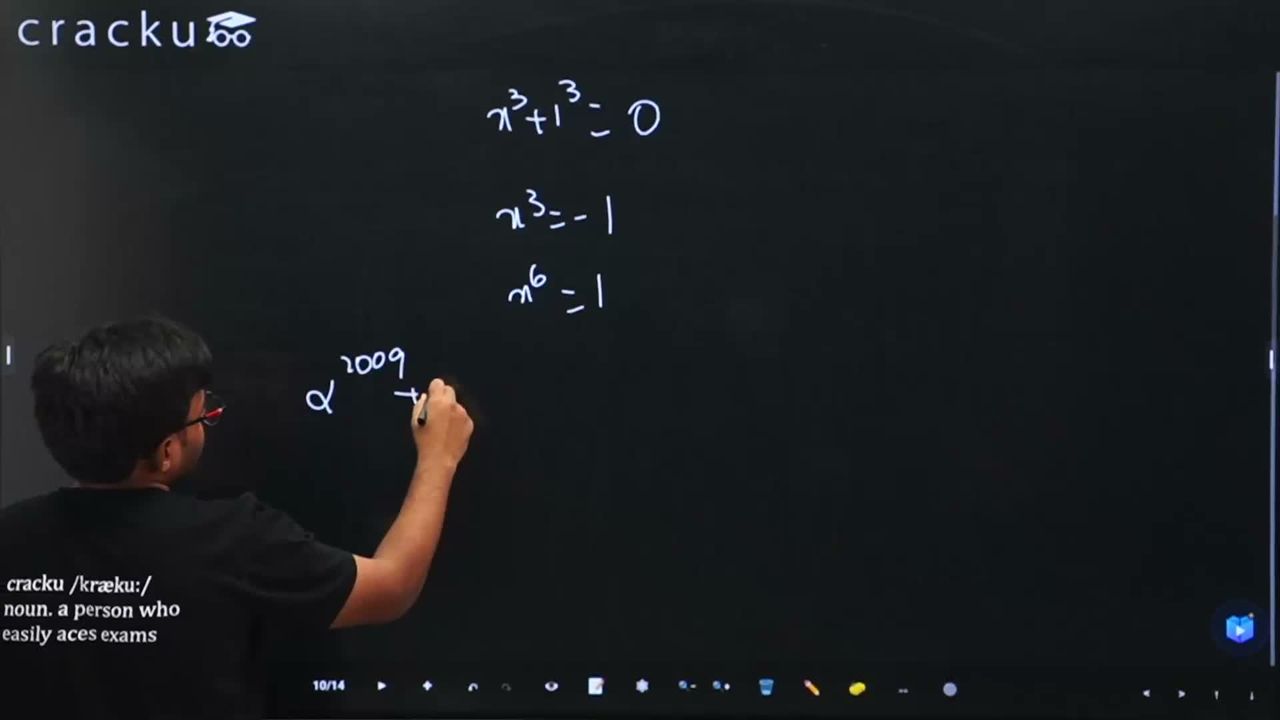
If $$\alpha$$ and $$\beta$$ are the roots of the equation $$x^2 - x + 1 = 0$$, then $$\alpha^{2009} + \beta^{2009} =$$
The quadratic $$x^{2}-x+1=0$$ has roots $$\alpha,\beta$$.
By Viète’s relations, $$\alpha+\beta = 1$$ and $$\alpha\beta = 1$$.
Since each root satisfies the equation, we can write for every integer $$n \ge 2$$
$$\alpha^{n}= \alpha^{n-1}-\alpha^{n-2}, \quad \beta^{n}= \beta^{n-1}-\beta^{n-2}$$
Add the two relations and define $$S_{n}= \alpha^{n}+\beta^{n}$$. This gives the linear recurrence
$$S_{n}=S_{\,n-1}-S_{\,n-2} \qquad -(1)$$
Initial terms:
$$S_{0}= \alpha^{0}+\beta^{0}=2,$$ $$S_{1}= \alpha+\beta = 1.$$
Use (1) to generate the next four terms:
$$S_{2}=S_{1}-S_{0}=1-2=-1,$$ $$S_{3}=S_{2}-S_{1}=-1-1=-2,$$ $$S_{4}=S_{3}-S_{2}=-2-(-1)=-1,$$ $$S_{5}=S_{4}-S_{3}=-1-(-2)=1.$$
Repeating the step once more gives $$S_{6}=S_{5}-S_{4}=1-(-1)=2,$$ so the sequence $$S_{n}$$ is periodic with period $$6$$:
$$\;n:\;0\;1\;2\;3\;4\;5\;6\;7\ldots$$ $$S_{n}: 2,1,-1,-2,-1,1,2,1,\ldots$$
Now reduce the exponent modulo the period: $$2009 \div 6 = 334$$ remainder $$5$$, so $$2009 \equiv 5 \pmod{6}$$.
Therefore $$S_{2009}=S_{5}=1$$, i.e.
$$\alpha^{2009}+\beta^{2009}=1.$$
Option B which is: $$1$$
Was this solution helpful?
Click on the Email ☝️ to Watch the Video Solution
Create a FREE account and get:
_1.webp)

Educational materials for JEE preparation

Ask our AI anything

AI can make mistakes. Please verify important information.
AI can make mistakes. Please verify important information.
