
Join Our JEE Preparation Group
Prep with like-minded aspirants; Get access to free daily tests and study material.
Sign in
Please select an account to continue using cracku.in
↓ →
Join Our JEE Preparation Group
Prep with like-minded aspirants; Get access to free daily tests and study material.
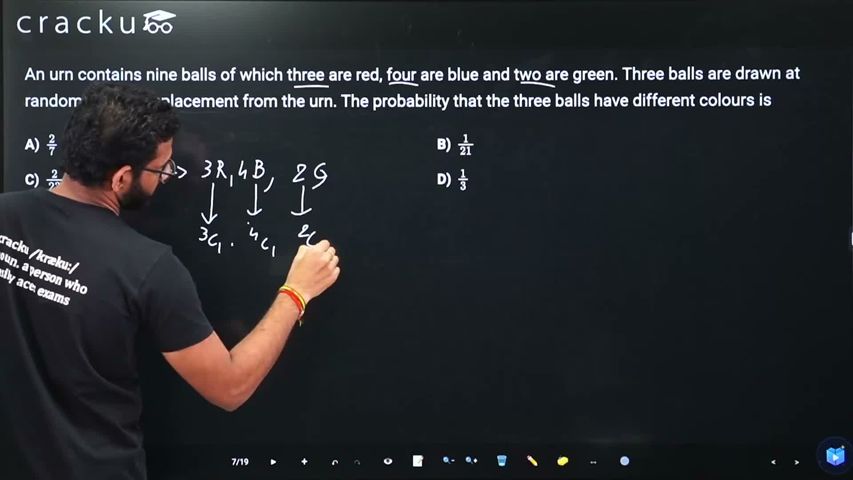
An urn contains nine balls of which three are red, four are blue and two are green. Three balls are drawn at random without replacement from the urn. The probability that the three balls have different colours is
Total number of balls in the urn = $$3 + 4 + 2 = 9$$.
The experiment: draw 3 balls without replacement. Total equally likely ways = number of 3-element subsets of 9 balls: $$\binom{9}{3} = 84$$.
For the three balls to have different colours we need 1 red, 1 blue, and 1 green.
• Ways to choose 1 red out of 3 red balls: $$\binom{3}{1}=3$$.
• Ways to choose 1 blue out of 4 blue balls: $$\binom{4}{1}=4$$.
• Ways to choose 1 green out of 2 green balls: $$\binom{2}{1}=2$$.
By the rule of product, favourable ways $$= 3 \times 4 \times 2 = 24$$.
Therefore, required probability $$P = \frac{\text{favourable ways}}{\text{total ways}} = \frac{24}{84} = \frac{2}{7}.$$
Option A which is: $$\frac{2}{7}$$
Was this solution helpful?
Click on the Email ☝️ to Watch the Video Solution
Create a FREE account and get:
_1.webp)

Educational materials for JEE preparation

Ask our AI anything

AI can make mistakes. Please verify important information.
AI can make mistakes. Please verify important information.
