
Join Our JEE Preparation Group
Prep with like-minded aspirants; Get access to free daily tests and study material.
Sign in
Please select an account to continue using cracku.in
↓ →
Join Our JEE Preparation Group
Prep with like-minded aspirants; Get access to free daily tests and study material.
Optical isomerism (chirality) is observed only when the complex has no plane of symmetry (σ), no centre of symmetry (i) and no improper rotation axis (Sn).
Typical situations that fulfil this requirement are:
(i) Octahedral complexes of the type $$[\text{M}(AA)_3]$$ where $$AA$$ is an unsymmetrical bidentate ligand such as ethylenediamine (en).
(ii) Tetrahedral complexes of the form $$\text{MABCD}$$ with four different monodentate ligands.
Let us examine every option.
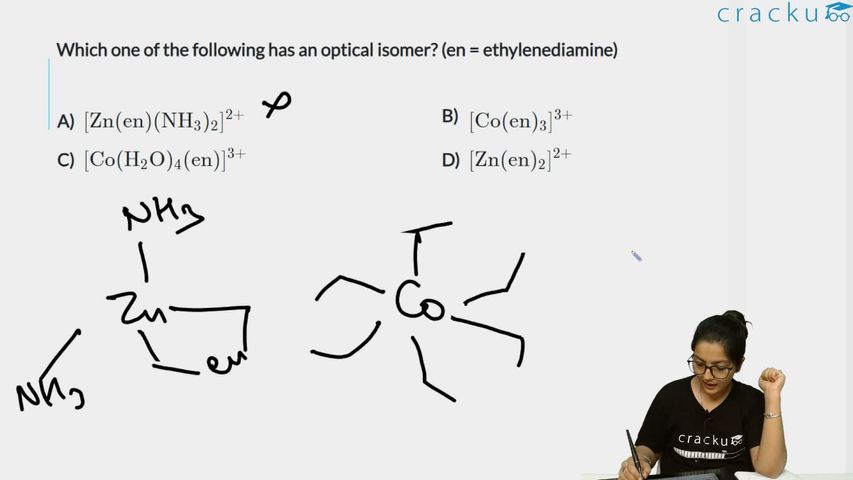
Option A : $$[\text{Zn}(\text{en})(\text{NH}_3)_2]^{2+}$$
Zn(II) with coordination number 4 adopts a tetrahedral geometry. Two ligands are identical ($$\text{NH}_3, \text{NH}_3$$), so the tetrahedron contains a plane that bisects the $$\text{en}$$ chelate ring and exchanges the two $$\text{NH}_3$$ ligands. Hence the complex is achiral and shows no optical isomerism.
Option B : $$[\text{Co}(\text{en})_3]^{3+}$$
This is an octahedral complex containing three bidentate $$\text{en}$$ ligands. The three chelate rings can wind around the metal centre in a right-handed (Δ) or a left-handed (Λ) sense, producing two non-superimposable mirror images. There is no plane, centre or Sn axis of symmetry, so the Δ and Λ forms are true optical isomers.
Option C : $$[\text{Co}(\text{H}_2\text{O})_4(\text{en})]^{3+}$$
Although the coordination number is 6, four positions are occupied by identical $$\text{H}_2\text{O}$$ ligands. A vertical plane can be drawn that passes through the $$\text{en}$$ ring and divides the four aquo ligands into two identical pairs. Therefore the complex possesses a plane of symmetry and cannot be chiral.
Option D : $$[\text{Zn}(\text{en})_2]^{2+}$$
With two identical bidentate ligands around Zn(II) (coordination number 4), the geometry is tetrahedral (or distorted tetrahedral). A plane passing through the metal and bisecting both $$\text{en}$$ rings interchanges the two chelates, rendering the structure achiral.
Only Option B lacks all symmetry elements that would destroy chirality, hence it exhibits optical isomerism.
Final answer: Option B which is: $$[\text{Co}(\text{en})_3]^{3+}$$
Was this solution helpful?
Click on the Email ☝️ to Watch the Video Solution
Create a FREE account and get:
_1.webp)

Educational materials for JEE preparation

Ask our AI anything

AI can make mistakes. Please verify important information.
AI can make mistakes. Please verify important information.
