
Join Our JEE Preparation Group
Prep with like-minded aspirants; Get access to free daily tests and study material.
Sign in
Please select an account to continue using cracku.in
↓ →
Join Our JEE Preparation Group
Prep with like-minded aspirants; Get access to free daily tests and study material.
The potential energy function for the force between two atoms in a diatomic molecule is approximately given by $$U(x) = \frac{a}{x^{12}} - \frac{b}{x^6}$$, where $$a$$ and $$b$$ are constants and $$x$$ is the distance between the atoms. If the dissociation energy of the molecule is $$D = [U(x = \infty) - U_{\text{at equilibrium}}]$$, $$D$$ is
The potential energy function ($$U(x)$$) between the two atoms is given by:
$$U(x) = \frac{a}{x^{12}} - \frac{b}{x^6}$$
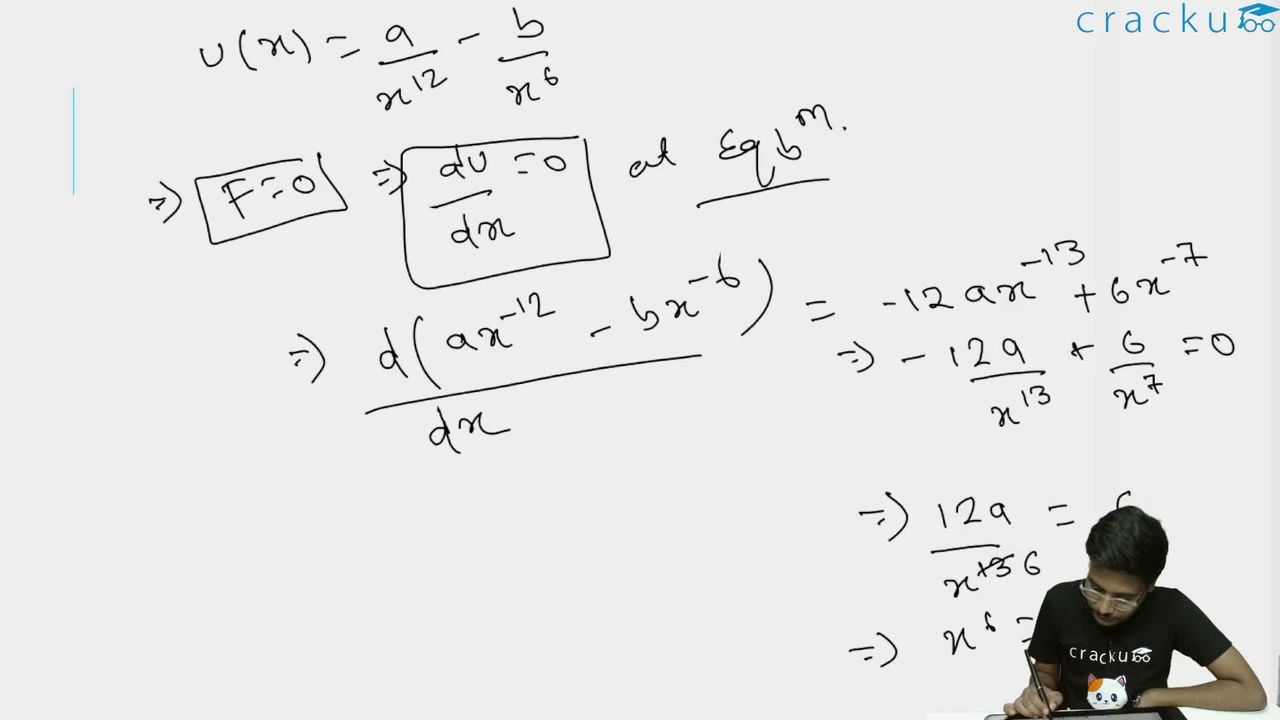
At the stable equilibrium configuration, the conservative internal force ($$F$$) acting between the atoms must be exactly equal to zero. The force is defined as the negative gradient of the potential energy function ($$F = -\frac{dU}{dx}$$):
$$\frac{dU}{dx} = 0$$
Differentiating $$U(x)$$ with respect to the interatomic distance $$x$$ using the power rule:
$$\frac{dU}{dx} = a \cdot (-12 \cdot x^{-13}) - b \cdot (-6 \cdot x^{-7}) = 0$$
$$-\frac{12a}{x^{13}} + \frac{6b}{x^7} = 0$$
Isolating the terms to solve for the equilibrium distance, let this specific position be $$x = x_0$$:
$$\frac{6b}{x_0^7} = \frac{12a}{x_0^{13}}$$
$$x_0^6 = \frac{12a}{6b} = \frac{2a}{b} \quad \text{--- (Eq. 1)}$$
We now substitute the equilibrium condition from Equation 1 ($$x_0^6 = \frac{2a}{b}$$) back into the original potential energy function to find the minimum energy value:
$$U_{\text{equilibrium}} = \frac{a}{(x_0^6)^2} - \frac{b}{x_0^6}$$
$$U_{\text{equilibrium}} = \frac{a}{\left(\frac{2a}{b}\right)^2} - \frac{b}{\left(\frac{2a}{b}\right)}$$
$$U_{\text{equilibrium}} = \frac{a \cdot b^2}{4a^2} - \frac{b^2}{2a}$$
$$U_{\text{equilibrium}} = \frac{b^2}{4a} - \frac{b^2}{2a} = -\frac{b^2}{4a}$$
The dissociation energy ($$D$$) represents the net energy required to break the molecular bond completely, moving the atoms from their stable equilibrium state to an infinite separation ($$x = \infty$$):
$$D = U(x = \infty) - U_{\text{equilibrium}}$$
Evaluating the potential energy at infinite separation:
$$U(x = \infty) = \frac{a}{\infty^{12}} - \frac{b}{\infty^6} = 0 - 0 = 0$$
Substituting both boundary values into our equation for dissociation energy:
$$D = 0 - \left( -\frac{b^2}{4a} \right) = \frac{b^2}{4a}$$
Concept Check: The negative value of potential energy at equilibrium ($$-\frac{b^2}{4a}$$) represents a bound, stable energy well. To completely separate the diatomic molecules into free independent atoms, we must supply an equivalent positive external energy of exactly $$\frac{b^2}{4a}$$ to overcome this attractive potential well.
Correct Option Key: Option C ($$\frac{b^2}{4a}$$)
Was this solution helpful?
Click on the Email ☝️ to Watch the Video Solution
Create a FREE account and get:
_1.webp)

Educational materials for JEE preparation

Ask our AI anything

AI can make mistakes. Please verify important information.
AI can make mistakes. Please verify important information.
