
Join Our JEE Preparation Group
Prep with like-minded aspirants; Get access to free daily tests and study material.
Sign in
Please select an account to continue using cracku.in
↓ →
Join Our JEE Preparation Group
Prep with like-minded aspirants; Get access to free daily tests and study material.
The correct sequence which shows decreasing order of the ionic radii of the elements is
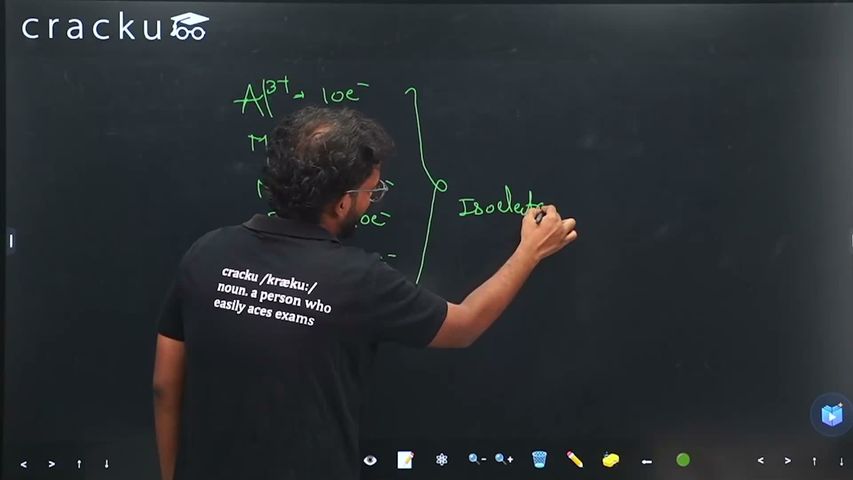
All the given species are $$\textbf{isoelectronic}$$; each of them possesses $$10$$ electrons, the same as the noble-gas atom neon.
For an isoelectronic series, the factor that decides the ionic radius is the nuclear charge $$Z$$ (the number of protons).
• Larger $$Z$$ pulls the same electron cloud more strongly ⇒ smaller radius.
• Smaller $$Z$$ exerts a weaker pull ⇒ larger radius.
Write the nuclear charge of each ion:
$$ \begin{aligned} \text{O}^{2-}&:& Z = 8 \\ \text{F}^{-}&:& Z = 9 \\ \text{Na}^{+}&:& Z = 11 \\ \text{Mg}^{2+}&:& Z = 12 \\ \text{Al}^{3+}&:& Z = 13 \end{aligned} $$
Arrange them in the order of increasing $$Z$$ (which gives decreasing radius):
$$Z: \; 8 \lt 9 \lt 11 \lt 12 \lt 13$$
Therefore the ionic radii follow the opposite trend:
$$\text{O}^{2-} \gt \text{F}^{-} \gt \text{Na}^{+} \gt \text{Mg}^{2+} \gt \text{Al}^{3+}$$
This sequence matches Option D.
Answer: Option D which is: $$\text{O}^{2-} \gt \text{F}^{-} \gt \text{Na}^{+} \gt \text{Mg}^{2+} \gt \text{Al}^{3+}$$
Was this solution helpful?
Click on the Email ☝️ to Watch the Video Solution
Create a FREE account and get:
_1.webp)

Educational materials for JEE preparation

Ask our AI anything

AI can make mistakes. Please verify important information.
AI can make mistakes. Please verify important information.
