
Join Our JEE Preparation Group
Prep with like-minded aspirants; Get access to free daily tests and study material.
Sign in
Please select an account to continue using cracku.in
↓ →
Join Our JEE Preparation Group
Prep with like-minded aspirants; Get access to free daily tests and study material.
The standard enthalpy of formation of $$\text{NH}_3$$ is $$-46.0$$ kJ mol$$^{-1}$$. If the enthalpy of formation of $$\text{H}_2$$ from its atoms is $$-436$$ kJ mol$$^{-1}$$ and that of $$\text{N}_2$$ is $$-712$$ kJ mol$$^{-1}$$, the average bond enthalpy of N$$-$$H bond in $$\text{NH}_3$$ is
Standard Enthalpy of Formation of $$\text{NH}_3$$:
This corresponds to synthesizing $$1 \text{ mole}$$ of ammonia gas from its constituent elements in their standard states:
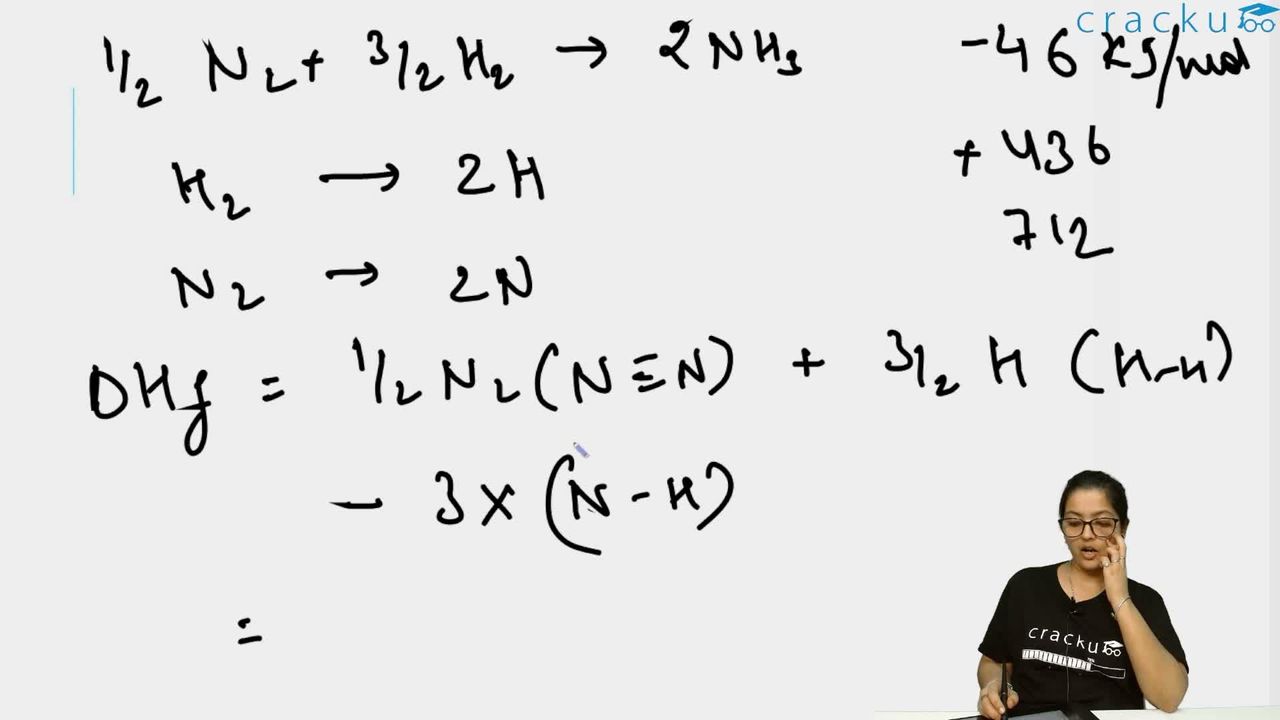
$$\frac{1}{2}\text{N}_{2(g)} + \frac{3}{2}\text{H}_{2(g)} \rightarrow \text{NH}_{3(g)} \quad \Delta H_f^\circ = -46.0 \text{ kJ mol}^{-1}$$
Enthalpy of Formation of $$\text{H}_2$$ from its Atoms (Bond Formation):
The problem gives the enthalpy of forming $$\text{H}_2$$ from gaseous atoms as $$-436 \text{ kJ mol}^{-1}$$. Since bond dissociation is the exact reverse process, the bond dissociation enthalpy of $$\text{H--H}$$ ($$\Delta H_{\text{diss}}^\circ$$) is positive:
$$\text{H}_{2(g)} \rightarrow 2\text{H}_{(g)} \quad \Delta H^\circ = +436 \text{ kJ mol}^{-1}$$
Enthalpy of Formation of $$\text{N}_2$$ from its Atoms (Bond Formation):
Similarly, the enthalpy of forming $$\text{N}_2$$ from individual nitrogen atoms is given as $$-712 \text{ kJ mol}^{-1}$$. Therefore, the bond dissociation enthalpy of the $$\text{N}\equiv\text{N}$$ triple bond is:
$$\text{N}_{2(g)} \rightarrow 2\text{N}_{(g)} \quad \Delta H^\circ = +712 \text{ kJ mol}^{-1}$$
Using the principle that the enthalpy of a reaction can be calculated by subtracting the total bond enthalpies of the products from the total bond enthalpies of the reactants:
$$\Delta H_f^\circ = \sum \Delta H_{\text{bond}} \text{(Reactants)} - \sum \Delta H_{\text{bond}} \text{(Products)}$$
For the formation reaction of $$\text{NH}_3$$:
$$\Delta H_f^\circ = \left[ \frac{1}{2} \Delta H_{\text{bond}}(\text{N}\equiv\text{N}) + \frac{3}{2} \Delta H_{\text{bond}}(\text{H--H}) \right] - \left[ 3 \times \Delta H_{\text{bond}}(\text{N--H}) \right]$$
Substitute the known values into the equation:
$$-46.0 = \left[ \frac{1}{2}(712) + \frac{3}{2}(436) \right] - 3 \times \Delta H_{\text{bond}}(\text{N--H})$$
Simplify the reactant bond enthalpies:
$$\frac{1}{2}(712) = 356$$
$$\frac{3}{2}(436) = 3 \times 218 = 654$$
$$\text{Total Reactant Bond Energy} = 356 + 654 = 1010 \text{ kJ}$$
Solve for the total product bond enthalpy term:
$$-46.0 = 1010 - 3 \times \Delta H_{\text{bond}}(\text{N--H})$$
$$3 \times \Delta H_{\text{bond}}(\text{N--H}) = 1010 + 46.0$$
$$3 \times \Delta H_{\text{bond}}(\text{N--H}) = 1056 \text{ kJ}$$
Isolate the average single $$\text{N--H}$$ bond enthalpy:
$$\Delta H_{\text{bond}}(\text{N--H}) = \frac{1056}{3} = +352 \text{ kJ mol}^{-1}$$
The average bond enthalpy required to break one mole of $$\text{N--H}$$ single bonds in ammonia is calculated to be $$+352 \text{ kJ mol}^{-1}$$.
Answer: Option B — $$+352 \text{ kJ mol}^{-1}$$
Was this solution helpful?
Click on the Email ☝️ to Watch the Video Solution
Create a FREE account and get:
_1.webp)

Educational materials for JEE preparation

Ask our AI anything

AI can make mistakes. Please verify important information.
AI can make mistakes. Please verify important information.
