
Join Our JEE Preparation Group
Prep with like-minded aspirants; Get access to free daily tests and study material.
Sign in
Please select an account to continue using cracku.in
↓ →
Join Our JEE Preparation Group
Prep with like-minded aspirants; Get access to free daily tests and study material.
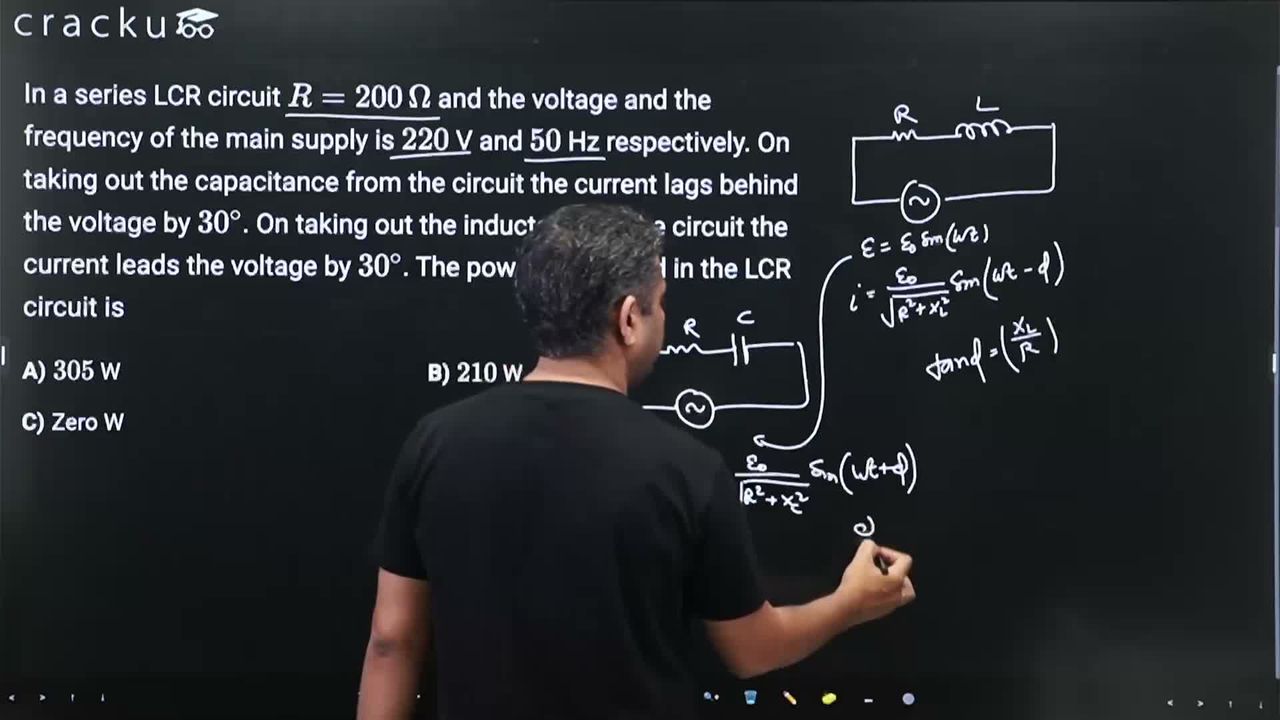
In a series LCR circuit $$R = 200\,\Omega$$ and the voltage and the frequency of the main supply is $$220$$ V and $$50$$ Hz respectively. On taking out the capacitance from the circuit the current lags behind the voltage by $$30^\circ$$. On taking out the inductor from the circuit the current leads the voltage by $$30^\circ$$. The power dissipated in the LCR circuit is
Given:
$$R=200\,\Omega,\qquad V=220\,V,\qquad f=50\,Hz$$
Let the applied voltage be
$$e=E_0\sin\omega t$$
For an RL circuit,
$$i=\frac{E_0}{\sqrt{R^2+X_L^2}}\sin(\omega t-\phi)$$
and
$$\tan\phi=\frac{X_L}{R}$$
Since the current lags by $$30^\circ$$,
$$X_L=R\tan30^\circ$$
Similarly, for the RC circuit,
$$i=\frac{E_0}{\sqrt{R^2+X_C^2}}\sin(\omega t+\phi)$$
Since the current leads by $$30^\circ$$,
$$X_C=R\tan30^\circ$$
Therefore,
$$X_L=X_C$$
So, in the original LCR circuit, the two reactances cancel:
$$Z=\sqrt{R^2+(X_L-X_C)^2}=R$$
Hence,
$$I_0=\frac{E_0}{\sqrt{R^2+(X_L-X_C)^2}}=\frac{E_0}{R}$$
Since $$V=\frac{E_0}{\sqrt2}$$,
$$I=\frac{V}{R}=\frac{220}{200}=1.1\,A$$
The circuit is effectively purely resistive, so
$$P=I^2R$$
$$P=(1.1)^2(200)=242\,W$$
Hence, the answer is $$242\,W$$.
Was this solution helpful?
Click on the Email ☝️ to Watch the Video Solution
Create a FREE account and get:
_1.webp)

Educational materials for JEE preparation

Ask our AI anything

AI can make mistakes. Please verify important information.
AI can make mistakes. Please verify important information.
