
Join Our JEE Preparation Group
Prep with like-minded aspirants; Get access to free daily tests and study material.
Sign in
Please select an account to continue using cracku.in
↓ →
Join Our JEE Preparation Group
Prep with like-minded aspirants; Get access to free daily tests and study material.
A person is to count $$4500$$ currency notes. Let $$a_n$$ denote the number of notes he counts in the $$n^{\text{th}}$$ minute. If $$a_1 = a_2 = \ldots = a_{10} = 150$$ and $$a_{10}, a_{11}, \ldots$$ are in A.P. with common difference $$-2$$, then the time taken by him to count all notes is
For the first $$10$$ minutes the person maintains a constant speed.
Number of notes counted per minute
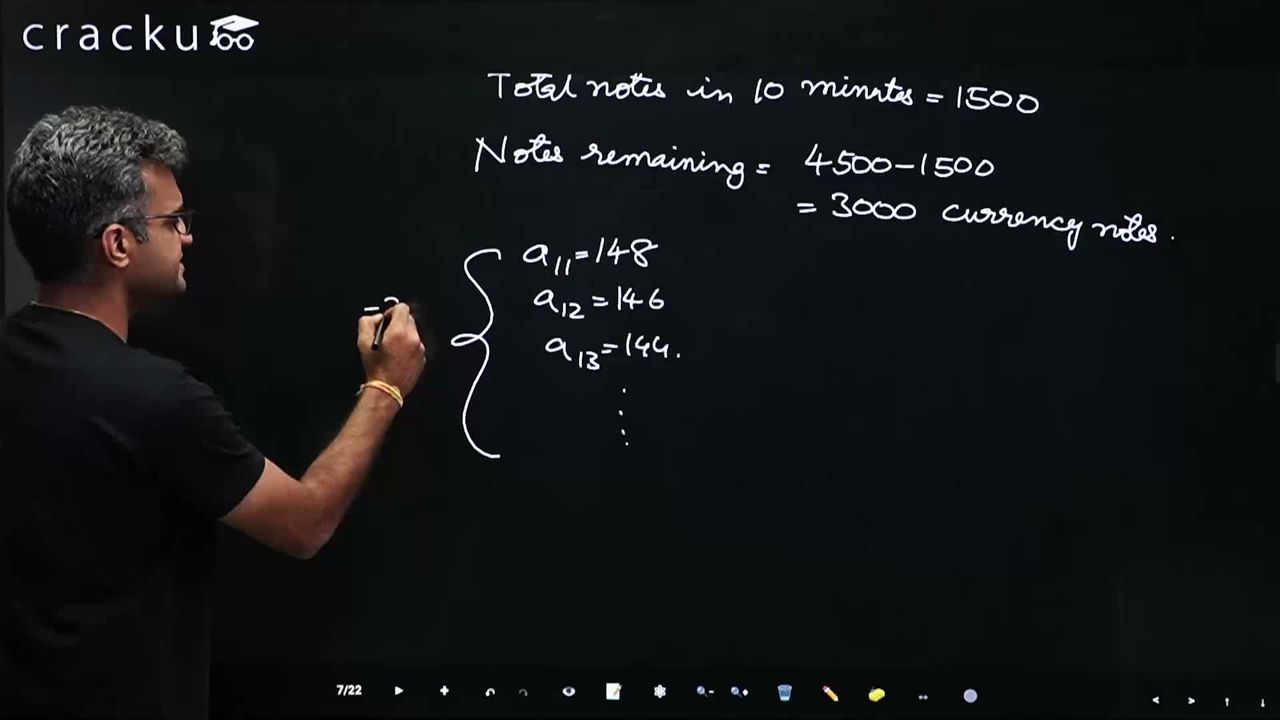
$$a_1 = a_2 = \dots = a_{10}=150$$
Total notes counted in these $$10$$ minutes
$$S_{10}=10\times150=1500$$
Notes still left to be counted
$$4500-1500=3000$$
From the $$11^{\text{th}}$$ minute onward the speeds form an arithmetic progression (A.P.) starting with $$a_{10}=150$$ and common difference $$d=-2$$:
$$a_{10}=150,\; a_{11}=148,\; a_{12}=146,\ldots$$
Let $$k$$ be the number of minutes after the $$10^{\text{th}}$$ minute that are needed to finish the work.
Then we must have
$$\sum_{t=1}^{k}a_{10+t}=3000$$
where $$a_{10+t}=150-2t$$.
Using the sum formula for an A.P.,
$$\sum_{t=1}^{k}(150-2t)=k\cdot150-2\cdot\frac{k(k+1)}{2}$$
$$=150k-k(k+1)= -k^{2}+149k$$
Set equal to $$3000$$:
$$-k^{2}+149k=3000$$
$$\Rightarrow k^{2}-149k+3000=0$$
Solve the quadratic:
Discriminant $$D=149^{2}-4\cdot3000=22201-12000=10201=101^{2}$$
$$k=\frac{149\pm101}{2}\;\Longrightarrow\;k_{1}=24,\;k_{2}=125$$
The value $$k=125$$ would give negative counts (because $$a_{10+125}=150-2\cdot125=-100$$), so it is rejected. Hence $$k=24$$.
Total time taken $$=10+k=10+24=34\text{ minutes}$$.
Option A which is: 34 minutes
Was this solution helpful?
Click on the Email ☝️ to Watch the Video Solution
Create a FREE account and get:
_1.webp)

Educational materials for JEE preparation

Ask our AI anything

AI can make mistakes. Please verify important information.
AI can make mistakes. Please verify important information.
