
Join Our JEE Preparation Group
Prep with like-minded aspirants; Get access to free daily tests and study material.
Sign in
Please select an account to continue using cracku.in
↓ →
Join Our JEE Preparation Group
Prep with like-minded aspirants; Get access to free daily tests and study material.
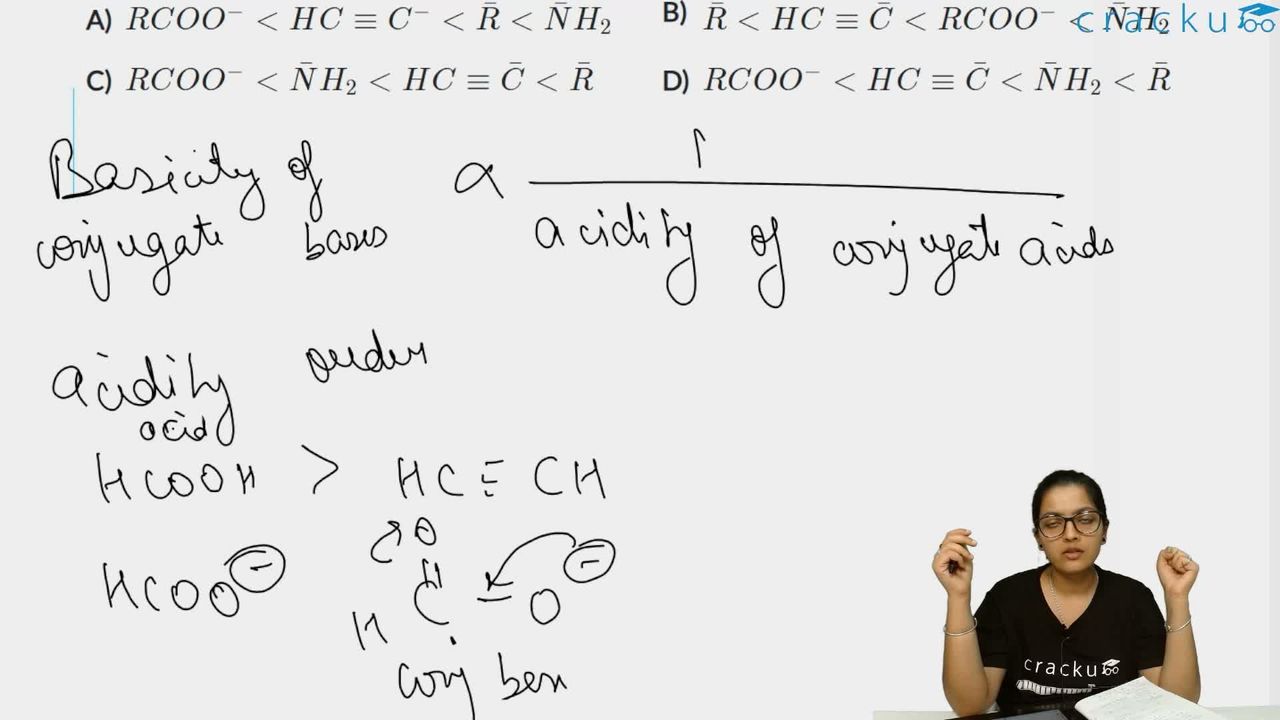
The correct order of increasing basicity of the given conjugate bases ($$R = CH_3$$) is
Basicity of a conjugate base is inversely related to the acidity of its conjugate acid.
Stronger acid ⟶ weaker conjugate base and vice-versa.
For the four conjugate acids involved (with $$R = CH_3$$):
• $$RCOOH$$ (carboxylic acid) has $$pK_a \approx 4\!-\!5$$.
• $$HC \equiv CH$$ (terminal alkyne) has $$pK_a \approx 25$$.
• $$NH_3$$ (ammonia) has $$pK_a \approx 38$$.
• $$CH_4$$ (alkane) has $$pK_a \approx 50$$.
Thus the acidity order is
$$RCOOH \gt HC\equiv CH \gt NH_3 \gt CH_4$$.
Reversing this gives the basicity order of their conjugate bases:
$$RCOO^- \lt HC\equiv C^- \lt NH_2^- \lt CH_3^-$$.
The same trend is supported by structure and electronegativity effects:
• $$RCOO^-$$ is strongly resonance-stabilised and the charge resides on highly electronegative O atoms ⇒ least basic.
• In $$HC\equiv C^-$$ the negative charge is on an sp carbon (50 % s-character) which holds the charge tightly ⇒ next.
• $$NH_2^-$$ has the charge on N (less electronegative than O, sp³ ⇒ 25 % s-character) ⇒ more basic.
• $$CH_3^-$$ carries the charge on sp³ carbon (least electronegative among the set) and has no stabilising resonance ⇒ most basic.
Therefore the correct increasing order of basicity is
$$RCOO^- \; \lt \; HC\equiv C^- \; \lt \; NH_2^- \; \lt \; CH_3^-$$.
Option D which is: $$RCOO^- \lt HC\equiv \bar{C} \lt \bar{N}H_2 \lt \bar{R}$$
Was this solution helpful?
Click on the Email ☝️ to Watch the Video Solution
Create a FREE account and get:
_1.webp)

Educational materials for JEE preparation

Ask our AI anything

AI can make mistakes. Please verify important information.
AI can make mistakes. Please verify important information.
