Join Our JEE Preparation Group
Prep with like-minded aspirants; Get access to free daily tests and study material.
Sign in
Please select an account to continue using cracku.in
↓ →
Join Our JEE Preparation Group
Prep with like-minded aspirants; Get access to free daily tests and study material.
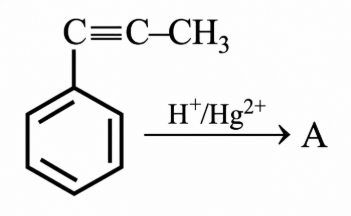
When an unsymmetrical alkyne reacts with $$\text{H}_2\text{SO}_4$$ and $$\text{HgSO}_4$$, water adds across the triple bond following Markovnikov's rule. The electrophile ($$\text{H}^+$$) attacks the carbon that yields the more stable carbocation intermediate.
The triple bond is between the carbon attached to the phenyl ring ($$\text{C}_1$$) and the carbon attached to the methyl group ($$\text{C}_2$$):
$$\text{Ph}-\text{C}\equiv\text{C}-\text{CH}_3$$
Because the benzylic carbocation is significantly more stable, the nucleophile ($$-\text{OH}$$ from water) will attack $$\text{C}_1$$.
The addition of $$-\text{H}$$ and $$-\text{OH}$$ results in an unstable enol intermediate:
$$\text{Ph}-\overset{\text{OH}}{\text{C}}=\text{CH}-\text{CH}_3$$
Enols are generally unstable and rapidly undergo tautomerization to form the more thermodynamically stable carbonyl compound (keto form).
$$\text{Ph}-\overset{\text{OH}}{\text{C}}=\text{CH}-\text{CH}_3 \rightleftharpoons \text{Ph}-\overset{\text{O}}{\overset{\parallel}{\text{C}}}-\text{CH}_2-\text{CH}_3$$
Was this solution helpful?
Click on the Email ☝️ to Watch the Video Solution
Create a FREE account and get:
_1.webp)

Educational materials for JEE preparation

Ask our AI anything

AI can make mistakes. Please verify important information.
AI can make mistakes. Please verify important information.