
Join Our JEE Preparation Group
Prep with like-minded aspirants; Get access to free daily tests and study material.
Sign in
Please select an account to continue using cracku.in
↓ →
Join Our JEE Preparation Group
Prep with like-minded aspirants; Get access to free daily tests and study material.
We examine every statement one-by-one and keep the fundamental facts in mind.
Statement A
Ethyl chloride, $$CH_3CH_2Cl$$, when treated with a Zn-Cu couple in the presence of an alcohol acts exactly as any other alkyl chloride: the metal couple removes chlorine and supplies a hydrogen atom from the solvent.
$$CH_3CH_2Cl \;\xrightarrow[\text{alcohol}]{\text{Zn-Cu}}\; CH_3CH_3$$
Hence ethane is indeed obtained. Statement A is correct.
Statement B
First recall the Grignard addition rule: an organomagnesium halide $$R-MgX$$ adds its alkyl group $$R$$ to the carbonyl carbon, giving a new C-C bond; after acidic work-up the product is an alcohol whose class (1°, 2°, 3°) depends on the starting carbonyl compound.
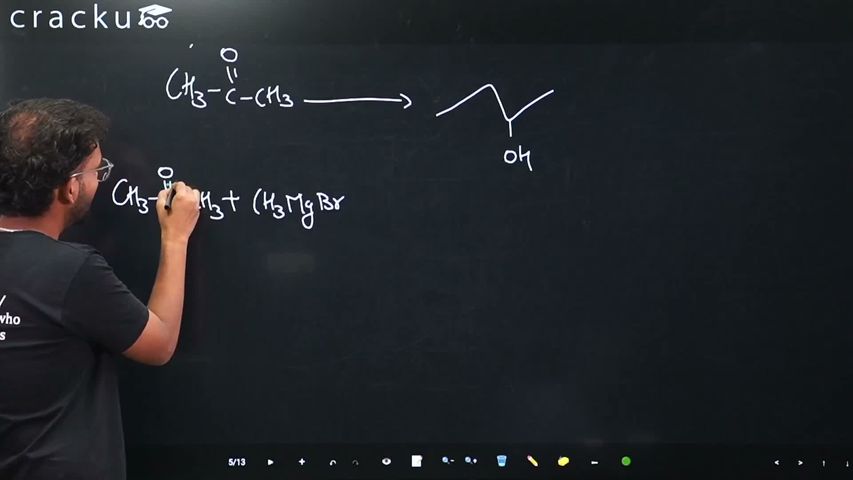
Acetone is $$CH_3COCH_3$$ (a 2° ketone). Adding a methyl Grignard reagent, $$CH_3MgBr$$, supplies another $$CH_3$$ group to the carbonyl carbon:
$$CH_3COCH_3 \;+\; CH_3MgBr \;\xrightarrow{\;ether\;}\; (CH_3)_3C\!-OMgBr$$
$$\quad\;\xrightarrow{\;H_2O/H^+\;}\; (CH_3)_3COH$$
The alcohol produced is 2-methyl-2-propanol (commonly called tert-butyl alcohol), not butan-2-ol. Therefore Statement B is wrong.
Statement C
In any reaction where the C-X bond must break (nucleophilic substitution, Wurtz coupling, etc.), the rate is governed mainly by C-X bond strength and the leaving-group ability: $$RI \gt RBr \gt RCl \gt RF$$. The trend written in the option, $$RI \gt RBr \gt RCl \gt RI$$, is intended to represent this order (the last $$RI$$ clearly stands in place of $$RF$$). Hence the trend is conceptually correct and Statement C is accepted as correct.
Statement D
The molecular formula $$C_2H_4Cl_2$$ allows two structural isomers:
1. $$CH_3CHCl_2$$ (1,1-dichloroethane)
2. $$CH_2ClCH_2Cl$$ (1,2-dichloroethane)
Thus two isomeric forms are possible, so Statement D is correct.
Only Statement B contradicts the standard reactions of Grignard reagents. Hence the wrong statement is:
Option B which is: The reaction of methyl magnesium bromide with acetone gives butanol-2.
Was this solution helpful?
Click on the Email ☝️ to Watch the Video Solution
Create a FREE account and get:
_1.webp)

Educational materials for JEE preparation

Ask our AI anything

AI can make mistakes. Please verify important information.
AI can make mistakes. Please verify important information.
