
Join Our JEE Preparation Group
Prep with like-minded aspirants; Get access to free daily tests and study material.
Sign in
Please select an account to continue using cracku.in
↓ →
Join Our JEE Preparation Group
Prep with like-minded aspirants; Get access to free daily tests and study material.
In context with the transition elements, which of the following statements is incorrect?
The question asks us to find the incorrect statement about transition (d-block) elements. We shall examine every option one by one.
Option A: “In addition to the normal oxidation states, the zero oxidation state is also shown by these elements in complexes.”
• Many transition metals form neutral (zero-oxidation-state) carbonyls and related complexes, e.g. $$Ni(CO)_4$$, $$Fe(CO)_5$$, $$Cr(CO)_6$$, $$V(CO)_6$$.
• Hence a zero oxidation state is indeed possible for several transition metals.
Therefore, Option A is a correct statement.
Option B: “In the highest oxidation states, the transition metal show basic character and form cationic complexes.”
• At very high oxidation states the metal centre possesses a high positive charge density. This makes the species strongly electrophilic (acidic), not basic.
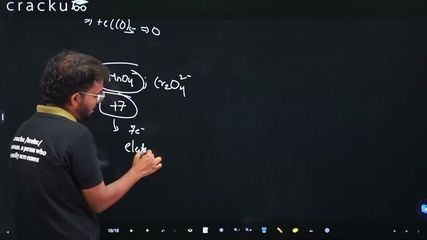
• Such metals commonly form oxo-anions and covalent oxides, e.g. $$MnO_4^-$$ (Mn in +7), $$Cr_2O_7^{2-}$$ (Cr in +6), $$VO_3^-$$ (V in +5). These are anionic or neutral covalent species, not cationic complexes.
Therefore, Option B is an incorrect statement.
Option C: “In the highest oxidation states of the first five transition elements (Sc to Mn), all the $$4s$$ and $$3d$$ electrons are used for bonding.”
Sc: $$[Ar]\,3d^1 4s^2 \rightarrow +3$$ (uses 3 electrons)
Ti: $$[Ar]\,3d^2 4s^2 \rightarrow +4$$ (4 electrons)
V: $$[Ar]\,3d^3 4s^2 \rightarrow +5$$ (5 electrons)
Cr: $$[Ar]\,3d^5 4s^1 \rightarrow +6$$ (6 electrons)
Mn: $$[Ar]\,3d^5 4s^2 \rightarrow +7$$ (7 electrons)
• In every case the sum of all $$4s$$ and $$3d$$ electrons equals the group number and is employed in the maximum oxidation state. Hence the statement is true.
Therefore, Option C is a correct statement.
Option D: “Once the $$d^5$$ configuration is exceeded, the tendency to involve all the 3d electrons in bonding decreases.”
• Beyond Mn (which is $$d^5$$), the maximum attainable oxidation states begin to drop: $$Fe^{+6}$$ (rare), $$Co^{+5}$$ (rare), $$Ni^{+4}$$, $$Cu^{+3}$$, $$Zn^{+2}$$. Thus, metals with more than five d electrons usually do not utilise all of them in bonding.
Therefore, Option D is a correct statement.
Only Option B conflicts with the well-established behaviour of transition metals in high oxidation states. Hence the incorrect statement is:
Option B which is: In the highest oxidation states, the transition metal show basic character and form cationic complexes.
Click on the Email ☝️ to Watch the Video Solution
Create a FREE account and get:
_1.webp)

Educational materials for JEE preparation

Ask our AI anything

AI can make mistakes. Please verify important information.
AI can make mistakes. Please verify important information.


