
Join Our JEE Preparation Group
Prep with like-minded aspirants; Get access to free daily tests and study material.
Sign in
Please select an account to continue using cracku.in
↓ →
Join Our JEE Preparation Group
Prep with like-minded aspirants; Get access to free daily tests and study material.
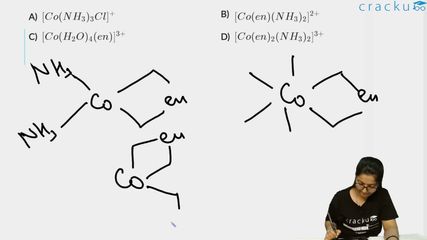
A coordination complex exhibits optical isomerism if its structure is chiral, meaning it lacks an improper axis of rotation (most commonly checked as lacking a plane of symmetry, $$\sigma$$, and a center of inversion, $$i$$). This allows it to exist as non-superimposable mirror images (enantiomers).
Option A: $$[\text{Co(NH}_3)_3\text{Cl}]^+$$
This formula represents a coordination number of 4. Assuming a standard tetrahedral or square planar geometry, the distribution of three identical ligands and one distinct ligand creates a highly symmetric layout with multiple planes of symmetry. It is optically inactive.
Option B: $$[\text{Co(en)(NH}_3)_2]^{2+}$$
This complex also possesses a lower coordination number environment where the single bidentate ligand along with two ammine groups coordinates symmetrically, yielding a configuration that contains an internal plane of symmetry. It is optically inactive.
Option C: $$[\text{Co(H}_2\text{O})_4\text{en}]^{3+}$$
This is an octahedral complex of the general formula $$[\text{M(AA)B}_4]$$. The single ethylenediamine ring lies entirely within one plane, and a plane of symmetry can easily be drawn that cuts directly through the ethylenediamine ring and bisects the pairs of aquo ($$\text{H}_2\text{O}$$) ligands. Because it possesses a plane of symmetry, it cannot exhibit optical isomerism.
Option D: $$[\text{Co(en)}_2\text{NH}_3)_2]^{3+}$$
This is an octahedral complex of the general formula $$[\text{M(AA)}_2\text{B}_2]$$. It can exist as two distinct geometric isomers:
Because its cis geometric variant is chiral, this complex exhibits optical isomerism.
Only the complex containing two bidentate ethylenediamine ligands, $$[\text{Co(en)}_2\text{NH}_3)_2]^{3+}$$, can form a non-superimposable mirror image geometry via its cis-isomer config.
Answer: Option D — $$[\text{Co(en)}_2\text{NH}_3)_2]^{3+}$$
Was this solution helpful?
Click on the Email ☝️ to Watch the Video Solution
Create a FREE account and get:
_1.webp)

Educational materials for JEE preparation

Ask our AI anything

AI can make mistakes. Please verify important information.
AI can make mistakes. Please verify important information.
