
Join Our JEE Preparation Group
Prep with like-minded aspirants; Get access to free daily tests and study material.
Sign in
Please select an account to continue using cracku.in
↓ →
Join Our JEE Preparation Group
Prep with like-minded aspirants; Get access to free daily tests and study material.
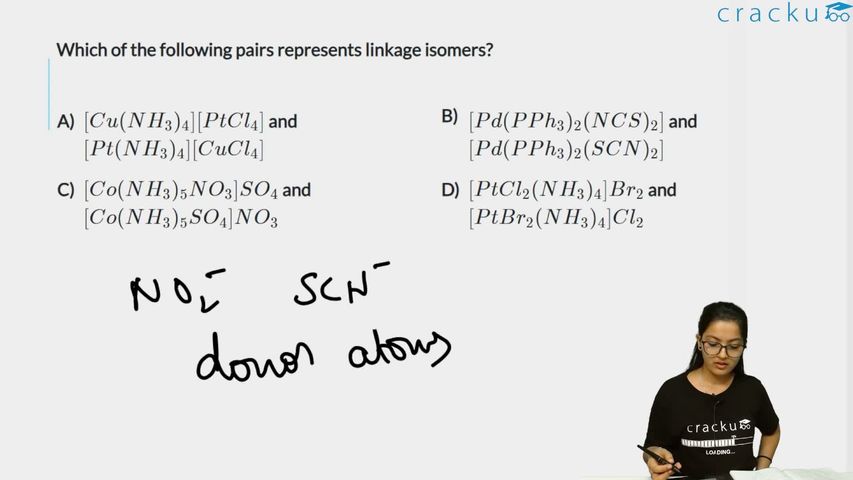
In coordination chemistry, linkage isomerism arises when an ambidentate ligand (one that has two or more different donor atoms) can coordinate to the metal centre through either of those donor atoms. Classic ambidentate ligands include $$NO_2^-$$ (can bind through N or O), $$SCN^-$$ (through S or N) and $$CN^-$$ (through C or N).
We must therefore look for a pair of complexes that differ only in the atom of the same ligand that is attached to the metal. Any pair that differs by exchange of entire ligands, or by swapping ligands between the coordination sphere and the counter-ion, belongs to some other type of isomerism (usually ionisation isomerism).
Option A: $$[Cu(NH_3)_4][PtCl_4]$$ and $$[Pt(NH_3)_4][CuCl_4]$$
Here, the whole cation-anion parts have been interchanged. No ambidentate ligand is involved; this is ionisation isomerism, not linkage isomerism.
Option B: $$[Pd(PPh_3)_2(NCS)_2]$$ and $$[Pd(PPh_3)_2(SCN)_2]$$
The ligand $$SCN^-$$ is ambidentate: it can bind through the nitrogen atom (written $$NCS^-$$, thiocyanato-N) or through the sulfur atom (written $$SCN^-$$, thiocyanato-S). The two complexes differ only in which atom of the same $$SCN^-$$ ligand is attached to palladium. This is the textbook definition of linkage isomerism.
Option C: $$[Co(NH_3)_5NO_3]SO_4$$ and $$[Co(NH_3)_5SO_4]NO_3$$
Nitrate and sulfate have exchanged positions between the inner and outer sphere. Again, the phenomenon is ionisation isomerism, not linkage isomerism.
Option D: $$[PtCl_2(NH_3)_4]Br_2$$ and $$[PtBr_2(NH_3)_4]Cl_2$$
Chloride and bromide have exchanged positions; no ambidentate ligand is involved. This is also ionisation isomerism.
Only Option B involves the same ambidentate ligand ($$SCN^-$$) coordinating through different donor atoms, so only this pair represents linkage isomerism.
Final answer: Option B which is: $$[Pd(PPh_3)_2(NCS)_2]$$ and $$[Pd(PPh_3)_2(SCN)_2]$$
Was this solution helpful?
Click on the Email ☝️ to Watch the Video Solution
Create a FREE account and get:
_1.webp)

Educational materials for JEE preparation

Ask our AI anything

AI can make mistakes. Please verify important information.
AI can make mistakes. Please verify important information.
