
Join Our JEE Preparation Group
Prep with like-minded aspirants; Get access to free daily tests and study material.
Sign in
Please select an account to continue using cracku.in
↓ →
Join Our JEE Preparation Group
Prep with like-minded aspirants; Get access to free daily tests and study material.
First identify the type of halogen compound in each option because the product formed with aqueous $$KOH$$ depends on whether the halogen atoms are on the same carbon (geminal), on adjacent carbons (vicinal), or attached in some other functional group.
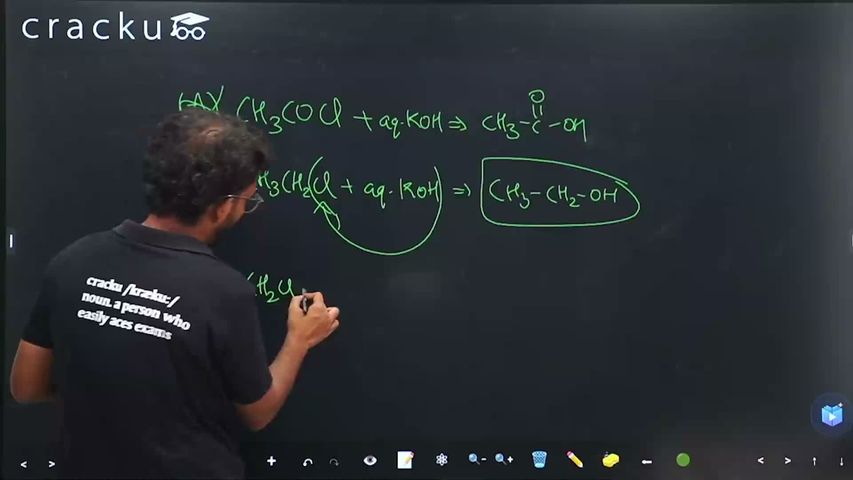
• $$CH_3COCl$$ is an acid chloride (acyl halide).
• $$CH_3CH_2Cl$$ is a simple 1° alkyl chloride.
• $$CH_2ClCH_2Cl$$ is a vicinal dihalide (two Cl on adjacent carbons).
• $$CH_3CHCl_2$$ is a geminal dihalide (two Cl on the same carbon).
Recall the general reactions with aqueous $$KOH$$:
1. Acyl chloride $$RCOCl$$ + $$KOH_{(aq)}$$ $$\rightarrow$$ carboxylic acid $$RCOOH$$.
2. Alkyl chloride $$R{-}Cl$$ + $$KOH_{(aq)}$$ $$\rightarrow$$ alcohol $$R{-}OH$$ (nucleophilic substitution).
3. Vicinal dihalide $$XCH_2CH_2X$$ + $$2KOH_{(aq)}$$ $$\rightarrow$$ diol $$HOCH_2CH_2OH$$ (glycol formation).
4. Geminal dihalide $$RCHX_2$$ + $$2KOH_{(aq)}$$ $$\rightarrow$$ gem-diol $$RCH(OH)_2$$ $$\rightarrow$$ aldehyde (or ketone) $$RCHO$$ + $$H_2O$$ (the unstable gem-diol loses water).
Apply these patterns to each option:
Option A: $$CH_3COCl$$ $$\xrightarrow{KOH_{(aq)}}$$ $$CH_3COOH$$ (acetic acid), not acetaldehyde.
Option B: $$CH_3CH_2Cl$$ $$\xrightarrow{KOH_{(aq)}}$$ $$CH_3CH_2OH$$ (ethanol).
Option C: $$CH_2ClCH_2Cl$$ $$\xrightarrow{2KOH_{(aq)}}$$ $$HOCH_2CH_2OH$$ (ethylene glycol).
Option D: $$CH_3CHCl_2$$ (gem-dichloride) reacts in two steps:
$$CH_3CHCl_2 + 2KOH_{(aq)} \rightarrow CH_3CH(OH)_2 + 2KCl$$
The gem-diol formed is unstable and eliminates water:
$$CH_3CH(OH)_2 \rightarrow CH_3CHO + H_2O$$
The final product is acetaldehyde $$CH_3CHO$$.
Therefore, the compound that gives acetaldehyde on heating with aqueous $$KOH$$ is:
Option D which is: $$CH_3CHCl_2$$
Was this solution helpful?
Click on the Email ☝️ to Watch the Video Solution
Create a FREE account and get:
_1.webp)

Educational materials for JEE preparation

Ask our AI anything

AI can make mistakes. Please verify important information.
AI can make mistakes. Please verify important information.
