
Join Our JEE Preparation Group
Prep with like-minded aspirants; Get access to free daily tests and study material.
Sign in
Please select an account to continue using cracku.in
↓ →
Join Our JEE Preparation Group
Prep with like-minded aspirants; Get access to free daily tests and study material.
The number of statement(s) correct from the following for Copper is/are
(A) Cu(II) complexes are always paramagnetic
(B) Cu(I) complexes are generally colourless
(C) Cu(I) is easily oxidized
(D) In Fehling solution, the active reagent has Cu(I)
Correct Answer: 3
Let us analyze each statement about Copper:
Statement (A): Cu(II) complexes are always paramagnetic
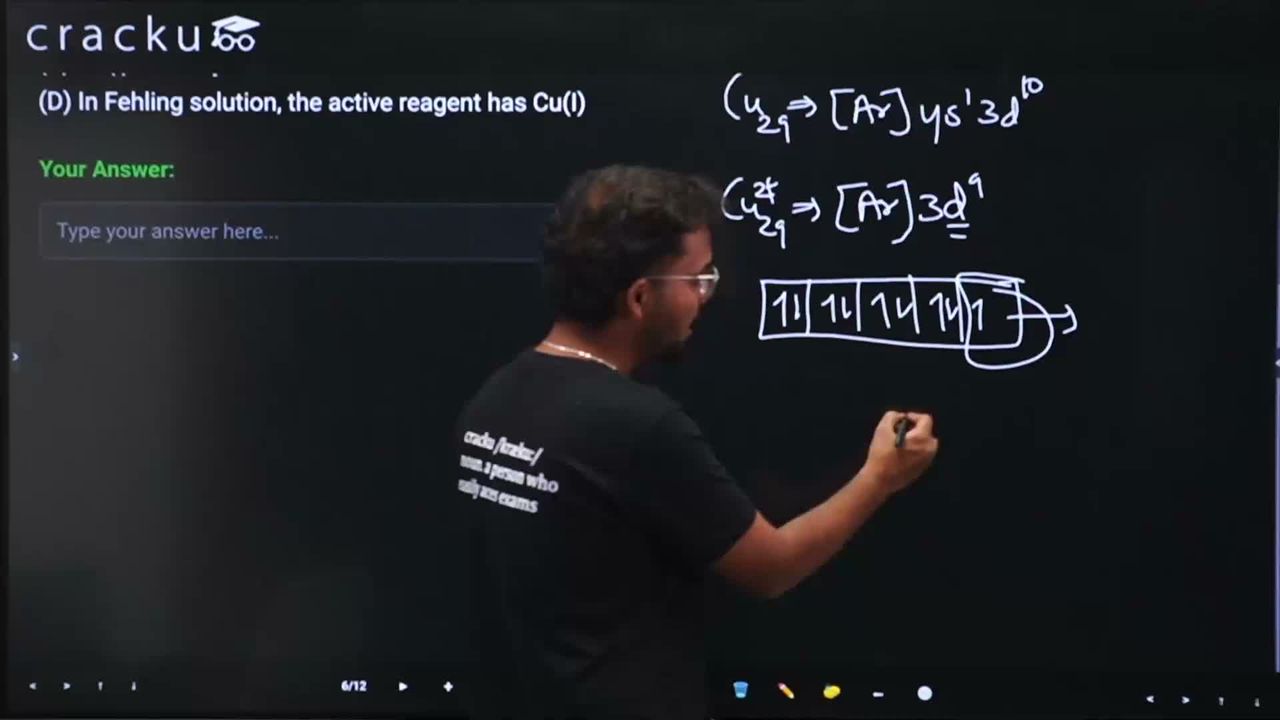
Cu(II) has the electronic configuration [Ar] 3d$$^9$$. With 9 electrons in the d-orbitals, there is always one unpaired electron regardless of the geometry or ligand field strength (whether the complex is octahedral, tetrahedral, or square planar).
Therefore, Cu(II) complexes are always paramagnetic. This statement is correct.
Statement (B): Cu(I) complexes are generally colourless
Cu(I) has the electronic configuration [Ar] 3d$$^{10}$$. Since all d-orbitals are completely filled, there are no d-d transitions possible. The colour of transition metal complexes arises from d-d electronic transitions, and since these cannot occur in a completely filled d-subshell, Cu(I) complexes are generally colourless.
This statement is correct.
Statement (C): Cu(I) is easily oxidized
Cu(I) with d$$^{10}$$ configuration is not very stable in aqueous solution and readily undergoes disproportionation or oxidation to Cu(II). The standard reduction potential $$E^\circ(Cu^{2+}/Cu^{+}) = +0.15$$ V indicates Cu(I) can be easily oxidized to Cu(II).
This statement is correct.
Statement (D): In Fehling solution, the active reagent has Cu(I)
Fehling's solution contains Cu(II) ions complexed with sodium potassium tartrate (Rochelle salt). The deep blue colour of Fehling's solution is due to the Cu(II)-tartrate complex. During the reaction with reducing sugars, Cu(II) gets reduced to Cu(I) as Cu$$_2$$O (red precipitate), but the active reagent itself contains Cu(II), not Cu(I).
This statement is incorrect.
The correct statements are (A), (B), and (C).
Therefore, the number of correct statements is 3.
Was this solution helpful?
Click on the Email ☝️ to Watch the Video Solution
Create a FREE account and get:
_1.webp)

Educational materials for JEE preparation

Ask our AI anything

AI can make mistakes. Please verify important information.
AI can make mistakes. Please verify important information.
