Join WhatsApp Icon JEE WhatsApp Group
Question 133

Of the following outer electronic configurations of atoms, the highest oxidation state is achieved by which one of them?

Solution

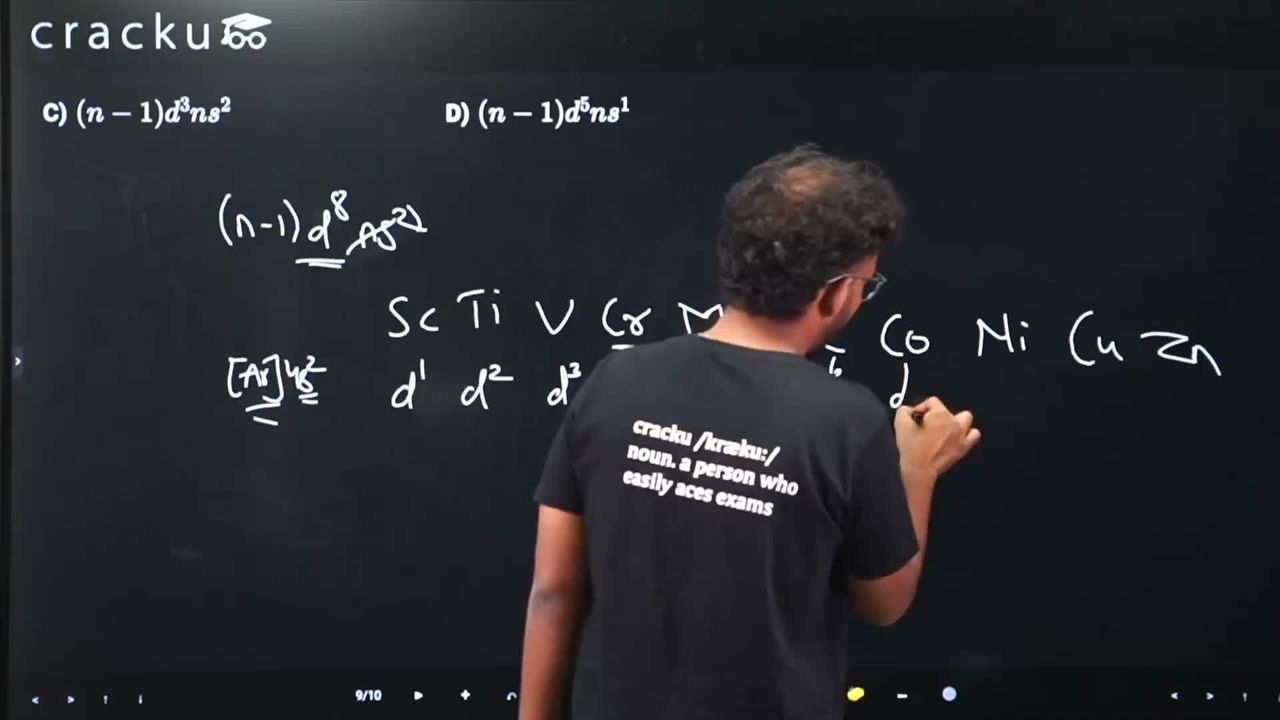
  • Option A: $$(n-1)d^8 ns^2$$
    • This element belongs to the nickel group (e.g., $$\text{Ni}$$). Because the $$d$$-orbital is mostly filled (pairing has occurred for 6 out of 8 electrons), it does not easily share all of its $$d$$ electrons. Its highest common oxidation state is usually $$+2$$ or $$+4$$.
  • Option B: $$(n-1)d^5 ns^2$$
    • This element belongs to the manganese group (e.g., $$\text{Mn}$$). It has a half-filled, highly stable $$d$$-subshell with 5 unpaired electrons and 2 electrons in the $$s$$-subshell. By losing or sharing all $$5 + 2 = 7$$ electrons, it can achieve a maximum oxidation state of $$+7$$ (as seen in $$\text{KMnO}_4$$).
  • Option C: $$(n-1)d^3 ns^2$$
    • This element belongs to the vanadium group (e.g., $$\text{V}$$). The maximum number of electrons it can involve in bonding is $$3 + 2 = 5$$. Thus, its highest oxidation state is $$+5$$.
  • Option D: $$(n-1)d^5 ns^1$$
    • This element belongs to the chromium group (e.g., $$\text{Cr}$$). The maximum number of electrons it can involve in bonding is $$5 + 1 = 6$$. Thus, its highest oxidation state is $$+6$$ (as seen in $$\text{K}_2\text{Cr}_2\text{O}_7$$).

Conclusion

Comparing the maximum oxidation states:
  • Option A $$\rightarrow +4$$
  • Option B $$\rightarrow +7$$
  • Option C $$\rightarrow +5$$
  • Option D $$\rightarrow +6$$

Get AI Help

Video Solution

video

Create a FREE account and get:

  • Free JEE Mains Previous Papers PDF
  • Take JEE Mains paper tests
Ask AI


