
Join Our JEE Preparation Group
Prep with like-minded aspirants; Get access to free daily tests and study material.
Sign in
Please select an account to continue using cracku.in
↓ →
Join Our JEE Preparation Group
Prep with like-minded aspirants; Get access to free daily tests and study material.
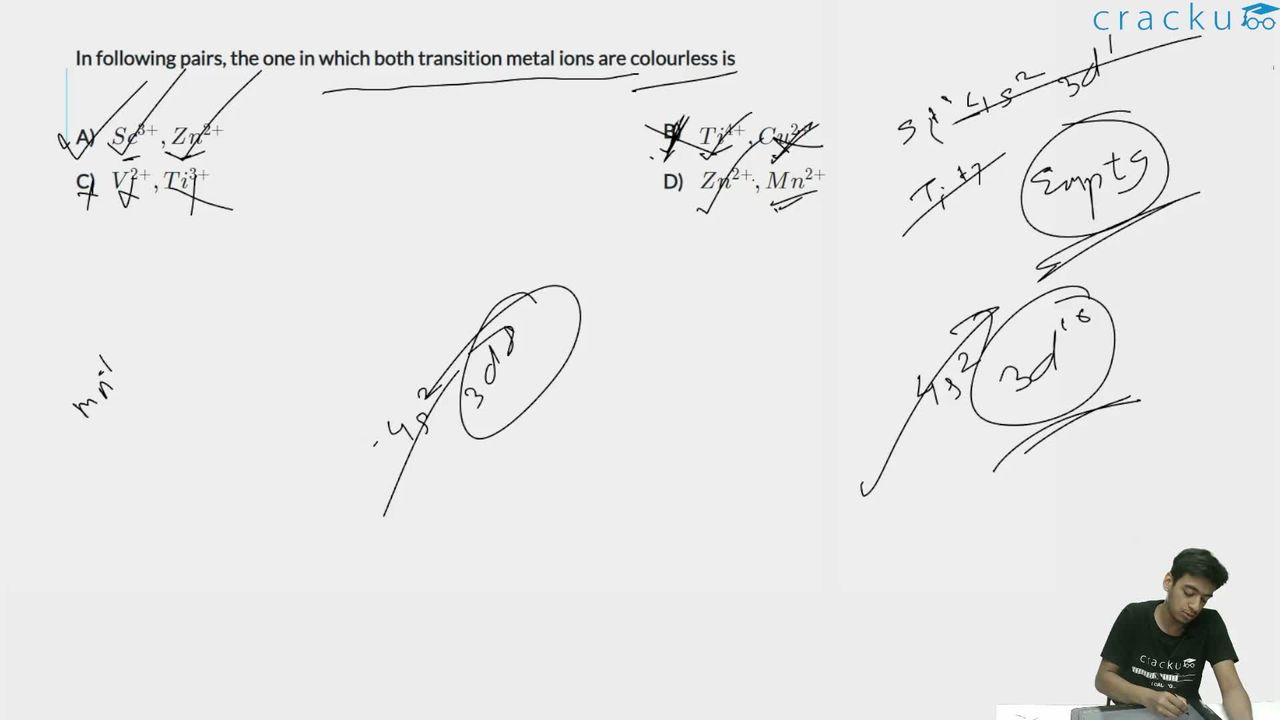
In following pairs, the one in which both transition metal ions are colourless is
We need to find the pair where both transition metal ions are colourless. The colour of a transition metal ion arises from d-d electronic transitions. An ion will be colourless if it has either a $$d^0$$ (empty d-orbitals) or $$d^{10}$$ (completely filled d-orbitals) configuration, because in either case no d-d transition is possible.
Let us examine each option:
Option A: $$Sc^{3+}$$ and $$Zn^{2+}$$
Scandium (Sc) has atomic number 21 with configuration $$[Ar]\,3d^1\,4s^2$$. So $$Sc^{3+}$$ has configuration $$[Ar]$$ — that is $$3d^0$$. With no d-electrons, no d-d transition is possible, so $$Sc^{3+}$$ is colourless.
Zinc (Zn) has atomic number 30 with configuration $$[Ar]\,3d^{10}\,4s^2$$. So $$Zn^{2+}$$ has configuration $$[Ar]\,3d^{10}$$. With completely filled d-orbitals, no d-d transition is possible, so $$Zn^{2+}$$ is colourless.
Both ions are colourless.
Option B: $$Ti^{4+}$$ and $$Cu^{2+}$$
$$Ti^{4+}$$ is $$3d^0$$ (colourless), but $$Cu^{2+}$$ is $$3d^9$$ which allows d-d transitions, making it blue/coloured. Not both colourless.
Option C: $$V^{2+}$$ and $$Ti^{3+}$$
$$V^{2+}$$ is $$3d^3$$ and $$Ti^{3+}$$ is $$3d^1$$. Both have partially filled d-orbitals, so both are coloured.
Option D: $$Zn^{2+}$$ and $$Mn^{2+}$$
$$Zn^{2+}$$ is $$3d^{10}$$ (colourless), but $$Mn^{2+}$$ is $$3d^5$$. Although $$Mn^{2+}$$ is only faintly coloured (all transitions are spin-forbidden), it is still not truly colourless. Moreover, strictly speaking it has partially filled d-orbitals.
Hence, the correct answer is Option A: $$Sc^{3+}, Zn^{2+}$$.
Was this solution helpful?
Click on the Email ☝️ to Watch the Video Solution
Create a FREE account and get:
_1.webp)

Educational materials for JEE preparation

Ask our AI anything

AI can make mistakes. Please verify important information.
AI can make mistakes. Please verify important information.
