
Join Our JEE Preparation Group
Prep with like-minded aspirants; Get access to free daily tests and study material.
Sign in
Please select an account to continue using cracku.in
↓ →
Join Our JEE Preparation Group
Prep with like-minded aspirants; Get access to free daily tests and study material.
Which of the following statement is not true for glucose?
We begin by examining each of the four statements about glucose one by one, keeping in mind the structural features of glucose in aqueous solution and in its derivatives.
We know that glucose is an aldohexose. In dilute aqueous solution it exists mainly in its two cyclic (hemi-acetal) forms, denoted $$\alpha$$-D-glucopyranose and $$\beta$$-D-glucopyranose, which interconvert through the open-chain aldehydic form. Let us now analyse the assertions.
Statement A. “Glucose exists in two crystalline forms $$\alpha$$ and $$\beta$$.”
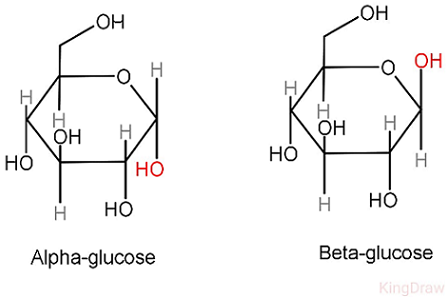
The two cyclic stereoisomers just mentioned crystallise separately. The $$\alpha$$-form melts at $$\;146^{\circ}\text{C}$$, whereas the $$\beta$$-form melts at $$\;150^{\circ}\text{C}$$. They are obtained by crystallising glucose from water at different temperatures. Hence Statement A is true.
Statement C. “Glucose reacts with hydroxylamine to form oxime.”
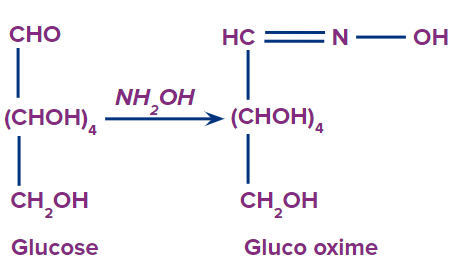
The aldehydic carbonyl group of the small fraction of open-chain glucose is capable of the usual nucleophilic addition reactions. Hydroxylamine ($$\mathrm{NH_2OH}$$) adds to an aldehyde or ketone to yield an oxime according to the general equation
$$\mathrm{R{-}CHO + NH_2OH \;\longrightarrow\; R{-}CH{=}NOH + H_2O}$$
Substituting $$\mathrm{R = (CHOH)_4CH_2OH}$$ for glucose, the same transformation occurs. Therefore Statement C is true.
Statement D. “The pentaacetate of glucose does not react with hydroxylamine to give oxime.”
In glucose pentaacetate, all five hydroxyl groups are converted to acetate esters. The anomeric hydroxyl at $$\mathrm{C\!-\!1}$$ is also acetylated, so the molecule is locked in the cyclic acetal form and cannot open to reveal the $$\mathrm{-CHO}$$ group. With no free carbonyl available, hydroxylamine cannot form an oxime. Consequently Statement D is true.
Statement B. “Glucose gives Schiff’s test for aldehyde.”
Schiff’s reagent detects free, un-hindered aldehyde groups; a positive result is the immediate appearance of a magenta colour. In solution the aldehyde functionality of glucose is effectively masked because the molecule overwhelmingly prefers its intramolecular hemi-acetal forms. Although the open-chain form exists in equilibrium, its concentration is too low and its carbonyl is too hindered to decolourise Schiff’s reagent rapidly. Experimentally, glucose gives a negative (or at best very faint and slow) Schiff’s test. Therefore Statement B is not true.
We have now classified all four statements. Only Statement B fails, while A, C and D are correct.
Hence, the correct answer is Option B.
Was this solution helpful?
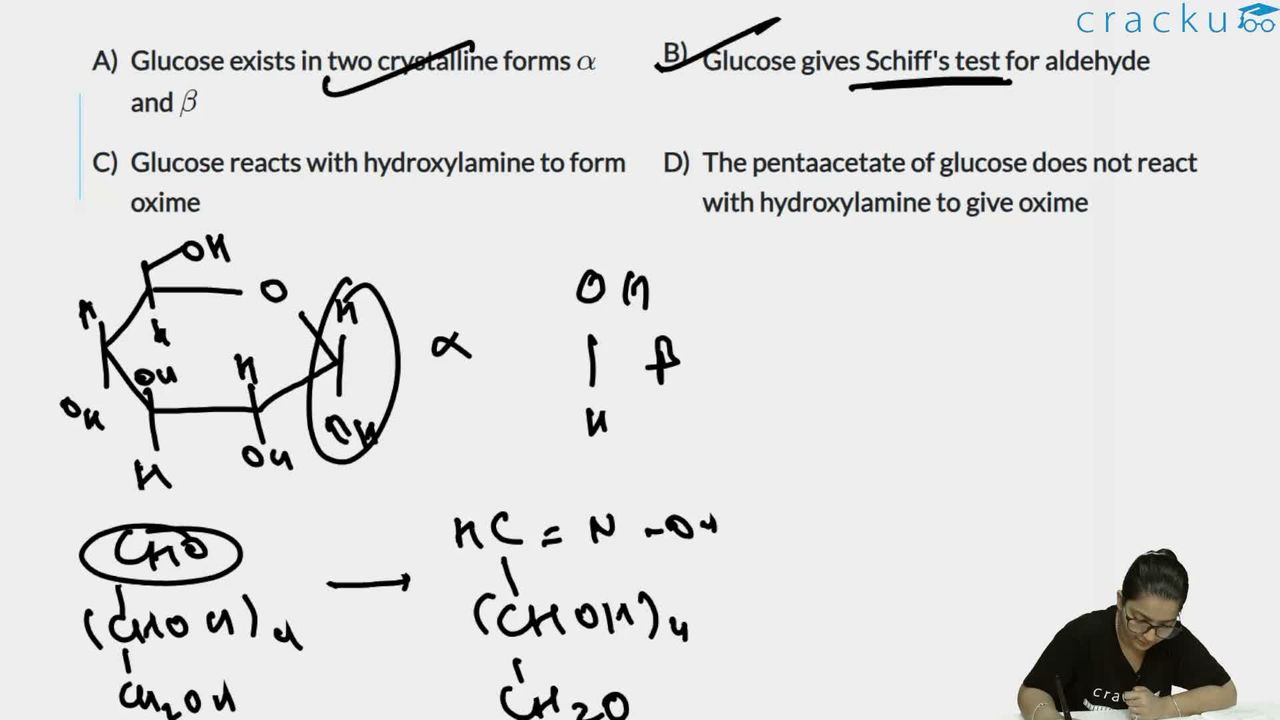
Click on the Email ☝️ to Watch the Video Solution
Create a FREE account and get:
_1.webp)

Educational materials for JEE preparation

Ask our AI anything

AI can make mistakes. Please verify important information.
AI can make mistakes. Please verify important information.
