For the following questions answer them individually
The dimension of stopping potential $$V_0$$ in photoelectric effect in units of Planck's constant 'h', speed of light 'c' and Gravitational constant 'G' and ampere A is:
A particle of mass $$m$$ is fixed to one end of a light spring having force constant $$k$$ and unstretched length $$l$$. The other end is fixed. The system is given an angular speed $$\omega$$ about the fixed end of the spring such that it rotates in a circle in gravity free space. Then the stretch in the spring is:
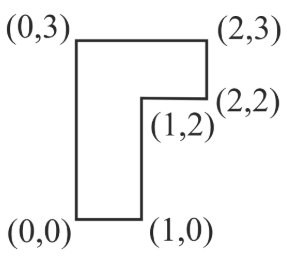
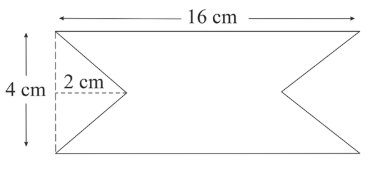
The coordinates of the centre of mass of a uniform flag-shaped lamina (thin flat plate) of mass 4 kg. (The coordinates of the same are shown in the figure) are:
Consider a uniform rod of mass $$M = 4$$ m and length $$l$$ pivoted about its centre. A mass $$m$$ moving with velocity $$v$$ making angle $$\theta = \frac{\pi}{4}$$ to the rod's long axis collides with one end of the rod and sticks to it. The angular speed of the rod-mass system just after the collision is:
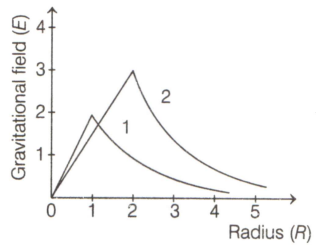
Consider two solid spheres of radii $$R_1 = 1$$ m, $$R_2 = 2$$ m and masses $$M_1$$ and $$M_2$$, respectively. The gravitational field due to sphere (1) and (2) are shown. The value of $$\frac{M_1}{M_2}$$ is:
A leak proof cylinder of length 1 m, made of a metal which has very low coefficient of expansion is floating vertically in water at 0$$^\circ$$C such that its height above the water surface is 20 cm. When the temperature of water is increased to 4$$^\circ$$C, the height of the cylinder above the water surface becomes 21 cm. The density of water at T = 4$$^\circ$$C, relative to the density at T = 0$$^\circ$$C is close to:
Consider a solid sphere of radius $$R$$ and mass density $$\rho(r) = \rho_0\left(1 - \frac{r^2}{R^2}\right)$$, $$0 < r \le R$$. The minimum density of a liquid in which it will float is:
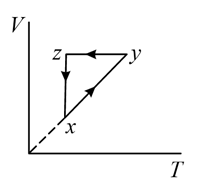
A thermodynamic cycle xyzx is shown on a V-T diagram.
The P-V diagram that best describes this cycle is: (Diagrams are schematic and not to scale)
The plot that depicts the behavior of the mean free time $$\tau$$ (time between two successive collisions) for the molecules of an ideal gas, as a function of temperature (T), qualitatively, is: (Graphs are schematic and not drawn to scale)
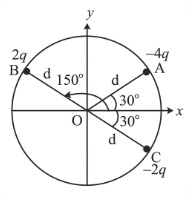
Three charged particles A, B and C with charges $$-4q$$, $$2q$$ and $$-2q$$ are present on the circumference of a circle of radius $$d$$. The charged particles A, C and centre O of the circle formed an equilateral triangle as shown in the figure. The electric field at the point O is