NTA JEE Main 8th January 2020 Shift 1
For the following questions answer them individually
NTA JEE Main 8th January 2020 Shift 1 - Question 11
In finding the electric field using Gauss law the formula $$\left|\vec{E}\right| = \frac{q_{enc}}{\varepsilon_0|A|}$$ is applicable. In the formula $$\varepsilon_0$$ is permittivity of free space, A is the area of the Gaussian surface and $$q_{enc}$$ is charge enclosed by the Gaussian surface. This equation can be used in which of the following situation?
NTA JEE Main 8th January 2020 Shift 1 - Question 12
Effective capacitance of parallel combination of two capacitors $$C_1$$ and $$C_2$$ is 10$$\mu$$F. When these capacitors are individually connected to a voltage source of 1V, the energy stored in the capacitor $$C_2$$ is 4 times that of $$C_1$$. If these capacitors are connected in series, their effective capacitance will be:
NTA JEE Main 8th January 2020 Shift 1 - Question 13
The length of a potentiometer wire is 1200 cm and it carries a current of 60 mA. For a cell of emf 5 V and internal resistance of 20 $$\Omega$$ the null point on it is found to be at 1000 cm. The resistance of whole wire is:

NTA JEE Main 8th January 2020 Shift 1 - Question 14
Proton with kinetic energy of 1 MeV moves from south to north. It gets an acceleration of $$10^{12}$$ m/s$$^2$$ by an applied magnetic field (west to east). The value of magnetic field: (Rest mass of proton is $$1.6 \times 10^{-27}$$ kg)
NTA JEE Main 8th January 2020 Shift 1 - Question 15
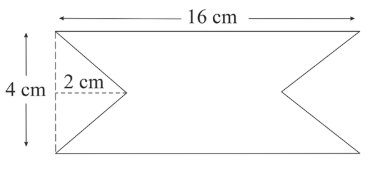
At time $$t = 0$$ magnetic field of 1000 Gauss is passing perpendicularly through the area defined by the closed loop shown in the figure. If the magnetic field reduces linearly to 500 Gauss, in the next 5s, then induced EMF in the loop is:
NTA JEE Main 8th January 2020 Shift 1 - Question 16
The critical angle of a medium for a specific wavelength, if the medium has relative permittivity 3 and relative permeability $$\frac{4}{3}$$ for this wavelength, will be:
NTA JEE Main 8th January 2020 Shift 1 - Question 17
The magnifying power of a telescope with tube length 60 cm is 5. What is the focal length of its eye piece?
NTA JEE Main 8th January 2020 Shift 1 - Question 18
When photon of energy 4.0 eV strikes the surface of a metal A, the ejected photoelectrons have maximum kinetic energy $$T_A$$ eV and de-Broglie wavelength $$\lambda_A$$. The maximum kinetic energy of photoelectrons liberated from another metal B by photon of energy 4.50 eV is $$T_B = (T_A - 1.5)$$ eV. If the de-Broglie wavelength of these photoelectrons $$\lambda_B = 2\lambda_A$$, then the work function of metal B is:
NTA JEE Main 8th January 2020 Shift 1 - Question 19
The graph which depicts the results of Rutherford gold foil experiment with $$\alpha$$-particles is:
$$\theta$$: Scattering angle
Y: Number of scattered $$\alpha$$-particles detected
(Plots are schematic and not to scale)
NTA JEE Main 8th January 2020 Shift 1 - Question 20
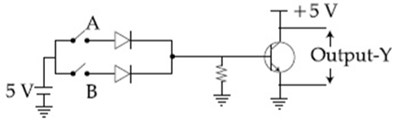
Boolean relation at the output stage Y for the following circuit is: