
Join Our JEE Preparation Group
Prep with like-minded aspirants; Get access to free daily tests and study material.
Sign in
Please select an account to continue using cracku.in
↓ →
Join Our JEE Preparation Group
Prep with like-minded aspirants; Get access to free daily tests and study material.
The volume (in mL) of 0.125 M AgNO$$_3$$ required to quantitatively precipitate chloride ions in 0.3 g of [Co(NH$$_3$$)$$_6$$]Cl$$_3$$ is __________.
M[Co(NH$$_3$$)$$_6$$]Cl$$_3$$ = 267.46 g/mol
M AgNO$$_3$$ = 169.87 g/mol
Report the nearest integer as the answer.
Correct Answer: 27
We are told that the chloride ions present in the coordination compound $$[\,\text{Co(NH}_3)_6\,]\text{Cl}_3$$ are to be completely precipitated by silver nitrate according to the well-known reaction
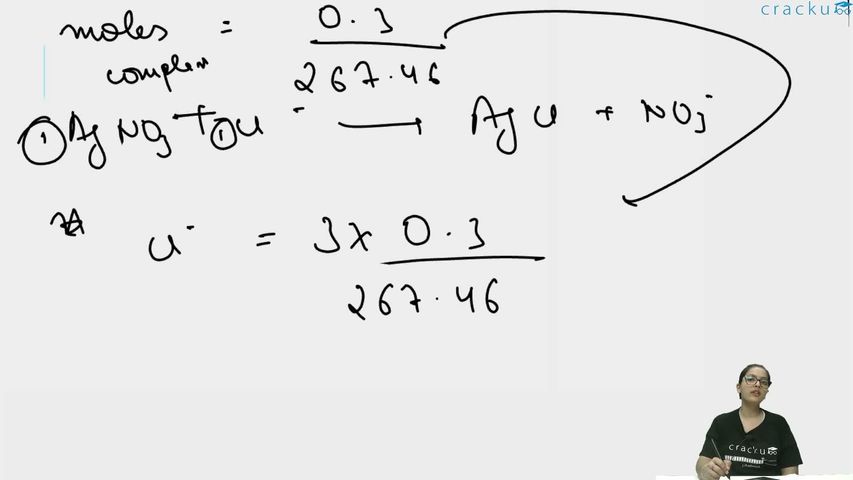
$$\text{AgNO}_3 + \text{Cl}^- \;\longrightarrow\; \text{AgCl}\,(s) + \text{NO}_3^-$$
This equation shows a simple $$1{:}1$$ mole ratio between $$\text{AgNO}_3$$ and $$\text{Cl}^-$$. Hence every mole of chloride ion consumes exactly one mole of silver nitrate.
Now let us begin with the sample of the complex salt.
The given mass of the complex is $$m = 0.3\;\text{g}$$ and its molar mass is $$M_{[\,\text{Co(NH}_3)_6\,]\text{Cl}_3}=267.46\;\text{g mol}^{-1}$$. Using the fundamental relation
$$\text{moles}=\dfrac{\text{mass}}{\text{molar mass}}$$
we obtain the moles of the complex present:
$$n_{ \text{complex} }=\dfrac{0.3\; \text{g} }{267.46\; \text{g mol} ^{-1}} =0.0011216\; \text{mol} \quad($$ keeping extra digits for intermediate accuracy $$).$$
Each formula unit of $$[\,\text{Co(NH}_3)_6\,]\text{Cl}_3$$ carries three chloride counter-ions. Therefore, the total moles of chloride ions are
$$n_{\text{Cl}^-}=3\times n_{\text{complex}} =3\times0.0011216 =0.0033648\;\text{mol}.$$
Because of the $$1{:}1$$ stoichiometry, the moles of $$\text{AgNO}_3$$ required are exactly the same:
$$n_{\text{AgNO}_3}=0.0033648\;\text{mol}.$$
The silver nitrate solution supplied has a molarity of $$0.125\;\text{M}$$, meaning
$$\text{Molarity}=\frac{\text{moles of solute}}{volume\ ofsolution\ \left(in\ litres\right)}$$
Re-arranging for volume, we have
$$V=\dfrac{n}{C},$$
so that
$$V_{\text{L}}=\dfrac{0.0033648\;\text{mol}}{0.125\;\text{mol L}^{-1}} =0.0269184\;\text{L}.$$
Converting litres to millilitres involves the simple relation $$1\;\text{L}=1000\;\text{mL}$$, hence
$$V_{\text{mL}}=0.0269184\times1000 =26.9184\;\text{mL}.$$
The question asks for the volume to the nearest integer, so we round $$26.9184$$ to $$27$$.
So, the answer is $$27$$.
Was this solution helpful?
Click on the Email ☝️ to Watch the Video Solution
Create a FREE account and get:
_1.webp)

Educational materials for JEE preparation

Ask our AI anything

AI can make mistakes. Please verify important information.
AI can make mistakes. Please verify important information.
