Join Our JEE Preparation Group
Prep with like-minded aspirants; Get access to free daily tests and study material.
Sign in
Please select an account to continue using cracku.in
↓ →
Join Our JEE Preparation Group
Prep with like-minded aspirants; Get access to free daily tests and study material.

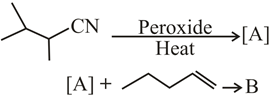
Step 1: Hydrogen Abstraction (Formation of Radical A)
When the starting nitrile, 2,3-dimethylbutanenitrile ($$(\text{CH}_3)_2\text{CH--CH(CH}_3\text{)--CN}$$), is heated with a peroxide initiator, the peroxide decomposes to form free radicals. These radicals abstract the most reactive hydrogen atom from the nitrile:
$$\text{Product A} = (\text{CH}_3)_2\text{CH--}\dot{\text{C}}(\text{CH}_3)\text{--CN}$$
Step 2: Radical Addition to Alkene (Formation of B)
The highly stable carbon radical A acts as a nucleophilic radical and adds to the terminal, less sterically hindered carbon of pent-1-ene ($$\text{CH}_2=\text{CH--CH}_2\text{--CH}_2\text{--CH}_3$$). This forms a new carbon-carbon bond and generates a secondary alkyl radical:
$$\text{Intermediate Radical} = (\text{CH}_3)_2\text{CH--C(CH}_3\text{)(CN)--CH}_2\text{--}\dot{\text{C}}\text{H--CH}_2\text{--CH}_2\text{--CH}_3$$Step 3: Chain Propagation
This newly formed secondary alkyl radical then abstracts a hydrogen atom from another molecule of the starting nitrile compound, completing the radical chain mechanism and yielding the final addition product B:
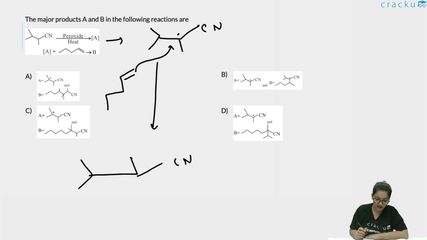
$$\text{Product B} = (\text{CH}_3)_2\text{CH--C(CH}_3\text{)(CN)--CH}_2\text{--CH}_2\text{--CH}_2\text{--CH}_2\text{--CH}_3$$The reaction proceeds via preferential formation of the resonance-stabilized alpha-cyano radical intermediate followed by anti-Markovnikov-like radical addition across the terminal alkene, matching the structures given in Option B.
Answer: Option B
Was this solution helpful?
Click on the Email ☝️ to Watch the Video Solution
Create a FREE account and get:
_1.webp)

Educational materials for JEE preparation

Ask our AI anything

AI can make mistakes. Please verify important information.
AI can make mistakes. Please verify important information.