
Join Our JEE Preparation Group
Prep with like-minded aspirants; Get access to free daily tests and study material.
Sign in
Please select an account to continue using cracku.in
↓ →
Join Our JEE Preparation Group
Prep with like-minded aspirants; Get access to free daily tests and study material.
The most suitable reagent for the given conversion is:
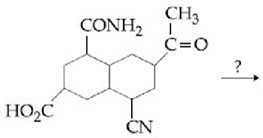
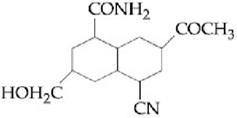
Looking at the transformation, only the carboxylic acid group ($$\text{--HO}_2\text{C}$$) is converted into a primary alcohol ($$\text{--HOH}_2\text{C}$$), while all other reducible functional groups (amide, ketone, and nitrile) remain completely intact. This requires a highly chemoselective reducing agent.
Diborane ($$\text{B}_2\text{H}_6$$) is uniquely suited for this task. It is an electrophilic reducing agent that reacts exceptionally fast with electron-rich carboxylic acids via a mechanism that involves initial coordination with the carbonyl oxygen followed by hydride delivery. The relative rate of reduction by diborane follows the order:
$$\text{--COOH} > \text{Olefin} > \text{--COCH}_3 >> \text{--COOR} \sim \text{--CN} \sim \text{--CONH}_2$$
Under controlled conditions, $$\text{B}_2\text{H}_6$$ selectively reduces the carboxylic acid group while leaving ketones, nitriles, and amides untouched.
Option B — $$\text{NaBH}_4$$ (Sodium Borohydride):
Sodium borohydride is too weak of a reducing agent to reduce carboxylic acids. Instead, it would selectively reduce the ketone ($$\text{--COCH}_3$$) group into a secondary alcohol, leaving the carboxylic acid untouched.
Option C — $$\text{LiAlH}_4$$ (Lithium Aluminum Hydride):
Lithium aluminum hydride is an extremely powerful, unselective nucleophilic reducing agent. It would reduce all of the functional groups present: the carboxylic acid to an alcohol, the ketone to a secondary alcohol, the nitrile to a primary amine, and the amide to an amine.
Option D — $$\text{H}_2/\text{Pd}$$ (Catalytic Hydrogenation):
Catalytic hydrogenation under normal laboratory conditions does not reduce carboxylic acids, amides, or nitriles. It is typically used for reducing carbon-carbon double/triple bonds, nitro groups, or aldehydes/ketones, making it unreactive or completely non-selective for the desired conversion.
Diborane ($$\text{B}_2\text{H}_6$$) is the only reagent capable of performing the selective reduction of a carboxylic acid group in the presence of ketone, nitrile, and amide functionalities.
Answer: Option A — $$\text{B}_2\text{H}_6$$
Was this solution helpful?
Click on the Email ☝️ to Watch the Video Solution
Create a FREE account and get:
_1.webp)

Educational materials for JEE preparation

Ask our AI anything

AI can make mistakes. Please verify important information.
AI can make mistakes. Please verify important information.
