
 Group
Group
 Group
Group


 Preferred Source

 Google Discover
JEE Carboxylic Acids PYQ
Carboxylic Acids is an important chapter in JEE Organic Chemistry. In this chapter, you study compounds that contain the carboxyl group, written as –COOH.
The chapter covers the preparation, properties, acidity, and reactions of carboxylic acids. It is also connected with alcohols, aldehydes, ketones, amines, and hydrocarbons.
Most questions from this chapter are based on acidity order, named reactions, preparation methods, conversions, and reaction products. Some questions may look easy, but a small change in the reagent or reaction condition can change the final answer.
Solving previous-year questions is one of the best ways to prepare this chapter. It helps you understand which topics are asked regularly and which reactions need more practice.
On this page, you can revise the main concepts, download the PYQ PDF, learn important formulas and reactions, avoid common mistakes, and practise chapter-wise questions.
With regular practice, Carboxylic Acids can become a simple and scoring topic in JEE Chemistry.
JEE Carboxylic Acids Previous-Year Questions
Previous-year questions help you understand the most important parts of the chapter. Questions are often asked from acidity, esterification, reduction, decarboxylation, the Hell–Volhard–Zelinsky reaction, and preparation methods.
While solving a JEE Main Previous Paper, first identify the functional group, reagent, and reaction condition.
Do not select the product only by looking at the starting compound. The same compound can give different products with different reagents.
For acidity questions, compare the stability of the conjugate base. A carboxylic acid is stronger when the carboxylate ion formed after losing H⁺ is more stable.
Electron-withdrawing groups increase acidity because they help stabilise the negative charge on the carboxylate ion.
Electron-donating groups usually decrease acidity. Also remember that the inductive effect becomes weaker as the group moves farther away from the –COOH group.
For reaction-based questions, check whether the acid is undergoing reduction, esterification, decarboxylation, or conversion into another functional group.
Try to solve every question within a fixed time. After completing the set, check your incorrect answers and find the exact reason behind each mistake.
Common reasons may include:
- You used the wrong acidity order.
- You missed the position of a substituent.
- You confused reduction with decarboxylation.
- You forgot an important reaction condition.
- You selected an intermediate instead of the final product.
Making a simple reaction chart can help you connect carboxylic acids with esters, alcohols, amides, acid chlorides, and alkanes.
JEE Carboxylic Acids PYQs PDF
You can download the JEE Carboxylic Acids PYQs PDF from the section below.
First, solve the PDF without checking the answers. Try to complete it in one sitting so that you can understand your current preparation level.
After solving the questions, divide them into three groups:
- Questions you solved easily
- Questions that took more time
- Questions you could not solve
Revise the weak topics and try the difficult questions again after a few days.
While practising these JEE Questions, do not only check the correct option. Read the full solution and understand why the other options are incorrect.
Pay close attention to the reagent and final work-up conditions.
For example, LiAlH₄ reduces a carboxylic acid to a primary alcohol. Soda lime, on the other hand, removes the carboxyl group and gives an alkane with one carbon atom less.
You can keep this PDF with your revision notes and use it before school tests, coaching tests, or the final exam.
When you solve the PDF again, focus mainly on the questions that were wrong or took too much time.
It is also helpful to practise conversions in both directions because JEE may ask the same reaction using a different starting compound.
Important Formulas for JEE Carboxylic Acids PYQs
Carboxylic Acids does not have many numerical formulas. However, it includes several important equations, reaction conditions, and acidity rules.
You can add the following points to your JEE Mains Formula notes for quick revision.
| Concept | Formula or Reaction | Simple Explanation |
|---|---|---|
| General Formula | $$\mathrm{R-COOH}$$ | The $$\mathrm{-COOH}$$ group is called the carboxyl group. |
| Ionisation | $$\mathrm{RCOOH \rightleftharpoons RCOO^-+H^+}$$ | Carboxylic acids can release $$\mathrm{H^+}$$ in water. |
| Acidity Rule | $$\mathrm{More\ Stable\ RCOO^-\Rightarrow Stronger\ Acid}$$ | A more stable conjugate base indicates a stronger acid. |
| Esterification | $$\mathrm{RCOOH+R'OH \rightleftharpoons RCOOR'+H_2O}$$ | A carboxylic acid reacts with an alcohol to form an ester. |
| Reduction | $$\mathrm{RCOOH+4[H]\xrightarrow{LiAlH_4}RCH_2OH+H_2O}$$ | $$\mathrm{LiAlH_4}$$ reduces the acid to a primary alcohol. |
| Soda-Lime Decarboxylation | $$\mathrm{RCOONa+NaOH\xrightarrow[\Delta]{CaO}RH+Na_2CO_3}$$ | The resulting alkane contains one carbon atom fewer. |
| Reaction with Bicarbonate | $$\mathrm{RCOOH+NaHCO_3\rightarrow RCOONa+CO_2+H_2O}$$ | Carbon dioxide gas is released. |
| HVZ Reaction | $$\mathrm{RCH_2COOH\xrightarrow{X_2/red\ P}RCHXCOOH}$$ | A halogen enters the alpha position. |
| Kolbe Electrolysis | $$\mathrm{2RCOO^-\rightarrow R-R+2CO_2+2e^-}$$ | Two alkyl groups combine to form an alkane. |
| Acidity Order | $$\mathrm{HCOOH>CH_3COOH>C_2H_5COOH}$$ | Electron-releasing alkyl groups generally reduce acidity. |
Do not memorise these reactions without understanding what is happening.
For example, soda-lime decarboxylation removes one carbon atom from the molecule. Esterification does not reduce the carbon chain because both the acid and alcohol become part of the ester.
In the HVZ reaction, the carboxylic acid must have at least one alpha-hydrogen.
Before applying the reaction, always check the carbon atom next to the –COOH group.
Common Mistakes to Avoid in JEE Carboxylic Acids PYQs
One common mistake is comparing acidity only by looking at the size of the compound.
The correct method is to compare the stability of the carboxylate ion.
Electron-withdrawing groups increase acidity because they stabilise the negative charge. Electron-donating groups usually decrease acidity.
Students also forget that the inductive effect decreases with distance.
For example, a chlorine atom near the –COOH group has a stronger effect than a chlorine atom placed farther away.
Another common mistake is using the HVZ reaction for every carboxylic acid. This reaction only works when an alpha-hydrogen is present.
While solving JEE Carboxylic Acids Questions, always count the carbon atoms before and after decarboxylation.
In soda-lime decarboxylation, the alkane formed has one carbon atom less than the original acid salt.
Do not confuse esterification with neutralisation.
Esterification gives an ester and water. Neutralisation gives a salt and water.
Also remember that carboxylic acids react with sodium bicarbonate and release carbon dioxide gas. This test can help distinguish carboxylic acids from phenols.
Read the complete reagent and reaction condition before choosing your answer. A missed condition can easily lead to the wrong product.
List of JEE Carboxylic Acids PYQs
Use the questions given below as a short chapter test.
Try to solve them like a JEE Main Mock Test. Set a time limit, avoid using notes, and check the answers only after completing the full set.
Question 1
The spin-only magnetic moment value of the ion among $$Ti^{2+}, V^{2+}, Co^{3+}$$ and $$Cr^{2+}$$, that acts as strong oxidising agent in aqueous solution is ______ BM (Near integer). (Given atomic numbers : $$Ti : 22, V : 23, Cr : 24, Co : 27$$)
correct answer:- 5
Question 2
The sodium salt of an organic acid X produces effervescence with concentrated H$$_{2}$$SO$$_{4}$$. X reacts with the acidified aqueous CaCl$$_{2}$$ solution to give a white precipitate which decolourises acidic solution of KMnO$$_{4}$$. X is
correct answer:- 3
Question 3
The products A and B formed in the following reaction scheme are respectively:
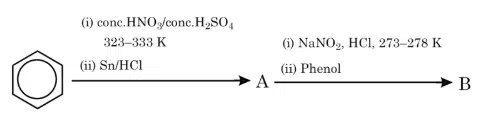
correct answer:- 3
Question 4
The correct order of acid character of the following compounds is:
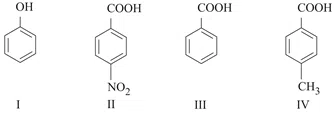
correct answer:- 2
Question 5
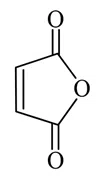
Maleic anhydride
Maleic anhydride can be prepared by:
correct answer:- 2

Question 6
The number of elements from the following that do not belong to lanthanoids is $$Eu, Cm, Er, Tb, Yb$$ and $$Lu$$
correct answer:- 3
Question 7
Consider the following molecules and statements related to them:
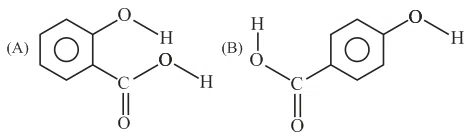
(a) (B) is more likely to be crystalline than (A)
(b) (B) has higher boiling point than (A)
(c) (B) dissolves more readily than (A) in water
Identify the correct option from below:
correct answer:- 4
Question 8
A cyclic anhydride reacts with H$$_2$$O to give 'A' (major product).
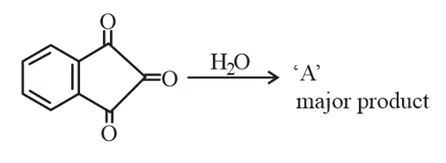
'A' formed in the above reaction is
correct answer:- 4
Question 9
An organic compound [A], molecular formula $$C_{10}H_{20}O_2$$ was hydrolyzed with dilute sulphuric acid to give a carboxylic acid [B] and an alcohol [C]. Oxidation of [C] with $$CrO_3 - H_2SO_4$$ produced [B]. Which of the following structures are not possible for [A]?
P)
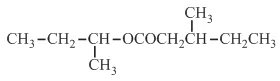
Q)
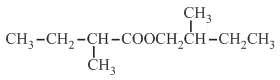
R) $$CH_3CH_2CH_2COOCH_2CH_2CH_2CH_3$$
S) $$(CH_3)_3 - C - COOCH_2C(CH_3)_3$$
correct answer:- 3
Question 10
The number of compound/s given below which contain/s $$-COOH$$ group is ______. (Integer answer)
(A) Sulphanilic acid (B) Picric acid (C) Aspirin (D) Ascorbic acid
correct answer:- 1

Question 11
Arrange the following elements in the increasing order of number of unpaired electrons in it. (A) Sc (B) Cr (C) V (D) Ti (E) Mn. Choose the correct answer from the options given below :
correct answer:- 3
Question 12
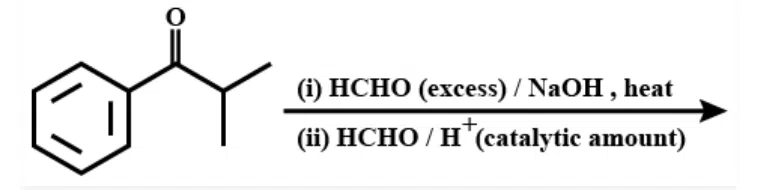

correct answer:- 1
Question 13
Compound(s) which will liberate carbon dioxide with sodium bicarbonate solution is/are:
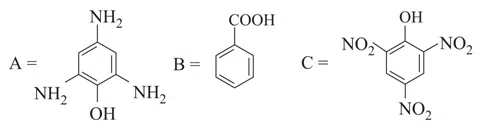
correct answer:- 2
Question 14
The major product of the following reaction is:
CH$$_3$$CH = CHCO$$_2$$CH$$_3$$ $$\xrightarrow{\text{LiAlH}_4}$$
correct answer:- 2
Question 15
The sum of total number of carbonyl groups $$(>C=O)$$ present in the major products $$\mathbf{X}$$ and $$\mathbf{Y}$$ in the following reactions is ___.
$$\mathbf{X}$$ is the major product from heating a 2-methyl-substituted malonic-type substrate having two $$-CO_2H$$ groups on the central carbon which also bears two $$H_3C-C(=O)-$$ (acetyl) ketone arms (i.e. $$3$$-methyl-$$3$$-(carboxy/diacid) pentane-$$2,4$$-dione type) on heating.
$$\mathbf{Y}$$ is the major product from heating a cyclopentane ring bearing a ketone $$(O=)$$ and two adjacent $$-CO_2H$$ groups on heating.
correct answer:- 4.00

Question 16
The sum of total number of carbonyl groups $$(>C=O)$$ present in the major products $$\mathbf{X}$$ and $$\mathbf{Y}$$ in the following reactions is ___.
$$\mathbf{X}$$ is the major product from heating a 2-methyl-substituted malonic-type substrate having two $$-CO_2H$$ groups on the central carbon which also bears two $$H_3C-C(=O)-$$ (acetyl) ketone arms (i.e. $$3$$-methyl-$$3$$-(carboxy/diacid) pentane-$$2,4$$-dione type) on heating.
$$\mathbf{Y}$$ is the major product from heating a cyclopentane ring bearing a ketone $$(O=)$$ and two adjacent $$-CO_2H$$ groups on heating.
correct answer:- 4.00
Question 17
The sum of total number of carbonyl groups $$(>C=O)$$ present in the major products $$\mathbf{X}$$ and $$\mathbf{Y}$$ in the following reactions is ___.
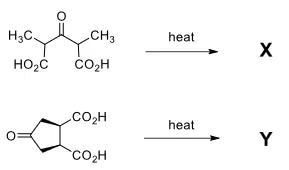
correct answer:- 4.00
Question 18
Consider the following sequence of reactions:
1. Benzoic acid reacts with $$Br_2/FeBr_3$$ to give product $$[A]$$.
2. Product $$[A]$$ is then treated with soda lime $$(NaOH/CaO,\ \Delta)$$ to produce product $$[B]$$.
3. Product $$[B]$$ is subjected to nitration using $$conc.\ HNO_3/conc.\ H_2SO_4$$ to give the final product $$[C]$$.
Identify the final product $$[C]$$.
correct answer:- 3
Question 19

Identify the major organic product Compound Y?
correct answer:- 3
Question 20
The molecular formula of second homologue in the homologous series of mono carboxylic acids is :
correct answer:- 2

Question 21
Number of colourless lanthanoid ions among the following is ________
$$Eu^{3+}, Lu^{3+}, Nd^{3+}, La^{3+}, Sm^{3+}$$
correct answer:- 2
Question 22
Match the dicarboxylic acids in List I with their respective major products formed upon strong heating $$(\Delta)$$ in List II.
**List I (Dicarboxylic Acid)**
| Column I | Compound |
| -------- | ------------- |
| P | Malonic acid |
| Q | Succinic acid |
| R | Adipic acid |
| S | Phthalic acid |
**List II (Major Product upon Heating)**
| Column II | Product |
| --------- | ------------------------------------ |
| 1 | Cyclopentanone + $$CO_2$$ + $$H_2O$$ |
| 2 | Acetic acid + $$CO_2$$ |
| 3 | Phthalic anhydride + $$H_2O$$ |
| 4 | Succinic anhydride + $$H_2O$$ |
Choose the correct answer from the options given below.
correct answer:- 1
Question 23
Aspirin is known as:
correct answer:- 1
Question 24
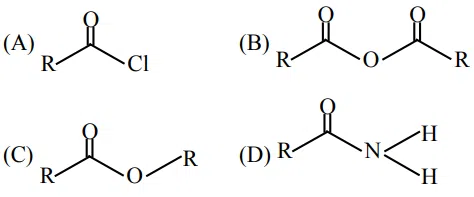
The correct order of their reactivity towards hydrolysis at room temperature is:
correct answer:- 1
Question 25
On mixing ethyl acetate with aqueous sodium chloride, the composition of the resultant solution is
correct answer:- 1

Question 26
The product "A" in the above reaction is:

correct answer:- 2
Question 27
Identify A in the following reaction.
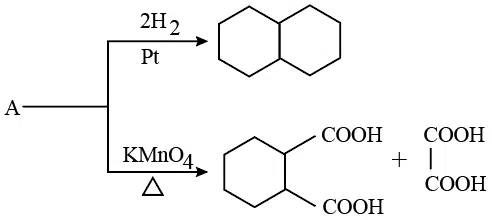
correct answer:- 4
Question 28
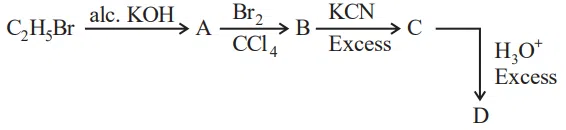
Acid D formed in above reaction is:
correct answer:- 2
Question 29
Number of compounds from the following which will not dissolve in cold NaHCO$$_3$$ and NaOH solutions but will dissolve in hot NaOH solution is ______.
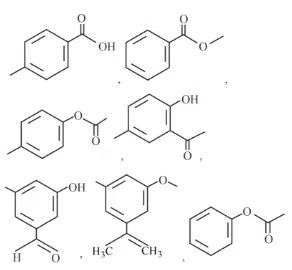
correct answer:- 3
Question 30
A liquid was mixed with ethanol and a drop of concentrated $$H_2SO_4$$ was added. A compound with a fruity smell was formed. The liquid was:
correct answer:- 4