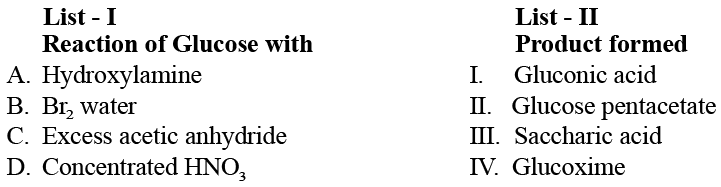
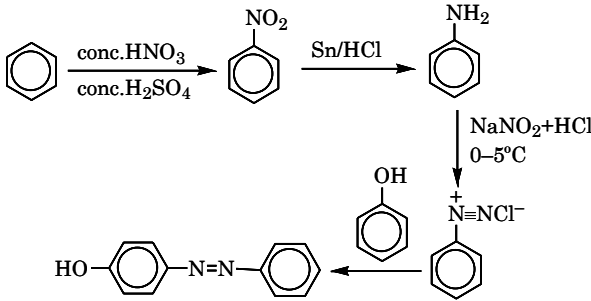
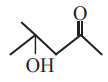
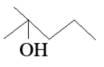
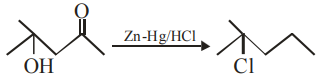
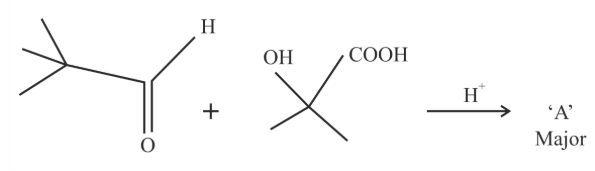
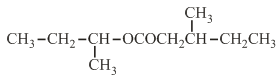
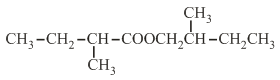
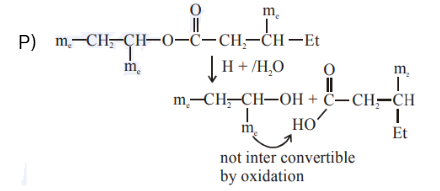
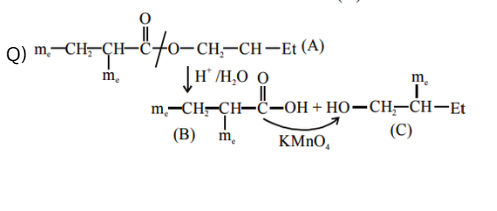
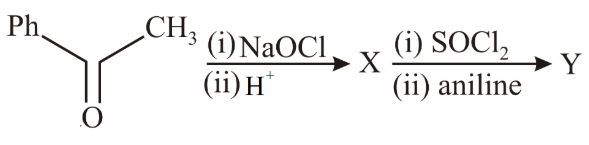
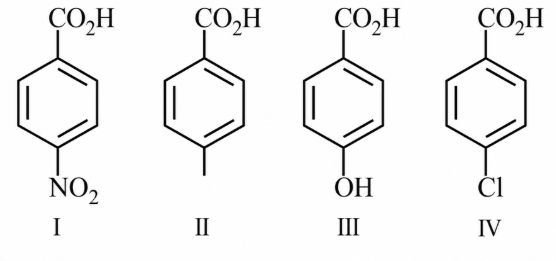
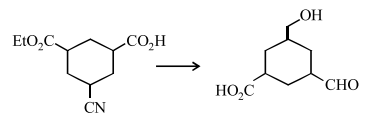
Match List - I with List - II.
choose the correct answer from the options given below :
Sign in
Please select an account to continue using cracku.in
↓ →
Join Our JEE Preparation Group
Prep with like-minded aspirants; Get access to free daily tests and study material.
Match List - I with List - II.
choose the correct answer from the options given below :
Glucose structure
C₁ = -CHO (aldehyde carbon)
C₂-C₅ = -CHOH
C₆ = -CH₂OH
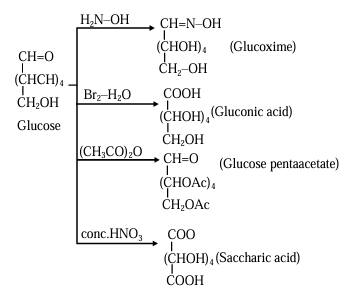
A. Hydroxylamine
Reaction name: Oxime formation (nucleophilic addition to carbonyl)
What reacts:
C₁ (aldehyde carbon)
Change:
-CHO → -CH=NOH
Product: Glucoxime
B. Br₂ / H₂O
Reaction name: Mild oxidation of aldehyde
What reacts:
Only C₁ (aldehyde carbon)
Change:
-CHO → -COOH
Product: Gluconic acid
C. Excess acetic anhydride ((CH₃CO)₂O)
Reaction name: Acetylation (ester formation)
What reacts:
All hydroxyl groups: C₂, C₃, C₄, C₅, C₆
Change:
-OH → -OCOCH₃
Note:
C₁ remains as aldehyde
Product: Glucose pentaacetate
D. Concentrated HNO₃
Reaction name: Strong oxidation
What reacts:
C₁ (-CHO) and C₆ (-CH₂OH)
Change:
-CHO → -COOH
-CH₂OH → -COOH
Product: Saccharic acid
Final Matching
A - IV (Glucoxime)
B - I (Gluconic acid)
C - II (Glucose pentaacetate)
D - III (Saccharic acid)
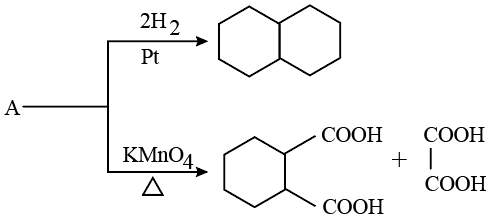
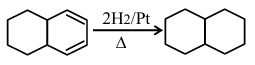
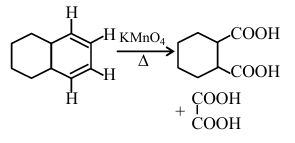
Identify A in the following reaction.
Step 1: Catalytic Hydrogenation (H₂ / Pt)
Step 2: Oxidation with hot KMnO₄ (Δ)
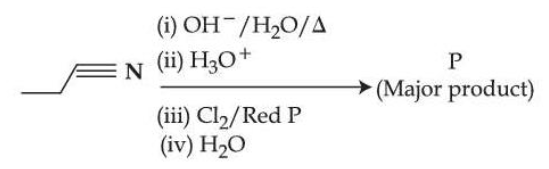
Complete the following reaction sequence and give the name of major product 'P'.

$$A \xrightarrow{(i) NaOH, (ii) H_3O^+} B \xrightarrow{(i) EtOH, (ii) H_2SO_4, \Delta} C$$
'A' shows positive Lassaign's test for N and its molar mass is 121. 'B' gives effervescence with aq. NaHCO$$_3$$. 'C' gives fruity smell. Identify A, B and C.
Consider the following reactions. From these reactions which reaction will give carboxylic acid as a major product ?
(A) $$R-C \equiv N \xrightarrow[\text{mild condition}]{(i) H^+/H_2O}$$
(B) $$R-MgX \xrightarrow[(ii) H_3O^+]{(i) CO_2}$$
(C) $$R-C \equiv N \xrightarrow[(ii) H_3O^+]{(i) SnCl_2/HCl}$$
(D) $$R-CH_2-OH \xrightarrow{PCC}$$
(E)

Choose the correct answer from the options given below :
Consider the following molecules:

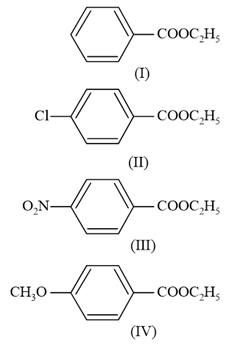
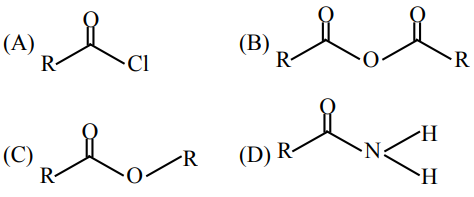
The correct order of rate of hydrolysis is:
The molecular formula of second homologue in the homologous series of mono carboxylic acids is :
{image}
The equilibrium $$Cr_2O_7^{2-} \rightleftharpoons 2CrO_4^{2-}$$ is shifted to the right in :
We need to determine in which medium the equilibrium $$Cr_2O_7^{2-} \rightleftharpoons 2CrO_4^{2-}$$ shifts to the right.
Write the complete ionic equilibrium
The interconversion between dichromate and chromate ions in aqueous solution involves $$H^+$$ and $$OH^-$$ ions. The complete equation is:
$$Cr_2O_7^{2-} + 2OH^- \rightleftharpoons 2CrO_4^{2-} + H_2O$$
Alternatively, in terms of $$H^+$$:
$$2CrO_4^{2-} + 2H^+ \rightleftharpoons Cr_2O_7^{2-} + H_2O$$
Apply Le Chatelier's Principle
The forward reaction (dichromate to chromate) consumes $$OH^-$$ ions. According to Le Chatelier's Principle:
- In a basic medium (excess $$OH^-$$): The high concentration of $$OH^-$$ drives the equilibrium to the right, favouring the formation of yellow $$CrO_4^{2-}$$ (chromate) ions.
- In an acidic medium (excess $$H^+$$): The $$OH^-$$ concentration is low, so the equilibrium shifts to the left, favouring the orange $$Cr_2O_7^{2-}$$ (dichromate) ions.
Conclusion
This is why dichromate solutions appear orange in acidic conditions and turn yellow (chromate) in basic conditions. The equilibrium shifts to the right in a basic medium.
The correct answer is Option (2): a basic medium.
Arrange the following elements in the increasing order of number of unpaired electrons in it. (A) Sc (B) Cr (C) V (D) Ti (E) Mn. Choose the correct answer from the options given below :
First note the atomic numbers: $$Sc = 21$$, $$Ti = 22$$, $$V = 23$$, $$Cr = 24$$, $$Mn = 25$$.
Use the Aufbau order $$\text{4s} \rightarrow \text{3d}$$ to write the ground-state electronic configurations:
$$Sc\;(21):\;[Ar]\,3d^{1}\,4s^{2}$$
$$Ti\;(22):\;[Ar]\,3d^{2}\,4s^{2}$$
$$V\;(23):\;[Ar]\,3d^{3}\,4s^{2}$$
$$Cr\;(24):\;[Ar]\,3d^{5}\,4s^{1}$$ (half-filled 3d subshell gives extra stability)
$$Mn\;(25):\;[Ar]\,3d^{5}\,4s^{2}$$
Count the unpaired electrons in each case (Hund’s rule: every degenerate orbital gets one electron before any pairing starts):
Sc : one unpaired electron in $$3d$$ ⇒ $$1$$ unpaired
Ti : two unpaired electrons in $$3d$$ ⇒ $$2$$ unpaired
V : three unpaired electrons in $$3d$$ ⇒ $$3$$ unpaired
Cr : five unpaired in $$3d$$ + one in $$4s$$ ⇒ $$6$$ unpaired
Mn : five unpaired in $$3d$$ (the $$4s^{2}$$ pair is paired) ⇒ $$5$$ unpaired
Arrange in increasing order of the number of unpaired electrons:
$$1 \lt 2 \lt 3 \lt 5 \lt 6$$ corresponds to $$Sc \lt Ti \lt V \lt Mn \lt Cr$$.
Using the given symbols: $$(A) \lt (D) \lt (C) \lt (E) \lt (B)$$.
Therefore the correct option is Option C.
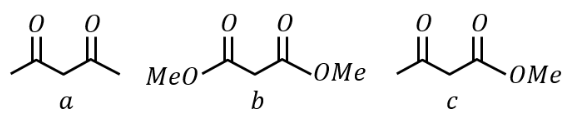
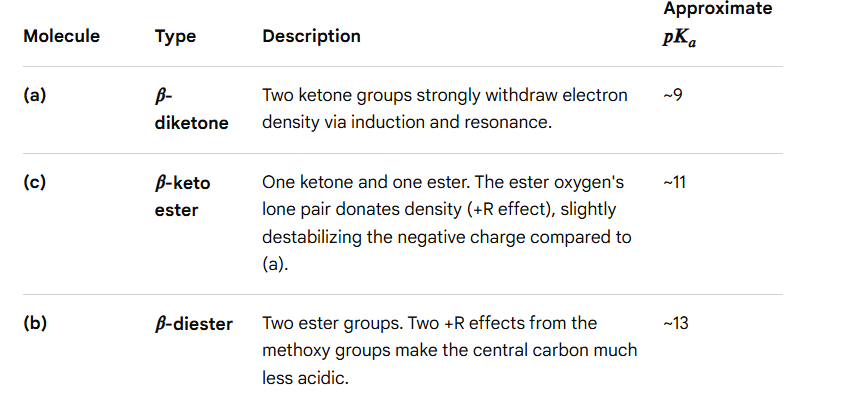
Which of the following has highly acidic hydrogen?
The number of elements from the following that do not belong to lanthanoids is $$Eu, Cm, Er, Tb, Yb$$ and $$Lu$$
We need to count how many of the given elements do not belong to the lanthanoid series.
Key Concept: The lanthanoid series consists of 15 elements from Lanthanum (La, Z = 57) to Lutetium (Lu, Z = 71). These elements are characterised by the progressive filling of the 4f orbitals.
Checking each element:
Eu (Europium, Z = 63): Falls between La (57) and Lu (71). Configuration: [Xe] 4f$$^7$$ 6s$$^2$$. This is a lanthanoid. ✓
Cm (Curium, Z = 96): Curium has atomic number 96, which falls in the actinoid series (Ac, Z = 89 to Lr, Z = 103). Configuration: [Rn] 5f$$^7$$ 6d$$^1$$ 7s$$^2$$. This is an actinoid, NOT a lanthanoid. ✗
Er (Erbium, Z = 68): Falls between La (57) and Lu (71). Configuration: [Xe] 4f$$^{12}$$ 6s$$^2$$. This is a lanthanoid. ✓
Tb (Terbium, Z = 65): Falls between La (57) and Lu (71). Configuration: [Xe] 4f$$^9$$ 6s$$^2$$. This is a lanthanoid. ✓
Yb (Ytterbium, Z = 70): Falls between La (57) and Lu (71). Configuration: [Xe] 4f$$^{14}$$ 6s$$^2$$. This is a lanthanoid. ✓
Lu (Lutetium, Z = 71): This is the last element of the lanthanoid series. Configuration: [Xe] 4f$$^{14}$$ 5d$$^1$$ 6s$$^2$$. This is a lanthanoid. ✓
Conclusion: Only Curium (Cm) does not belong to the lanthanoids. The number of non-lanthanoid elements is 1.
The correct answer is Option 3: 1.
Electronic configuration of Cu(II) is $$3d^9$$ whereas that of Cu(I) is $$3d^{10}$$. Which of the following is correct?
Cu(II) has configuration $$3d^9$$ and Cu(I) has $$3d^{10}$$.
Although Cu(I) has a fully filled $$3d^{10}$$ configuration (which is stable), Cu(II) is actually more stable in aqueous solution. This is because the higher hydration enthalpy of Cu²⁺ (due to its smaller size and higher charge) more than compensates for the second ionization energy required.
The high hydration energy of Cu²⁺ stabilizes it in aqueous solutions. Cu(I) compounds tend to disproportionate in water: $$2Cu^+ \rightarrow Cu + Cu^{2+}$$.
The correct answer is Option 2: Cu(II) is more stable.
Given below are two statements : Statement (I) : Fusion of $$MnO_2$$ with KOH and an oxidising agent gives dark green $$K_2MnO_4$$. Statement (II) : Manganate ion on electrolytic oxidation in alkaline medium gives permanganate ion. In the light of the above statements, choose the correct answer from the options given below :
We need to evaluate both statements about manganese compounds.
First, fusion of $$MnO_2$$ with KOH and an oxidising agent gives dark green $$K_2MnO_4$$ by a standard preparation method for potassium manganate.
$$2MnO_2 + 4KOH + O_2 \rightarrow 2K_2MnO_4 + 2H_2O$$
Here, $$MnO_2$$ (Mn in +4 state) is oxidised to $$K_2MnO_4$$ (Mn in +6 state) and the product is indeed dark green in colour. Therefore, the first statement is true.
Next, the manganate ion $$MnO_4^{2-}$$ can be oxidised to the permanganate ion $$MnO_4^{-}$$ by electrolytic oxidation in an alkaline solution.
$$MnO_4^{2-} \rightarrow MnO_4^{-} + e^{-}$$
This is a well-known method for preparing $$KMnO_4$$ from $$K_2MnO_4$$, so the second statement is also true.
Since both statements are true, the correct answer is Option 4: Both Statement I and Statement II are true.
The metal that shows highest and maximum number of oxidation state is :
Among the given transition metals, we need to find which shows the highest and maximum number of oxidation states.
Manganese (Mn): Electronic configuration [Ar] $$3d^5 4s^2$$. It shows oxidation states from +2 to +7 (total 6 different oxidation states). The maximum oxidation state is +7 (in $$KMnO_4$$), which equals the total number of 3d + 4s electrons (5 + 2 = 7).
Iron (Fe): [Ar] $$3d^6 4s^2$$. Shows up to +6 (rare). Common: +2, +3.
Cobalt (Co): [Ar] $$3d^7 4s^2$$. Shows up to +4. Common: +2, +3.
Titanium (Ti): [Ar] $$3d^2 4s^2$$. Shows up to +4.
Mn shows the highest maximum oxidation state (+7) and the maximum number of oxidation states among the 3d transition metals.
The correct answer is Option (2): Mn.
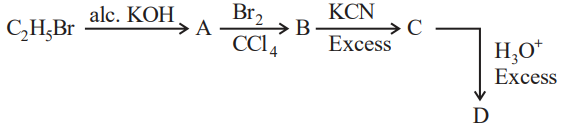
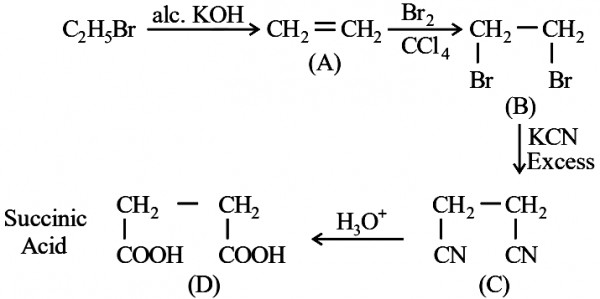
Acid D formed in above reaction is:
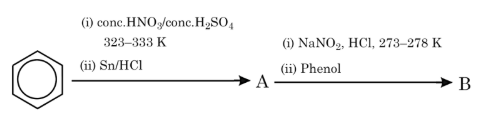
The products A and B formed in the following reaction scheme are respectively:
Among $$VO_2^{+}$$, $$MnO_4^{-}$$ and $$Cr_2O_7^{2-}$$, the spin-only magnetic moment value of the species with least oxidising ability is ___________ BM (Nearest integer). (Given atomic number $$V = 23, Mn = 25, Cr = 24$$)
We need to find the spin-only magnetic moment of the species with the least oxidising ability among $$VO_2^+$$, $$MnO_4^-$$, and $$Cr_2O_7^{2-}$$.
Oxidising ability is related to the ease with which the species can be reduced. The higher the reduction potential, the stronger the oxidising agent. Among common oxidising agents in acidic medium: $$MnO_4^- > Cr_2O_7^{2-} > VO_2^+$$ in terms of oxidising strength.
The species with the least oxidising ability is $$VO_2^+$$.
Find the oxidation state and d-electron configuration of V in $$VO_2^+$$:
Let the oxidation state of V be $$x$$. Then $$x + 2(-2) = +1$$, so $$x = +5$$.
Vanadium (Z = 23) has the configuration [Ar]3d$$^3$$4s$$^2$$. V$$^{5+}$$ loses all 5 valence electrons, giving [Ar] = 3d$$^0$$.
Calculate the spin-only magnetic moment using the formula:
$$\mu = \sqrt{n(n+2)} \, \text{BM}$$
where $$n$$ is the number of unpaired electrons. Since V$$^{5+}$$ has d$$^0$$ configuration, $$n = 0$$:
$$\mu = \sqrt{0(0+2)} = 0 \, \text{BM}$$
The answer is 0.
Among $$CrO$$, $$Cr_2O_3$$ and $$CrO_3$$, the sum of spin-only magnetic moment values of basic and amphoteric oxides is _______ $$\times 10^{-2}$$ BM (nearest integer). (Given atomic number of Cr is 24)
CrO: Cr²⁺ (d⁴), basic oxide. μ = √(4×6) = √24 = 4.90 BM.
Cr₂O₃: Cr³⁺ (d³), amphoteric oxide. μ = √(3×5) = √15 = 3.87 BM.
CrO₃: Cr⁶⁺ (d⁰), acidic oxide. μ = 0 BM.
Sum of basic and amphoteric = 4.90 + 3.87 = 8.77 BM = 877 × 10⁻² BM.
The answer is 877.
The 'spin only' magnetic moment value of $$MO_4^{2-}$$ is ______ BM. (Where M is a metal having least metallic radii among $$Sc, Ti, V, Cr, Mn$$ and $$Zn$$). (Given atomic number: $$Sc = 21, Ti = 22, V = 23, Cr = 24, Mn = 25$$ and $$Zn = 30$$)
The metallic radius decreases steadily from Sc to Cr in the 3d series because the increasing nuclear charge is not fully screened by the added 3d electrons. After Cr the radius stops decreasing and even rises slightly. Therefore, among the given elements (Sc, Ti, V, Cr, Mn, Zn) the one with the smallest metallic radius is chromium (Cr).
Hence in $$MO_4^{2-}$$ the metal atom is chromium, giving the anion $$CrO_4^{2-}$$ (chromate ion).
Each oxide ion carries a charge of $$-2$$, so for $$CrO_4^{2-}$$ the overall charge balance is
$$x + 4(-2) = -2 \;\;\Longrightarrow\;\; x = +6$$
Thus chromium is in the $$+6$$ oxidation state.
Electronic configuration of a neutral Cr atom: $$[Ar]\,3d^5\,4s^1$$.
To obtain $$Cr^{+6}$$ we remove six electrons (the one 4s electron and five 3d electrons), leaving
$$Cr^{+6}: [Ar]\,3d^{0}$$.
Number of unpaired electrons, $$n = 0$$.
The spin-only magnetic moment is calculated by the formula
$$\mu_{\text{spin}} = \sqrt{n(n+2)}\;\text{BM}$$.
Substituting $$n = 0$$ gives
$$\mu_{\text{spin}} = \sqrt{0(0+2)} = 0\;\text{BM}$$.
Hence the ‘spin only’ magnetic moment of $$MO_4^{2-}$$ is $$\mathbf{0\;BM}$$.
The spin-only magnetic moment value of the ion among $$Ti^{2+}, V^{2+}, Co^{3+}$$ and $$Cr^{2+}$$, that acts as strong oxidising agent in aqueous solution is ______ BM (Near integer). (Given atomic numbers : $$Ti : 22, V : 23, Cr : 24, Co : 27$$)
Among the ions $$Ti^{2+}, V^{2+}, Co^{3+}, Cr^{2+}$$, the one that acts as a strong oxidising agent in aqueous solution is $$Co^{3+}$$. A strong oxidising agent easily gets reduced (accepts electrons), and $$Co^{3+}$$ readily accepts an electron to form the more stable $$Co^{2+}$$. The other ions ($$Ti^{2+}, V^{2+}, Cr^{2+}$$) are actually strong reducing agents.
The electronic configuration of cobalt is Co: [Ar] $$3d^7 4s^2$$, so for $$Co^{3+}$$ it becomes [Ar] $$3d^6$$. In aqueous solution, the complex $$[Co(H_2O)_6]^{3+}$$ behaves as a high-spin complex (since water is a weak field ligand), giving the configuration $$t_{2g}^4 e_g^2$$ with 4 unpaired electrons.
Using the spin-only formula for the magnetic moment, we have $$\mu = \sqrt{n(n+2)} = \sqrt{4(4+2)} = \sqrt{24} = 4.9 \approx 5 \text{ BM}$$.
Final answer: $$Co^{3+}$$ is the strong oxidising agent and its spin-only magnetic moment is 5 BM.
Number of colourless lanthanoid ions among the following is ________
$$Eu^{3+}, Lu^{3+}, Nd^{3+}, La^{3+}, Sm^{3+}$$
Colourless lanthanoid ions are those with $$4f^0$$ or $$4f^{14}$$ configurations (no unpaired f-electrons to undergo f-f transitions).
$$Eu^{3+}$$: $$[Xe]4f^6$$ — coloured ✗
$$Lu^{3+}$$: $$[Xe]4f^{14}$$ — colourless ✓
$$Nd^{3+}$$: $$[Xe]4f^3$$ — coloured ✗
$$La^{3+}$$: $$[Xe]4f^0$$ — colourless ✓
$$Sm^{3+}$$: $$[Xe]4f^5$$ — coloured ✗
Number of colourless ions = 2 ($$Lu^{3+}$$ and $$La^{3+}$$).
The answer is $$\boxed{2}$$.
The difference in the 'spin-only' magnetic moment values of $$KMnO_4$$ and the manganese product formed during titration of $$KMnO_4$$ against oxalic acid in acidic medium is _______ BM. (nearest integer)
KMnO₄: Mn⁷⁺ (d⁰), μ = 0 BM.
In acidic medium titration with oxalic acid: KMnO₄ → Mn²⁺. Mn²⁺ (d⁵), μ = √(5×7) = √35 = 5.92 ≈ 6 BM.
Difference = |0 - 6| = 6 BM.
The answer is 6.
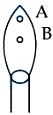
In a borax bead test under hot condition, a metal salt (one from the given) is heated at point B of the flame, resulted in green colour salt bead. The spin-only magnetic moment value of the salt is ______ BM (Nearest integer) [Given atomic number of $$Cu = 29, Ni = 28, Mn = 25, Fe = 26$$]
Which will undergo deprotonation most readily in basic medium?
The descending order of acidity for the following carboxylic acid is-
(A) CH$$_3$$COOH
(B) F$$_3$$C-COOH
(C) ClCH$$_2$$-COOH
(D) FCH$$_2$$-COOH
(E) BrCH$$_2$$-COOH
Choose the correct answer from the options given below:
We need to arrange the given carboxylic acids in descending order of acidity: (A) CH$$_3$$COOH, (B) F$$_3$$C-COOH, (C) ClCH$$_2$$-COOH, (D) FCH$$_2$$-COOH, and (E) BrCH$$_2$$-COOH.
The acidity of carboxylic acids is enhanced by electron-withdrawing groups through the negative inductive effect (-I effect). The stronger the -I effect, the more the electron density is pulled away from the O-H bond, making it easier to release the proton.
Trifluoroacetic acid (B) has three fluorine atoms, providing a very strong cumulative -I effect, making it the strongest acid in the group.
Now, among the monohaloacetic acids, we compare based on electronegativity: F (3.98) > Cl (3.16) > Br (2.96). Since all three halogens are at the same position (alpha carbon), the -I effect follows the electronegativity order, giving FCH$$_2$$COOH (D) > ClCH$$_2$$COOH (C) > BrCH$$_2$$COOH (E).
CH$$_3$$COOH (A) has no electron-withdrawing substituent, making it the weakest acid.
So the descending order of acidity is:
$$\text{B} > \text{D} > \text{C} > \text{E} > \text{A}$$
Hence, the correct answer is Option C.
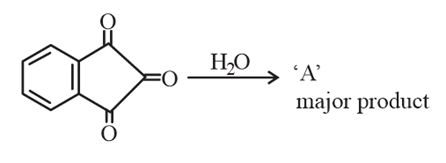
A cyclic anhydride reacts with H$$_2$$O to give 'A' (major product).
'A' formed in the above reaction is
'A' in the given reaction is
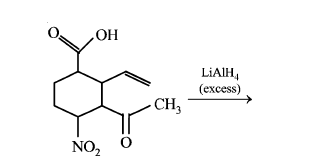
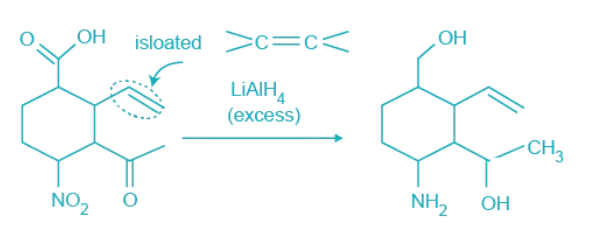
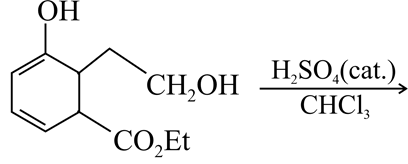
The major product formed in the following reaction is

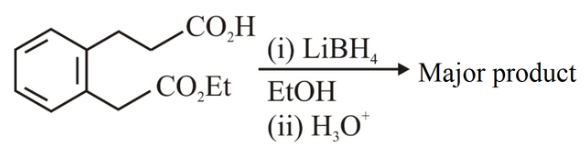
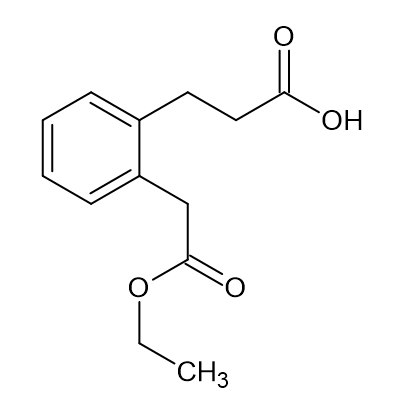
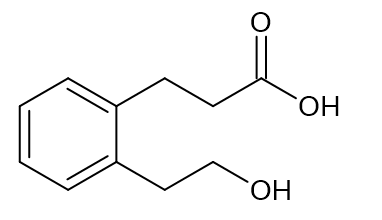
CO$$_2$$H + CO$$_2$$Et compound treated with (i) LiBH$$_4$$/EtOH (ii) H$$_3$$O$$^+$$
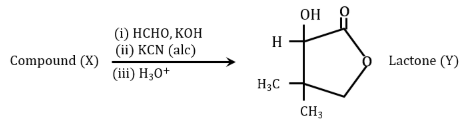
Compound X undergoes following sequence of reactions to give the Lactone Y.
Aldol Addition: Isobutyraldehyde reacts with Formaldehyde in the presence of KOH. Since Isobutyraldehyde has only one alpha-hydrogen, it adds one HCHO unit to form 2,2-dimethyl-3-hydroxypropanal.
(CH3)2CHCHO + HCHO -> HO-CH2-C(CH3)2-CHO
2. Cyanohydrin Formation: The aldehyde group reacts with $KCN$ to form a cyanohydrin.
$$HO-CH_2-C(CH_3)_2-CHO -> HO-CH2-C(CH3)2-CH(OH)CN
3. Hydrolysis & Cyclization: Acidic hydrolysis converts the $-CN$ to $-COOH$. The gamma-hydroxy group then attacks the carboxylic acid to form the stable 5-membered Lactone (Y).
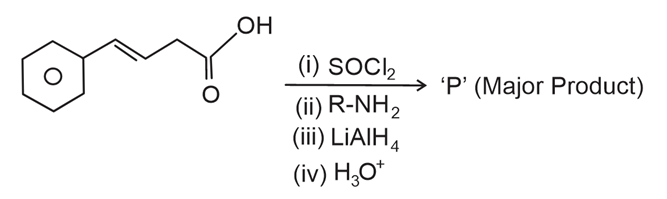
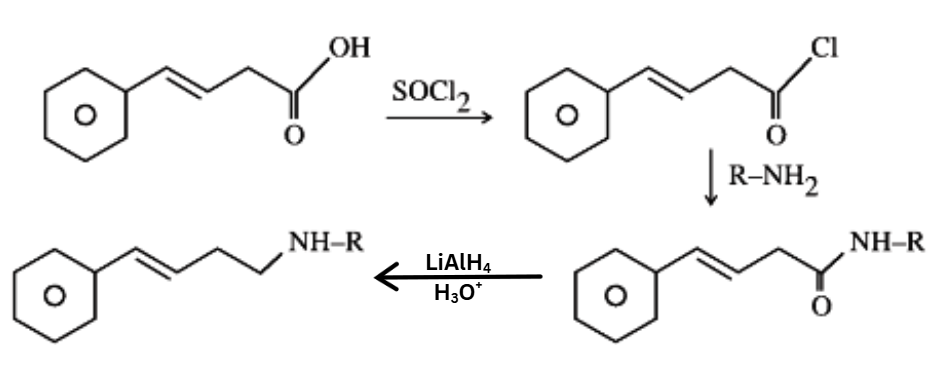
The major product 'P' formed in the following sequence of reactions is
The reaction used for preparation of soap from fat is:
Soap is prepared by saponification, which is the alkaline hydrolysis of fats/oils with NaOH or KOH.
Fat + NaOH → Soap (sodium salt of fatty acid) + Glycerol
The correct answer is Option 3: Alkaline hydrolysis reaction.
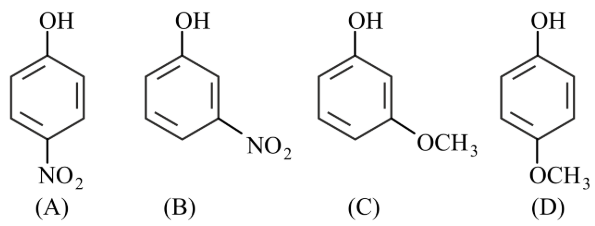
Arrange the following in decreasing acidic strength.
To determine the decreasing order of acidic strength for the given substituted phenols, we must evaluate how the different substituents affect the stability of the phenoxide ion formed after the loss of a proton ($$H^+$$). As a general rule, electron-withdrawing groups stabilize the negative charge on the phenoxide ion through inductive ($$-I$$) or resonance ($$-R$$) effects, thereby increasing acidity. Conversely, electron-donating groups destabilize the ion by pushing electron density toward the oxygen through positive inductive ($$+I$$) or resonance ($$+R$$) effects, which decreases acidity.
The nitro group ($$-NO_2$$) is a powerful electron-withdrawing group that can exert both $$-I$$ and $$-R$$ effects. In compound (A), p-nitrophenol, the nitro group is located at the para position, allowing both the $$-I$$ and strong $$-R$$effects to heavily stabilize the phenoxide ion, making it the most acidic. In compound (B), m-nitrophenol, the nitro group is at the meta position. Because resonance effects cannot operate from the meta position, only the $$-I$$ effect stabilizes the anion. This makes it highly acidic, but slightly less so than the para isomer.
The methoxy group ($$-OCH_3$$), on the other hand, exerts an electron-withdrawing $$-I$$ effect but a much stronger electron-donating $$+R$$ effect. In compound (C), m-methoxyphenol, the methoxy group is at the meta position where its $$+R$$ effect cannot operate. Therefore, only its mild $$-I$$ effect influences the ring, slightly stabilizing the phenoxide ion. In compound (D), p-methoxyphenol, the methoxy group is at the para position. Here, its dominant electron-donating $$+R$$ effect actively pushes electron density into the ring, highly destabilizing the phenoxide ion and making it the least acidic of all four options.
By comparing the relative stabilization and destabilization caused by these groups at their respective positions, we can conclude the final sequence. The strongest stabilization occurs in compound (A), followed by (B), then a much weaker stabilization in (C), and finally an active destabilization in (D). Therefore, the correct decreasing order of acidic strength is (A) > (B) > (C) > (D).
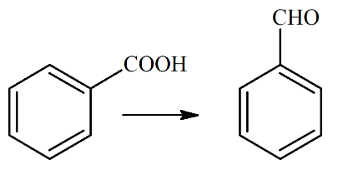
The reagent, from the following, which converts benzoic acid to benzaldehyde in one step is
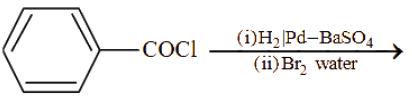
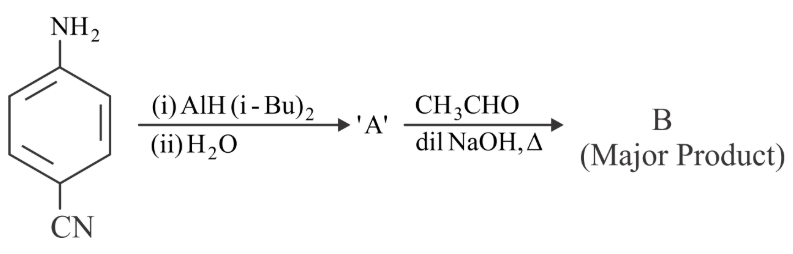
Consider the following reaction sequence. The product 'B' is
Two statements are given below :
Statement I : The melting point of monocarboxylic acid with even number of carbon atoms is higher than that of with odd number of carbon atoms acid immediately below and above it in the series.
Statement II : The solubility of monocarboxylic acids in water decreases with increase in molar mass.
Choose the most appropriate option :
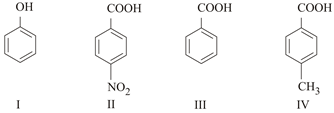
The correct order of acid character of the following compounds is:
Thus, the electron-withdrawing group makes II the strongest, III serves as the neutral baseline in the middle, the electron-donating group makes IV weaker than the baseline, and the phenol I is the weakest functional group overall.
Therefore, the correct decreasing order of acid character is:
$$II > III > IV > I$$
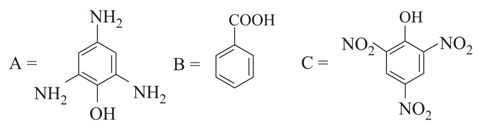
Compound(s) which will liberate carbon dioxide with sodium bicarbonate solution is/are:
To liberate carbon dioxide ($$CO_2$$) from sodium bicarbonate ($$NaHCO_3$$), an organic molecule must be a stronger acid than carbonic acid ($$H_2CO_3$$). If the compound is a weaker acid than carbonic acid, no reaction will take place.
Compound A: 2,4,6-Triaminophenol (Does Not React)
Compound A fails this test. Standard, unsubstituted phenol is already a weaker acid than carbonic acid. In Compound A, the three amine ($$-NH_2$$) groups attached to the ring are strongly electron-donating due to the resonance (+R) effect of their nitrogen lone pairs. They push electron density into the benzene ring, which severely repels and destabilizes the negatively charged phenoxide oxygen that would form if it lost a proton. This makes Compound A an extremely weak acid that cannot react with bicarbonate.
Compound B: Benzoic Acid (Reacts)
Compound B successfully reacts. It contains a standard carboxylic acid group ($$-COOH$$). As a general rule, almost all carboxylic acids are inherently stronger acids than carbonic acid. Therefore, Compound B easily reacts with sodium bicarbonate to release carbon dioxide gas.
Compound C: Picric Acid / 2,4,6-Trinitrophenol (Reacts)
Compound C also successfully reacts. Although it belongs to the phenol family (which typically fails this test), the presence of three strongly electron-withdrawing nitro
($$-NO_2$$) groups completely changes its behavior. These groups pull electron density away from the oxygen atom, powerfully stabilizing the phenoxide conjugate base. This makes picric acid exceptionally acidic—actually more acidic than some carboxylic acids—allowing it to easily liberate $$CO_2$$.
Final Conclusion
Because only the carboxylic acid and the highly deactivated phenol possess the required acid strength, Compounds B and C only will liberate carbon dioxide with sodium bicarbonate solution. Thus, the right option is B.
Which one of the following reactions will not yield propanoic acid?
Option A: CH₃CH₂CH₂Br + Mg, CO₂ dry ether / H₃O⁺ This reaction involves the formation of a Grignard reagent followed by carboxylation. First, 1-bromopropane (a 3-carbon chain) reacts with magnesium in dry ether to form propylmagnesium bromide (CH₃CH₂CH₂MgBr). This Grignard reagent then acts as a nucleophile and attacks the carbon atom in carbon dioxide (CO₂). Because CO₂ provides an additional carbon atom, the carbon chain length increases by one. After acidic workup (H₃O⁺), the final product is butanoic acid (CH₃CH₂CH₂COOH), which has 4 carbons. Therefore, this reaction does not yield propanoic acid.
Option B: CH₃CH₂CH₃ + KMnO₄(Heat), OH⁻ / H₃O⁺ In the context of this specific exam question, the reactant CH₃CH₂CH₃ (propane) is a known typographical error intended to be propan-1-ol (CH₃CH₂CH₂OH). According to standard chemical principles, alkanes like propane are highly resistant to oxidation by potassium permanganate (KMnO₄) and would not react. However, if we evaluate the intended reactant (propan-1-ol), treating a primary alcohol with a strong oxidizing agent like hot alkaline KMnO₄ completely oxidizes it to a carboxylic acid with the same number of carbon atoms. This yields propanoic acid.
Option C: CH₃CH₂CCl₃ + OH⁻ / H₃O⁺ This is the alkaline hydrolysis of a terminal trihalide. The reactant is 1,1,1-trichloropropane. When treated with aqueous hydroxide ions (OH⁻), all three chlorine atoms undergo nucleophilic substitution to form an unstable intermediate with three hydroxyl groups on the same carbon, CH₃CH₂C(OH)₃. This intermediate immediately loses a molecule of water to form a stable carboxylic acid. Since the carbon chain length remains unchanged, the 3-carbon reactant yields propanoic acid.
Option D: CH₃CH₂COCH₃ + OI⁻ / H₃O⁺ This reaction represents the haloform reaction. The reactant, butan-2-one, is a methyl ketone (it has a methyl group directly attached to the carbonyl carbon). When a methyl ketone is treated with a hypoiodite ion (OI⁻), the methyl group is cleaved off to form iodoform (CHI₃), and the remaining part of the molecule becomes a carboxylate salt containing one less carbon atom than the original ketone. Since butan-2-one has 4 carbons, it loses one to become a 3-carbon propanoate salt. The final acidic workup protonates this salt, yielding propanoic acid.
Hence, the only reaction that does not produce propanoic acid is option A, because it results in butanoic acid due to the addition of a carbon atom from CO₂.
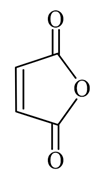
Maleic anhydride
Maleic anhydride can be prepared by:
Maleic anhydride is made by the dehydration of maleic acid, which is done by the heating of maleic acid (cis-but-2-enedioic acid).

The product "A" in the above reaction is:
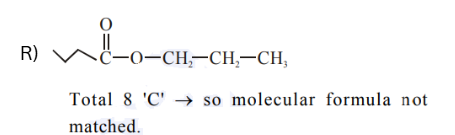
In the following sequence of reactions a compound A, (molecular formula C$$_6$$H$$_{12}$$O$$_2$$) with a straight chain structure gives a C$$_4$$ carboxylic acid. A is:
$$A \xrightarrow[\mathrm{H_3O^+}]{\mathrm{LiAlH_4}} B \xrightarrow{\text{Oxidation}} \text{C}_4\text{-carboxylic acid}$$
The number of compound/s given below which contain/s $$-COOH$$ group is ______. (Integer answer)
(A) Sulphanilic acid (B) Picric acid (C) Aspirin (D) Ascorbic acid
We need to identify which of the given compounds contain a $$-COOH$$ (carboxyl) group.
(A) Sulphanilic acid: This is 4-aminobenzenesulfonic acid ($$H_2N\text{-}C_6H_4\text{-}SO_3H$$). It contains a sulfonic acid group ($$-SO_3H$$) and an amino group ($$-NH_2$$), but no $$-COOH$$ group.
(B) Picric acid: This is 2,4,6-trinitrophenol ($$C_6H_2(NO_2)_3OH$$). It is a phenol derivative with nitro groups. It does not contain a $$-COOH$$ group.
(C) Aspirin: This is acetylsalicylic acid ($$CH_3COOC_6H_4COOH$$). It contains a $$-COOH$$ group attached to the benzene ring, along with an ester group ($$-OCOCH_3$$). So aspirin does contain a $$-COOH$$ group.
(D) Ascorbic acid (Vitamin C): Despite being called an "acid," ascorbic acid does not contain a $$-COOH$$ group. It is a lactone (cyclic ester) with an enediol structure. Its acidity comes from the enol hydroxyl groups, not from a carboxyl group.
Therefore, only aspirin contains a $$-COOH$$ group, and the answer is $$\boxed{1}$$.
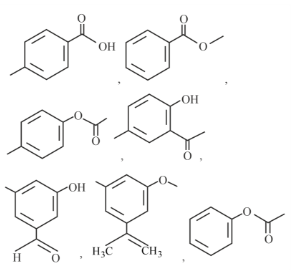
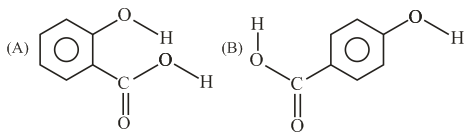
Consider the following molecules and statements related to them:

(a) (B) is more likely to be crystalline than (A)
(b) (B) has higher boiling point than (A)
(c) (B) dissolves more readily than (A) in water
Identify the correct option from below:
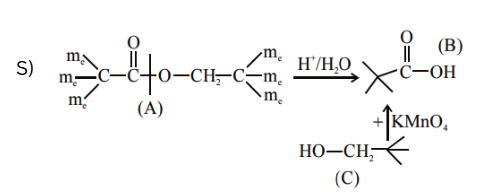
An organic compound (A) (molecular formula $$C_6H_{12}O_2$$) was hydrolysed with dil. $$H_2SO_4$$ to give a carboxylic acid (B) and an alcohol (C). 'C' gives white turbidity immediately when treated with anhydrous $$ZnCl_2$$ and conc. HCl. The organic compound (A) is:
We have to identify an organic compound (A) whose molecular formula is $$C_6H_{12}O_2$$. On hydrolysis with dilute $$H_2SO_4$$ it gives a carboxylic acid (B) and an alcohol (C). This description exactly fits the behaviour of an ester, because an ester undergoes acid-catalysed hydrolysis according to the general equation
$$\text{RCOOR'}\;+\;H_2O\;\xrightarrow[\;]{\;H_2SO_4\;}\;\text{RCOOH}\;+\;\text{R'OH}$$
So, compound (A) must be an ester made up of an acid part $$\text{RCO-}$$ and an alcohol part $$\text{-OR'}$$.
Now, alcohol (C) gives white turbidity immediately with anhydrous $$ZnCl_2$$ and conc. HCl. This is the well-known Lucas test for classifying alcohols:
• Tertiary alcohol → turbidity within seconds (immediate).
• Secondary alcohol → turbidity in 5-10 min.
• Primary alcohol → no turbidity at room temperature.
Because turbidity is obtained at once, alcohol (C) must be a tertiary alcohol.
Let us search for the smallest tertiary alcohol that can arise from an ester whose total formula is $$C_6H_{12}O_2$$. The simplest tertiary alcohol is tert-butyl alcohol (2-methyl-2-propanol):
$$\text{(CH}_3)_3\text{C-OH}$$
Its molecular formula is $$C_4H_{10}O$$ (four carbons, one oxygen, ten hydrogens).
If alcohol (C) contributes four carbon atoms, the remaining two carbon atoms (because the ester has six carbons in all) must belong to the acid (B). The only common two-carbon carboxylic acid is acetic acid (ethanoic acid):
$$\text{CH}_3\text{COOH}$$
Acetic acid has the formula $$C_2H_4O_2$$.
Now we must check that these two fragments really fit the molecular formula of (A) when they combine to form an ester. Combining an acid and an alcohol produces an ester with the loss of one molecule of water ($$H_2O$$). Let us add their formulas algebraically and then subtract the elements of water.
• Acid part: $$C_2H_4O_2$$
• Alcohol part: $$C_4H_{10}O$$
• Sum: $$C_{2+4}H_{4+10}O_{2+1}=C_6H_{14}O_3$$
• Subtract water $$\left(H_2O\right)$$: $$C_6H_{14-2}O_{3-1}=C_6H_{12}O_2$$
Exactly the required molecular formula. Therefore our choice of fragments is correct.
Hence compound (A) must be the ester formed from acetic acid and tert-butyl alcohol, i.e. tert-butyl acetate:
$$\text{CH}_3\text{COO-C(CH}_3)_3$$
Among the given structural options, this structure corresponds to Option (1).
Hence, the correct answer is Option (1).
What is the product of the following reaction?
An organic compound [A], molecular formula $$C_{10}H_{20}O_2$$ was hydrolyzed with dilute sulphuric acid to give a carboxylic acid [B] and an alcohol [C]. Oxidation of [C] with $$CrO_3 - H_2SO_4$$ produced [B]. Which of the following structures are not possible for [A]?
The major product obtained in the following reaction is:
The major product of the following reaction is:
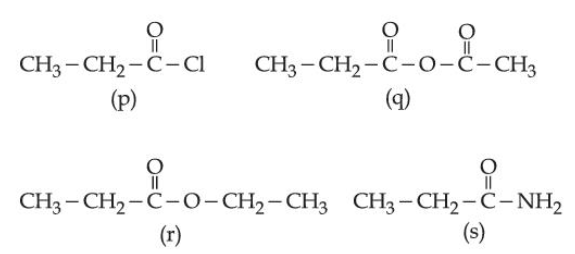
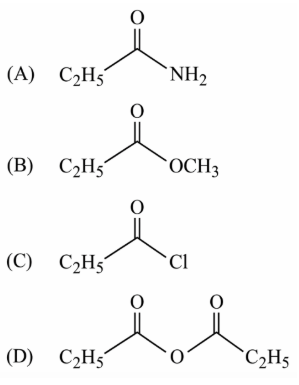
The increasing order of the reactivity of the following with LiAlH$$_4$$ is:
LiAlH4 is a strong nucleophilic reducing agent that attacks the carbonyl carbon of carboxylic-acid derivatives by the nucleophilic acyl-substitution mechanism.
For such reactions, the rate depends mainly on the quality of the leaving group $$Y^-$$ in the tetrahedral intermediate: better leaving groups give faster reactions. The general order of leaving-group ability (best → worst) is: $$Cl^- \gt RCOO^- \gt RO^- \gt NH_2^-$$.
Matching each derivative with its leaving group:
$$C_2H_5COCl$$ (acid chloride, C) → leaves $$Cl^-$$ (best)
$$(C_2H_5CO)_2O$$ (acid anhydride, D) → leaves $$RCOO^-$$
$$C_2H_5COOCH_3$$ (ester, B) → leaves $$RO^-$$
$$C_2H_5CONH_2$$ (amide, A) → leaves $$NH_2^-$$ (worst)
Therefore the reactivity order toward LiAlH4 is
$$\text{amide (A)} \lt \text{ester (B)} \lt \text{anhydride (D)} \lt \text{acid chloride (C)}$$
Hence, the increasing order asked in the question is: (A) < (B) < (D) < (C).
Option C matches this sequence.
Final answer: Option C
Acid strength given below the correct decreasing order will be:
We want to compare the acidic strength of the four substituted acetic acids
$$\text{XCH}_2\text{COOH}\;(X = NO_2,\;F,\;NC,\;Cl).$$
An acid is stronger when its conjugate base is more stable. When one of the hydrogens of the -COOH group is lost, the following equilibrium is set up
$$\text{XCH}_2\text{COOH}\;\rightleftharpoons\;\text{XCH}_2\text{COO}^- + H^+$$
The acid-dissociation constant is written as
$$K_a=\dfrac{[\text{XCH}_2\text{COO}^-][H^+]}{[\text{XCH}_2\text{COOH}]},$$
and a larger $$K_a$$ (or a smaller $$pK_a=-\log K_a$$) indicates a stronger acid. As soon as the proton is removed the negative charge resides on the carboxylate ion; any factor that withdraws electron density from the -COO- group will spread out (delocalise) that negative charge and lower the energy of the conjugate base, thereby raising $$K_a$$.
The factor that dominates here is the inductive effect (symbolised as -I). A group with a strong -I effect pulls σ-electrons toward itself through the σ-bond framework, reducing the electron density on the -COO- unit and stabilising it. The groups in question are compared below.
1. The -F group
Fluorine is the most electronegative element (χ = 4.0 on Pauling’s scale). Just one σ-bond away from the carboxylate, it exerts the strongest -I effect of all the substituents in the list. Consequently $$\mathrm{FCH_2COO^-}$$ is stabilised the most, and $$\mathrm{FCH_2COOH}$$ is expected to have the largest $$K_a$$ (the smallest $$pK_a$$) and therefore be the strongest acid among the four.
2. The -NC (cyano) group
In the nitrile group the carbon is sp-hybridised and therefore very electronegative. This makes the -NC group a powerful electron withdrawer through the σ-framework. Its -I effect is slightly weaker than that of -F but still very large, so $$\mathrm{NCCH_2COOH}$$ is expected to be the next strongest acid after $$\mathrm{FCH_2COOH}$$.
3. The -NO2 group
-NO2 is well known for an intense -M (-R) effect on π-conjugated systems, but that resonance effect cannot operate through the saturated -CH2- bridge present here. Only its -I effect remains operative, and that -I effect, while strong, is a little weaker than that of the -NC group because two heavy atoms (N and O) lie one bond farther from the acidic centre, lessening the field-inductive pull. Hence $$\mathrm{NO_2CH_2COOH}$$ comes third.
4. The -Cl group
Chlorine is electronegative, but its -I effect is appreciably less than that of -F and just smaller than that of -NO2 and -NC. Moreover, because Cl has available 3d orbitals, a small +R effect can partly offset its -I pull, making its overall withdrawing ability the weakest of the four. Thus $$\mathrm{ClCH_2COOH}$$ is the least acidic in the set.
As a result we have the decreasing order of acid strength
$$\mathrm{FCH_2COOH} \; > \; \mathrm{NCCH_2COOH} \; > \; \mathrm{NO_2CH_2COOH} \; > \; \mathrm{ClCH_2COOH}.$$
This sequence is exactly the one written in Option B.
Hence, the correct answer is Option B.
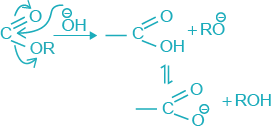
The decreasing order of ease of alkaline hydrolysis for the following esters is:
The major product Y in the following reaction is:
The major product of the following reaction is:
CH$$_3$$CH = CHCO$$_2$$CH$$_3$$ $$\xrightarrow{\text{LiAlH}_4}$$
LiAlH4 is a strong reducing agent hence it reduces the the carbonyl group to -OH and since -OH and OMe are unstable staying on a single carbon -OMe leaves and forms MeOH and another Hydrogen is added to the -OH substituted carbon.
With dehydrating agent present which dicarboxylic acid is least reactive towards forming an anhydride?
For any dicarboxylic acid, conversion into a cyclic anhydride in the presence of a dehydrating agent (such as $$\text{P}_2\text{O}_5$$ or conc. $$\text{H}_2\text{SO}_4$$) is an intramolecular reaction in which one -COOH group supplies the carbonyl carbon while the other -COOH group supplies the nucleophilic oxygen. The reaction therefore succeeds most readily when the two carboxyl groups can approach each other without creating excessive ring strain. A well-known rule of thumb is that

$$ \text{Ease of anhydride formation } \propto \frac{1}{\text{Ring strain in the product}} $$
The most favourable rings are five-membered; six-membered rings are still quite easy to make; rings containing seven or more atoms (or rings that would be highly twisted) form only with difficulty, if at all. Let us now look at every acid given and work out the ring that would be produced.
1. Phthalic acid. The two -COOH groups occupy adjacent (ortho) positions on a rigid benzene ring, so no conformational adjustment is needed; they are already side by side. Heating alone converts it smoothly to phthalic anhydride, a five-membered ring. Hence its reactivity is extremely high.
2. trans-Cyclohexane-1,2-dicarboxylic acid. Although the -COOH groups are on neighbouring carbon atoms, they sit on opposite faces of the chair conformer. Ring flipping, however, can place one substituent axial and the other equatorial, bringing the two groups reasonably close. When this happens the product is once again a five-membered anhydride, so the reaction does proceed, though somewhat more slowly than in the rigid ortho-aromatic case.
3. Glutaric acid, $$\text{HOOC-(CH}_2)_3\text{-COOH}$$. There are three methylene units between the carboxyl groups. Bending the chain back on itself gives a six-membered ring in the anhydride. Six-membered rings are only slightly less comfortable than five-membered ones, so glutaric acid still dehydrates fairly readily.
4. Succinic acid, $$\text{HOOC-(CH}_2)_2\text{-COOH}$$. Here only two methylene units separate the -COOH groups. To meet, the chain must adopt a gauche conformation in which the two interior C-C bonds are eclipsed. The resulting five-membered ring is therefore under noticeably greater angle and torsional strain than the corresponding rings obtained from the other acids. Consequently, the activation energy for cyclisation is highest and succinic acid is the slowest of the four to give an anhydride, even in the presence of a powerful dehydrating agent.
Comparing all four acids we obtain the qualitative order of reactivity
$$ \text{Phthalic} \;>\; \text{trans-1,2-cyclohexanedicarboxylic} \;>\; \text{Glutaric} \;>\; \text{Succinic}. $$
Thus, succinic acid shows the least tendency to form a cyclic anhydride.
Hence, the correct answer is Option D.
Phenol on treatment with $$CO_2$$ in the presence of NaOH followed by acidification produces compound X as the major product. X on treatment with $$(CH_3CO)_2O$$ in the presence of catalytic amount of $$H_2SO_4$$ produces:
The increasing order of the acidity of the following carboxylic acids is:
The reagent(s) required for the following conversion are:
The sodium salt of an organic acid X produces effervescence with concentrated H$$_{2}$$SO$$_{4}$$. X reacts with the acidified aqueous CaCl$$_{2}$$ solution to give a white precipitate which decolourises acidic solution of KMnO$$_{4}$$. X is
First, we note that the sodium salt in each option is the sodium salt of a particular organic acid. We have to match all the observations given in the question with the behaviour of the salt.
Observation 1: “produces effervescence with concentrated $$H_2SO_4$$.” To trigger effervescence, a gas must be evolved. With sodium salts of carboxylic acids, concentrated sulphuric acid generally liberates the free acid, and if that free acid is unstable it decomposes to a gas. Let us write the general idea for the oxalate candidate because oxalic acid is known to decompose thermally:
We would have
$$Na_2C_2O_4 + H_2SO_4 \;(\text{conc.}) \rightarrow H_2C_2O_4 + Na_2SO_4$$
and then
$$H_2C_2O_4 \rightarrow CO + CO_2 + H_2O$$
The mixture of $$CO$$ and $$CO_2$$ comes out as brisk effervescence. By contrast, the free acids obtained from $$HCOONa$$, $$CH_3COONa$$ or $$C_6H_5COONa$$ do not give such noticeable effervescence under the same conditions. Thus, sodium oxalate already fits the first clue well.
Observation 2: “reacts with the acidified aqueous $$CaCl_2$$ solution to give a white precipitate.” We write the reaction of sodium oxalate with calcium chloride in the presence of dilute hydrochloric acid (to keep the medium acidic):
$$Na_2C_2O_4 + CaCl_2 \rightarrow CaC_2O_4 \downarrow + 2\,NaCl$$
The substance $$CaC_2O_4$$ is calcium oxalate, and it is well known to be an insoluble white precipitate. So the second observation is also fully satisfied by sodium oxalate.
Observation 3: “the precipitate decolourises acidic $$KMnO_4$$ solution.” In acidic solution the purple permanganate ion $$MnO_4^-$$ is reduced to the nearly colourless $$Mn^{2+}$$ ion. For that reduction, some species must be oxidised. Oxalate ion $$C_2O_4^{2-}$$ is a classic reducing agent under acidic conditions and is oxidised to carbon dioxide. The net ionic redox change is usually written as
$$5\,C_2O_4^{2-} + 2\,MnO_4^- + 16\,H^+ \rightarrow 2\,Mn^{2+} + 10\,CO_2 + 8\,H_2O$$
Because oxalate reduces the permanganate, the purple colour disappears; therefore calcium oxalate precipitate indeed shows the described behaviour. None of the other possible precipitates (calcium formate, calcium acetate, calcium benzoate) possesses this strong reducing power toward acidic permanganate.
All three observations fit perfectly and uniquely with the salt $$Na_2C_2O_4$$, i.e., sodium oxalate. The option list shows this as option C.
Hence, the correct answer is Option C.
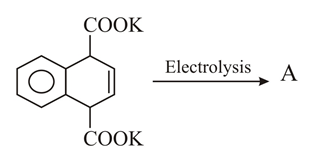
A is:
This is Kolbe’s Electrolysis. It involves the decarboxylation of potassium salts of carboxylic acids at the anode to form hydrocarbons.
Mechanism:
Decarboxylation: The two $$-COOK$$ groups at the 1 and 4 positions are removed as two molecules of $$CO_2$$.
Radical Formation: This generates free radicals at the C1 and C4 positions of the dihydronaphthalene ring.
Aromatization: The 1,4-diradical system undergoes immediate aromatization to reach the most stable state.
Final product: The loss of the carboxyl groups and the resulting electronic rearrangement converts the 1,4-dihydronaphthalene core into a fully aromatic Naphthalene ring.
In the presence of a small amount of phosphorous, aliphatic carboxylic acid reacts with chlorine or bromine to yield a reaction in which, $$\alpha$$-hydrogen is been replaced by halogen. This reaction is known as
We first recall an important named reaction of organic chemistry: when an aliphatic carboxylic acid that contains at least one $$\alpha$$-hydrogen is treated with a halogen such as $$Cl_2$$ or $$Br_2$$ in the presence of a trace amount of red phosphorus, the hydrogen attached to the $$\alpha$$-carbon (the carbon atom that is next to the carbonyl carbon) is replaced by the corresponding halogen. This specific transformation is historically called the Hell-Volhard-Zelinsky reaction, often abbreviated as the HVZ reaction.
No other commonly cited name reactions—neither the Etard oxidation, the Wolff-Kishner reduction, nor the Rosenmund reduction—involve the halogenation of the $$\alpha$$-carbon of carboxylic acids under these conditions. Therefore, the description given in the question matches uniquely with the Hell-Volhard-Zelinsky reaction.
Hence, the correct answer is Option D.
Phthalic acid reacts with resorcinol in the presence of concentrated H$$_2$$SO$$_4$$ to give:
Phthalic acid, when heated with concentrated sulfuric acid, first dehydrates to form phthalic anhydride. The reaction then proceeds with phthalic anhydride acting as an electrophile.
Resorcinol (1,3-dihydroxybenzene) has a highly activated benzene ring due to the presence of two electron-donating hydroxyl groups in the meta position. The ortho and para positions relative to each hydroxyl group are nucleophilic sites.
In the presence of concentrated H₂SO₄, phthalic anhydride undergoes electrophilic substitution with resorcinol. The carbonyl carbon of the anhydride attacks the para position of one hydroxyl group in resorcinol (specifically, the position between the two hydroxyl groups, which is highly activated). This forms an intermediate keto-acid:
$$\text{Phthalic anhydride} + \text{Resorcinol} \rightarrow \text{2-(2,4-dihydroxybenzoyl)benzoic acid}$$
This intermediate undergoes intramolecular cyclization: the carboxylic acid group attacks the ortho position relative to the other hydroxyl group in the resorcinol moiety. This forms a six-membered lactone ring, releasing a water molecule. The resulting compound is fluorescein, which has a xanthene ring system fused to a benzoic acid derivative.
Now, evaluating the options:
Hence, the correct answer is Option D.
Among the following organic acids, the acid present in rancid butter is:
The question asks which organic acid is present in rancid butter among the given options.
Rancid butter develops an unpleasant odor due to the breakdown of fats. This process releases short-chain fatty acids. Specifically, butyric acid is known to be responsible for the characteristic smell of rancid butter.
Now, let's examine each option:
Option A: Pyruvic acid has the formula $$CH_3COCOOH$$. It is an intermediate in metabolic pathways and is not associated with rancid butter.
Option B: Acetic acid has the formula $$CH_3COOH$$. It is the main component of vinegar and gives vinegar its sour taste, but it is not the acid in rancid butter.
Option C: Butyric acid has the formula $$CH_3CH_2CH_2COOH$$. It is a short-chain fatty acid produced when butter becomes rancid due to the hydrolysis of triglycerides, leading to the release of butyric acid, which causes the foul smell.
Option D: Lactic acid has the formula $$CH_3CH(OH)COOH$$. It is found in sour milk and is produced during anaerobic respiration in muscles, but it is not the acid in rancid butter.
Therefore, butyric acid is the acid present in rancid butter.
Hence, the correct answer is Option C.
Monocarboxylic acids are functional isomers of:
Functional isomers are compounds that have the same molecular formula but different functional groups. To determine what monocarboxylic acids are functional isomers of, we must compare their molecular formulas with those of the given options.
A monocarboxylic acid has the general formula R-COOH, where R is an alkyl group. For example, acetic acid (CH₃COOH) has the molecular formula C₂H₄O₂. In general, a monocarboxylic acid with n carbon atoms has the molecular formula CₙH₂ₙO₂.
Now, let's examine each option:
Option A: Ethers
Ethers have the general formula R-O-R'. For example, dimethyl ether (CH₃OCH₃) has the molecular formula C₂H₆O. This differs from acetic acid's formula C₂H₄O₂. Therefore, ethers cannot be functional isomers of monocarboxylic acids.
Option B: Amines
Amines have the general formula R-NH₂ for primary amines. For example, ethylamine (CH₃CH₂NH₂) has the molecular formula C₂H₇N. This differs from C₂H₄O₂. Hence, amines cannot be functional isomers.
Option C: Esters
Esters have the general formula R-COO-R'. For example, methyl formate (HCOOCH₃) has the molecular formula C₂H₄O₂, which matches acetic acid's formula. Both have the same atoms but different functional groups: carboxylic acid (-COOH) versus ester (-COO-). Another example: propanoic acid (C₃H₆O₂) and methyl acetate (CH₃COOCH₃, also C₃H₆O₂). Thus, esters are functional isomers of monocarboxylic acids.
Option D: Alcohols
Alcohols have the general formula R-OH. For example, ethanol (CH₃CH₂OH) has the molecular formula C₂H₆O, which differs from C₂H₄O₂. Therefore, alcohols cannot be functional isomers.
Hence, monocarboxylic acids are functional isomers of esters.
So, the correct answer is Option C.
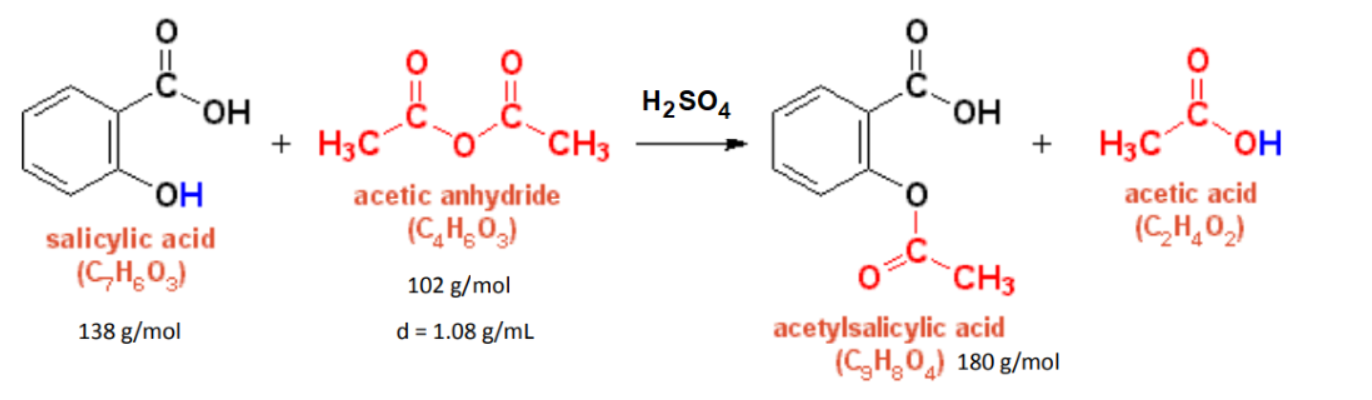
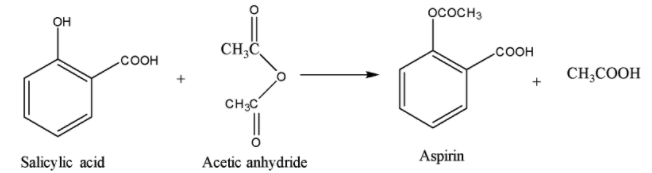
Aspirin can be prepared by the reaction of
Aspirin is known as:
The strongest acid amongst the following compounds is:
Sodium ethoxide has reacted with ethanoyl chloride. The compound that is produced in the above reaction is:
A liquid was mixed with ethanol and a drop of concentrated $$H_2SO_4$$ was added. A compound with a fruity smell was formed. The liquid was:
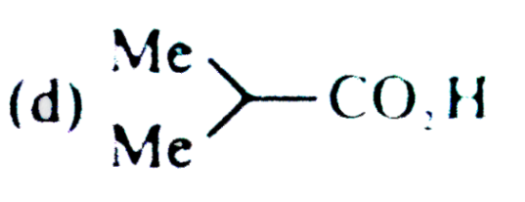
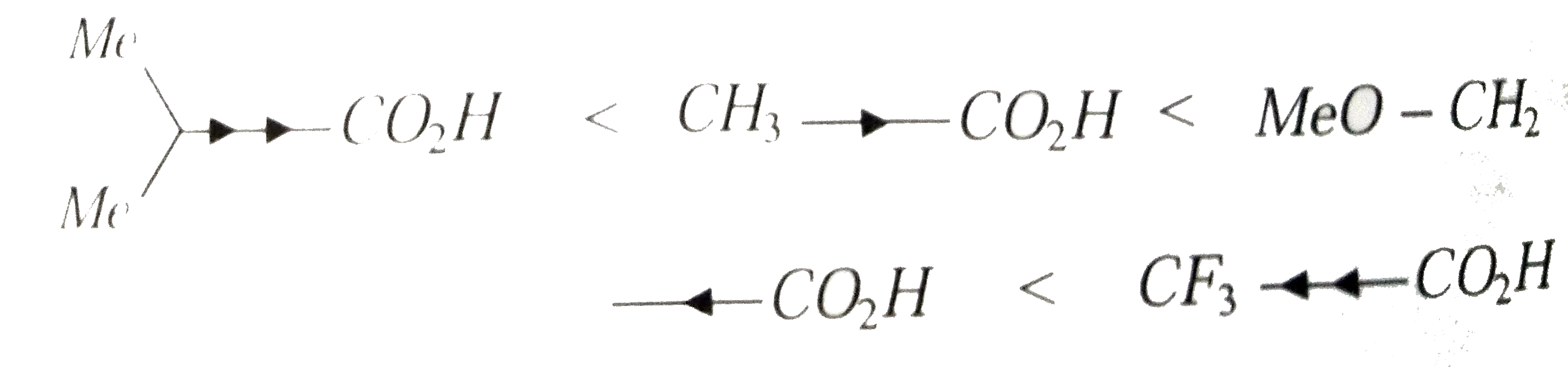
The correct order of increasing acid strength of the compounds is (a) $$CH_3CO_2H$$ (b) $$MeOCH_2CO_2H$$ (c)
(d) $$CF_3CO_2H$$
Consider the reaction:
The reaction is fastest when $$X$$ is
Among the following acids which has the lowest p$$K_a$$ value
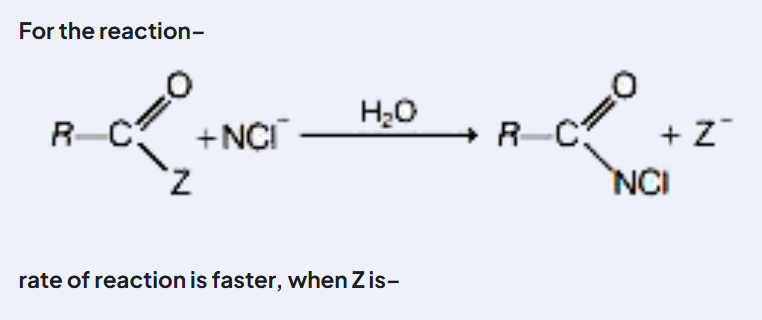
Rate of the reaction
is fastest when Z is
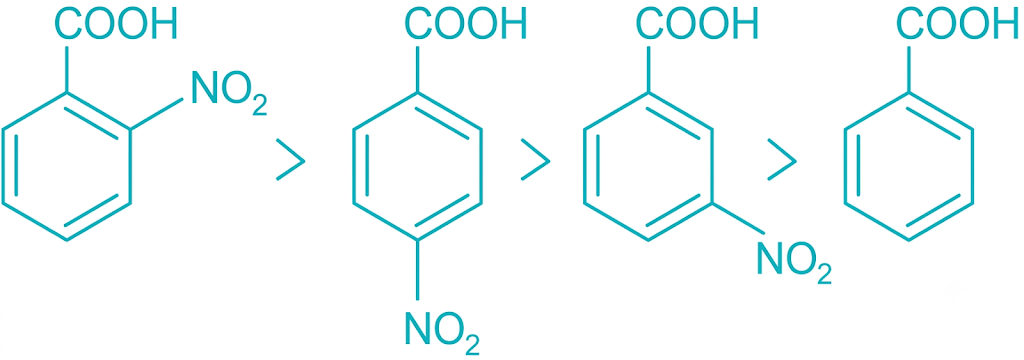
Consider the acidity of the carboxylic acids:
On mixing ethyl acetate with aqueous sodium chloride, the composition of the resultant solution is
Terms of Service
Predict your JEE Main percentile, rank & performance in seconds
Educational materials for JEE preparation