
Join Our JEE Preparation Group
Prep with like-minded aspirants; Get access to free daily tests and study material.
Sign in
Please select an account to continue using cracku.in
↓ →
Join Our JEE Preparation Group
Prep with like-minded aspirants; Get access to free daily tests and study material.
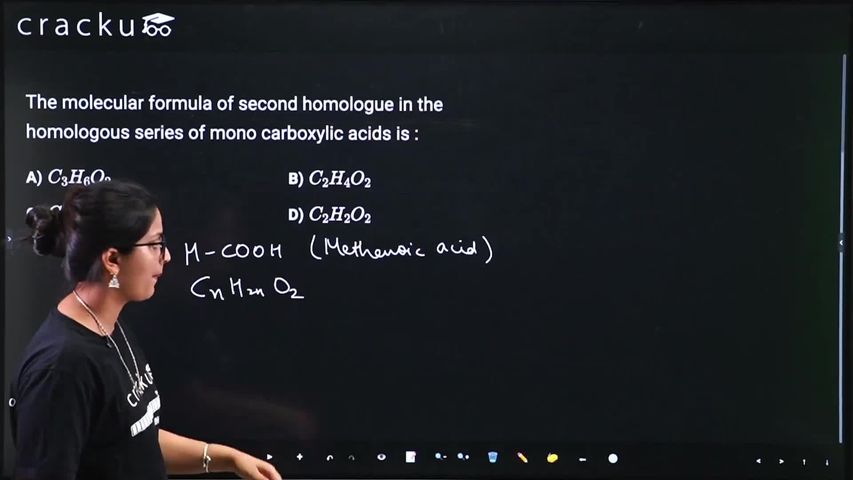
The molecular formula of second homologue in the homologous series of mono carboxylic acids is :
We need to determine the molecular formula of the second homologue in the homologous series of monocarboxylic acids.
Key Concept: A homologous series is a group of organic compounds sharing the same functional group and general chemical properties, where each successive member differs from the previous one by a methylene ($$\text{-}CH_2\text{-}$$) unit. The general formula for the homologous series of open-chain monocarboxylic acids is $$C_nH_{2n}O_2$$ (where $$n \ge 1$$).
Step 1: Finding the first member of the series ($$n = 1$$)
The first homologue contains one carbon atom. This compound is methanoic acid (formic acid), having the structural formula $$HCOOH$$. Combining the atoms gives its molecular formula:
$$CH_2O_2$$
Step 2: Finding the second member of the series ($$n = 2$$)
The second homologue is formed by adding a $$\text{-}CH_2\text{-}$$ group to the first member, meaning it contains two carbon atoms ($$n = 2$$). This compound is ethanoic acid (acetic acid), having the structural formula $$CH_3COOH$$.
Step 3: Writing the final molecular formula
Counting the total number of carbon, hydrogen, and oxygen atoms in $$CH_3COOH$$ gives the molecular formula:
$$C_2H_4O_2$$
Therefore, the molecular formula of the second homologue is $$C_2H_4O_2$$, which corresponds to Option B.
Answer: Option B — $$C_2H_4O_2$$
Was this solution helpful?
Click on the Email ☝️ to Watch the Video Solution
Create a FREE account and get:
_1.webp)

Educational materials for JEE preparation

Ask our AI anything

AI can make mistakes. Please verify important information.
AI can make mistakes. Please verify important information.
