
Join Our JEE Preparation Group
Prep with like-minded aspirants; Get access to free daily tests and study material.
Sign in
Please select an account to continue using cracku.in
↓ →
Join Our JEE Preparation Group
Prep with like-minded aspirants; Get access to free daily tests and study material.
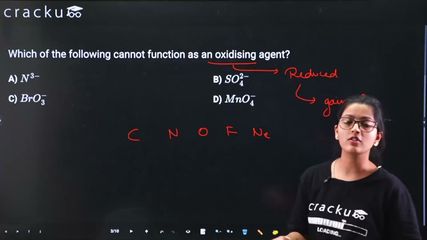
We need to identify which species cannot function as an oxidising agent.
Key Concept: An oxidising agent accepts electrons (gets reduced). For this, the element must have the ability to decrease its oxidation state.
$$N^{3-}$$: Nitrogen is in its lowest possible oxidation state (-3). Since it cannot be reduced further (there is no lower oxidation state for nitrogen), it cannot act as an oxidising agent. It can only act as a reducing agent (losing electrons to go to higher oxidation states).
$$SO_4^{2-}$$: Sulphur is in +6 state. It can be reduced (e.g., to $$SO_2$$, $$S$$, or $$H_2S$$). It can act as an oxidising agent, especially in concentrated $$H_2SO_4$$.
$$BrO_3^-$$: Bromine is in +5 state. It can be reduced to $$Br^-$$ (0 or -1). It is a known oxidising agent.
$$MnO_4^-$$: Manganese is in +7 state. It is one of the strongest oxidising agents, capable of being reduced to $$Mn^{2+}$$, $$MnO_2$$, or $$MnO_4^{2-}$$.
The correct answer is Option 1: $$N^{3-}$$.
Was this solution helpful?
Click on the Email ☝️ to Watch the Video Solution
Create a FREE account and get:
_1.webp)

Educational materials for JEE preparation

Ask our AI anything

AI can make mistakes. Please verify important information.
AI can make mistakes. Please verify important information.
