
Join Our JEE Preparation Group
Prep with like-minded aspirants; Get access to free daily tests and study material.
Sign in
Please select an account to continue using cracku.in
↓ →
Join Our JEE Preparation Group
Prep with like-minded aspirants; Get access to free daily tests and study material.
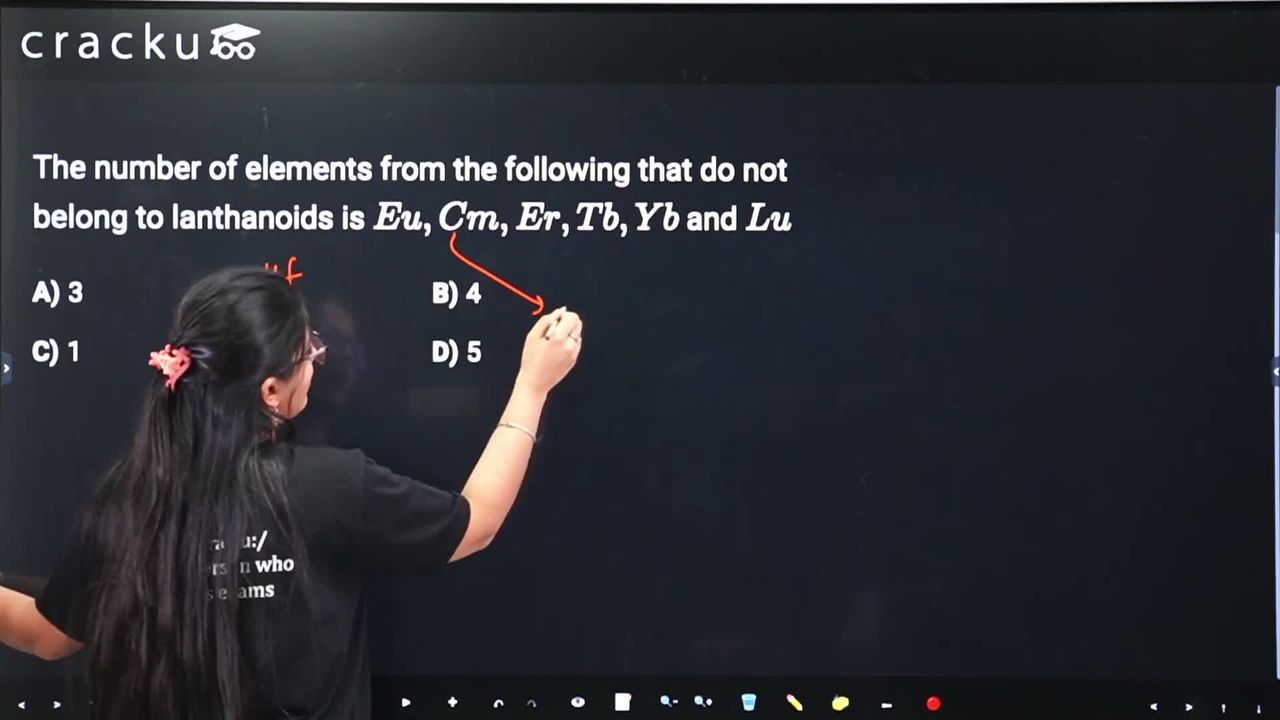
The number of elements from the following that do not belong to lanthanoids is $$Eu, Cm, Er, Tb, Yb$$ and $$Lu$$
We need to count how many of the given elements do not belong to the lanthanoid series.
Key Concept: The lanthanoid series consists of 15 elements from Lanthanum (La, Z = 57) to Lutetium (Lu, Z = 71). These elements are characterised by the progressive filling of the 4f orbitals.
Checking each element:
Eu (Europium, Z = 63): Falls between La (57) and Lu (71). Configuration: [Xe] 4f$$^7$$ 6s$$^2$$. This is a lanthanoid. ✓
Cm (Curium, Z = 96): Curium has atomic number 96, which falls in the actinoid series (Ac, Z = 89 to Lr, Z = 103). Configuration: [Rn] 5f$$^7$$ 6d$$^1$$ 7s$$^2$$. This is an actinoid, NOT a lanthanoid. ✗
Er (Erbium, Z = 68): Falls between La (57) and Lu (71). Configuration: [Xe] 4f$$^{12}$$ 6s$$^2$$. This is a lanthanoid. ✓
Tb (Terbium, Z = 65): Falls between La (57) and Lu (71). Configuration: [Xe] 4f$$^9$$ 6s$$^2$$. This is a lanthanoid. ✓
Yb (Ytterbium, Z = 70): Falls between La (57) and Lu (71). Configuration: [Xe] 4f$$^{14}$$ 6s$$^2$$. This is a lanthanoid. ✓
Lu (Lutetium, Z = 71): This is the last element of the lanthanoid series. Configuration: [Xe] 4f$$^{14}$$ 5d$$^1$$ 6s$$^2$$. This is a lanthanoid. ✓
Conclusion: Only Curium (Cm) does not belong to the lanthanoids. The number of non-lanthanoid elements is 1.
The correct answer is Option 3: 1.
Was this solution helpful?
Click on the Email ☝️ to Watch the Video Solution
Create a FREE account and get:
_1.webp)

Educational materials for JEE preparation

Ask our AI anything

AI can make mistakes. Please verify important information.
AI can make mistakes. Please verify important information.
