Join Our JEE Preparation Group
Prep with like-minded aspirants; Get access to free daily tests and study material.
Sign in
Please select an account to continue using cracku.in
↓ →
Join Our JEE Preparation Group
Prep with like-minded aspirants; Get access to free daily tests and study material.
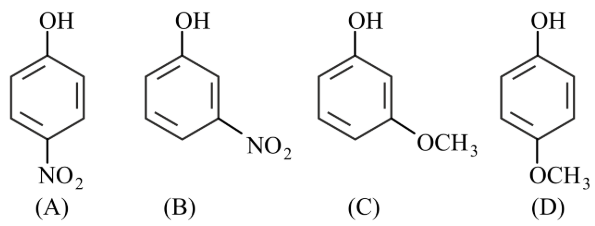
To determine the decreasing order of acidic strength for the given substituted phenols, we must evaluate how the different substituents affect the stability of the phenoxide ion formed after the loss of a proton ($$H^+$$). As a general rule, electron-withdrawing groups stabilize the negative charge on the phenoxide ion through inductive ($$-I$$) or resonance ($$-R$$) effects, thereby increasing acidity. Conversely, electron-donating groups destabilize the ion by pushing electron density toward the oxygen through positive inductive ($$+I$$) or resonance ($$+R$$) effects, which decreases acidity.
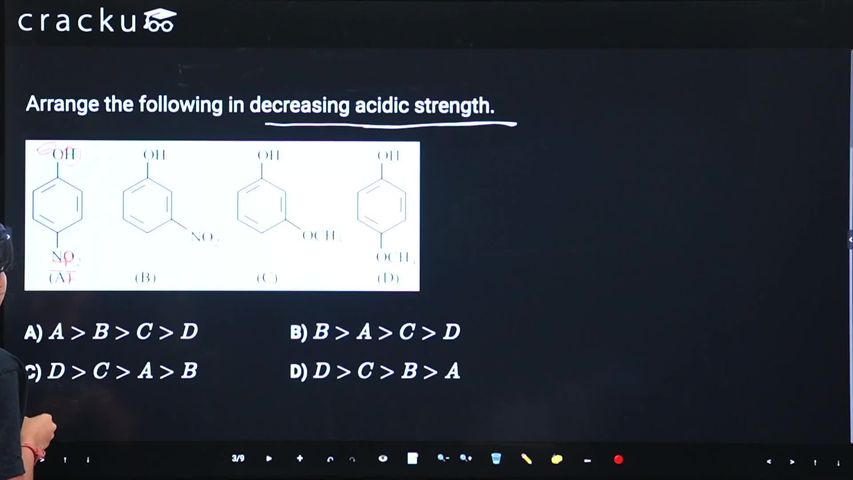
The nitro group ($$-NO_2$$) is a powerful electron-withdrawing group that can exert both $$-I$$ and $$-R$$ effects. In compound (A), p-nitrophenol, the nitro group is located at the para position, allowing both the $$-I$$ and strong $$-R$$effects to heavily stabilize the phenoxide ion, making it the most acidic. In compound (B), m-nitrophenol, the nitro group is at the meta position. Because resonance effects cannot operate from the meta position, only the $$-I$$ effect stabilizes the anion. This makes it highly acidic, but slightly less so than the para isomer.
The methoxy group ($$-OCH_3$$), on the other hand, exerts an electron-withdrawing $$-I$$ effect but a much stronger electron-donating $$+R$$ effect. In compound (C), m-methoxyphenol, the methoxy group is at the meta position where its $$+R$$ effect cannot operate. Therefore, only its mild $$-I$$ effect influences the ring, slightly stabilizing the phenoxide ion. In compound (D), p-methoxyphenol, the methoxy group is at the para position. Here, its dominant electron-donating $$+R$$ effect actively pushes electron density into the ring, highly destabilizing the phenoxide ion and making it the least acidic of all four options.
By comparing the relative stabilization and destabilization caused by these groups at their respective positions, we can conclude the final sequence. The strongest stabilization occurs in compound (A), followed by (B), then a much weaker stabilization in (C), and finally an active destabilization in (D). Therefore, the correct decreasing order of acidic strength is (A) > (B) > (C) > (D).
Was this solution helpful?
Click on the Email ☝️ to Watch the Video Solution
Create a FREE account and get:
_1.webp)

Educational materials for JEE preparation

Ask our AI anything

AI can make mistakes. Please verify important information.
AI can make mistakes. Please verify important information.