Join Our JEE Preparation Group
Prep with like-minded aspirants; Get access to free daily tests and study material.
Sign in
Please select an account to continue using cracku.in
↓ →
Join Our JEE Preparation Group
Prep with like-minded aspirants; Get access to free daily tests and study material.
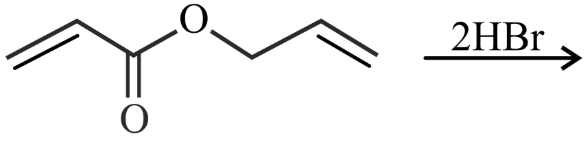
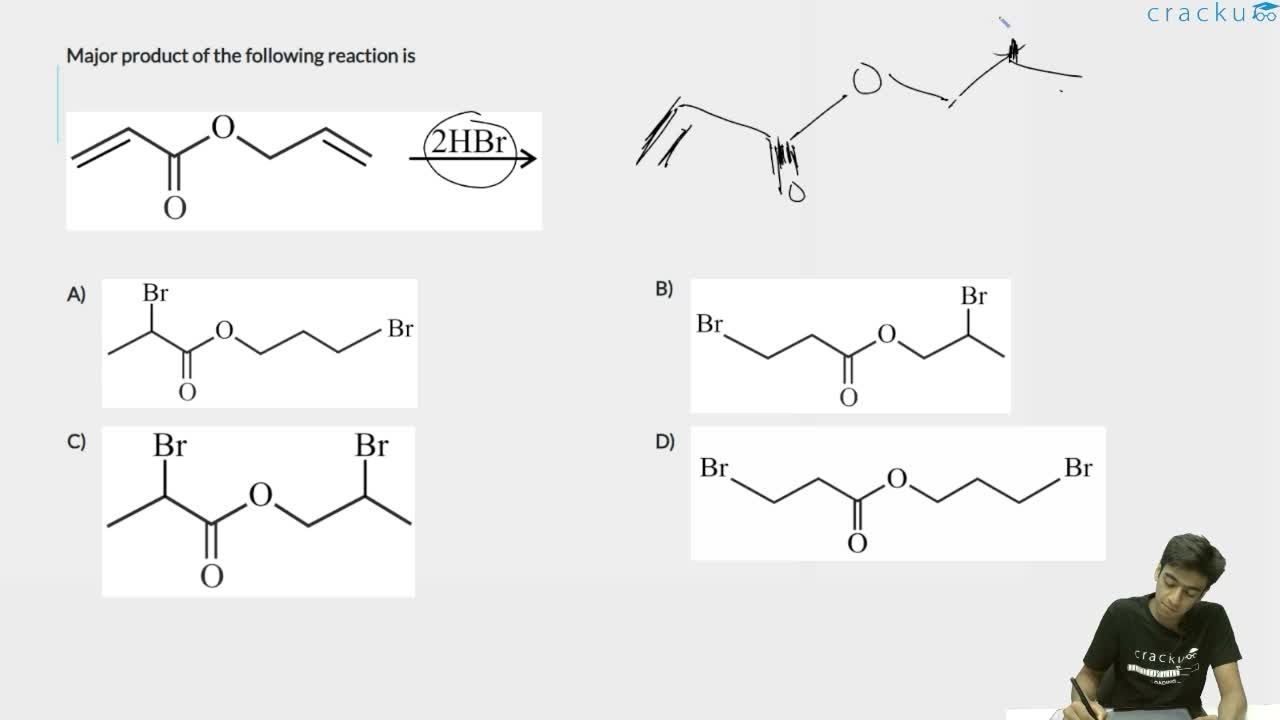
The starting compound is allyl acrylate, which contains two different carbon-carbon double bonds.
Since:
$$\mathrm{2\ equivalents\ of\ HBr}$$
are used, both double bonds undergo electrophilic addition.
The double bond on the allyl side:
$$\mathrm{-O-CH_2-CH=CH_2}$$
undergoes normal Markovnikov addition.
The proton adds to the terminal carbon to generate the more stable secondary carbocation.
$$\mathrm{-CH=CH_2 \longrightarrow -C^+H-CH_3}$$
The bromide ion then attacks the carbocation.
Thus:
$$\mathrm{-O-CH_2-CH=CH_2 \longrightarrow -O-CH_2-CH(Br)-CH_3}$$
The double bond on the acrylate side:
$$\mathrm{CH_2=CH-C(=O)-}$$
is conjugated with the carbonyl group.
The electron-withdrawing:
$$\mathrm{C=O}$$
group alters the regiochemistry of addition.
Addition occurs such that bromine attaches to the terminal:
$$\mathrm{\beta}$$
carbon.
Thus:
$$\mathrm{CH_2=CH-C(=O)- \longrightarrow Br-CH_2-CH_2-C(=O)-}$$
Combining both additions, the final major product is:
$$\mathrm{Br-CH_2-CH_2-C(=O)-O-CH_2-CH(Br)-CH_3}$$
Was this solution helpful?
Click on the Email ☝️ to Watch the Video Solution
Create a FREE account and get:
_1.webp)

Educational materials for JEE preparation

Ask our AI anything

AI can make mistakes. Please verify important information.
AI can make mistakes. Please verify important information.