
Join Our JEE Preparation Group
Prep with like-minded aspirants; Get access to free daily tests and study material.
Sign in
Please select an account to continue using cracku.in
↓ →
Join Our JEE Preparation Group
Prep with like-minded aspirants; Get access to free daily tests and study material.
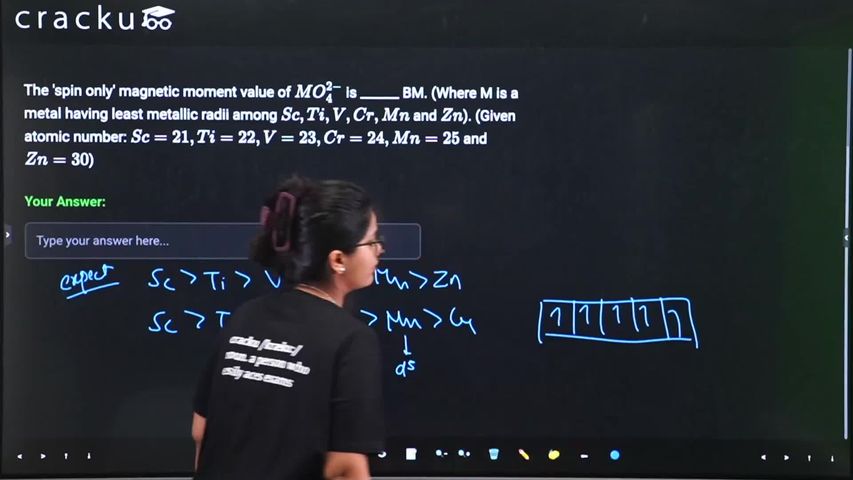
The 'spin only' magnetic moment value of $$MO_4^{2-}$$ is ______ BM. (Where M is a metal having least metallic radii among $$Sc, Ti, V, Cr, Mn$$ and $$Zn$$). (Given atomic number: $$Sc = 21, Ti = 22, V = 23, Cr = 24, Mn = 25$$ and $$Zn = 30$$)
Correct Answer: 0
The metallic radius decreases steadily from Sc to Cr in the 3d series because the increasing nuclear charge is not fully screened by the added 3d electrons. After Cr the radius stops decreasing and even rises slightly. Therefore, among the given elements (Sc, Ti, V, Cr, Mn, Zn) the one with the smallest metallic radius is chromium (Cr).
Hence in $$MO_4^{2-}$$ the metal atom is chromium, giving the anion $$CrO_4^{2-}$$ (chromate ion).
Each oxide ion carries a charge of $$-2$$, so for $$CrO_4^{2-}$$ the overall charge balance is
$$x + 4(-2) = -2 \;\;\Longrightarrow\;\; x = +6$$
Thus chromium is in the $$+6$$ oxidation state.
Electronic configuration of a neutral Cr atom: $$[Ar]\,3d^5\,4s^1$$.
To obtain $$Cr^{+6}$$ we remove six electrons (the one 4s electron and five 3d electrons), leaving
$$Cr^{+6}: [Ar]\,3d^{0}$$.
Number of unpaired electrons, $$n = 0$$.
The spin-only magnetic moment is calculated by the formula
$$\mu_{\text{spin}} = \sqrt{n(n+2)}\;\text{BM}$$.
Substituting $$n = 0$$ gives
$$\mu_{\text{spin}} = \sqrt{0(0+2)} = 0\;\text{BM}$$.
Hence the ‘spin only’ magnetic moment of $$MO_4^{2-}$$ is $$\mathbf{0\;BM}$$.
Was this solution helpful?
Click on the Email ☝️ to Watch the Video Solution
Create a FREE account and get:
_1.webp)

Educational materials for JEE preparation

Ask our AI anything

AI can make mistakes. Please verify important information.
AI can make mistakes. Please verify important information.
