
Join Our JEE Preparation Group
Prep with like-minded aspirants; Get access to free daily tests and study material.
Sign in
Please select an account to continue using cracku.in
↓ →
Join Our JEE Preparation Group
Prep with like-minded aspirants; Get access to free daily tests and study material.
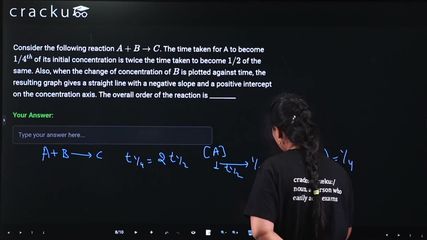
Consider the following reaction $$A + B \rightarrow C$$. The time taken for A to become $$1/4^{th}$$ of its initial concentration is twice the time taken to become $$1/2$$ of the same. Also, when the change of concentration of $$B$$ is plotted against time, the resulting graph gives a straight line with a negative slope and a positive intercept on the concentration axis. The overall order of the reaction is ________
Correct Answer: 1
Find the overall order of the reaction $$A + B \rightarrow C$$.
Since the time for A to become $$\tfrac{1}{4}$$ of its initial concentration is twice the time required to reach half its initial concentration, and because for a first-order reaction $$t_{1/4} = \frac{2\ln 2}{k} = 2 \times \frac{\ln 2}{k} = 2t_{1/2}\,$$, the reaction exhibits first-order kinetics with respect to A.
Next, the plot of the concentration of B versus time is a straight line with a negative slope and a positive intercept, which corresponds to the integrated rate law $$[B] = [B]_0 - kt$$ for a zero-order reaction in B.
Using these results, the overall order of the reaction is $$1\;( \text{for A} ) + 0\;( \text{for B} ) = 1\,$$.
The correct answer is $$1$$.
Was this solution helpful?
Click on the Email ☝️ to Watch the Video Solution
Create a FREE account and get:
_1.webp)

Educational materials for JEE preparation

Ask our AI anything

AI can make mistakes. Please verify important information.
AI can make mistakes. Please verify important information.
