
Join Our JEE Preparation Group
Prep with like-minded aspirants; Get access to free daily tests and study material.
Sign in
Please select an account to continue using cracku.in
↓ →
Join Our JEE Preparation Group
Prep with like-minded aspirants; Get access to free daily tests and study material.
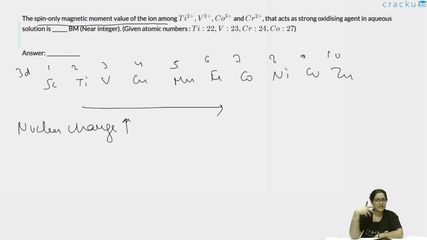
The spin-only magnetic moment value of the ion among $$Ti^{2+}, V^{2+}, Co^{3+}$$ and $$Cr^{2+}$$, that acts as strong oxidising agent in aqueous solution is ______ BM (Near integer). (Given atomic numbers : $$Ti : 22, V : 23, Cr : 24, Co : 27$$)
Correct Answer: 5
Among the ions $$Ti^{2+}, V^{2+}, Co^{3+}, Cr^{2+}$$, the one that acts as a strong oxidising agent in aqueous solution is $$Co^{3+}$$. A strong oxidising agent easily gets reduced (accepts electrons), and $$Co^{3+}$$ readily accepts an electron to form the more stable $$Co^{2+}$$. The other ions ($$Ti^{2+}, V^{2+}, Cr^{2+}$$) are actually strong reducing agents.
The electronic configuration of cobalt is Co: [Ar] $$3d^7 4s^2$$, so for $$Co^{3+}$$ it becomes [Ar] $$3d^6$$. In aqueous solution, the complex $$[Co(H_2O)_6]^{3+}$$ behaves as a high-spin complex (since water is a weak field ligand), giving the configuration $$t_{2g}^4 e_g^2$$ with 4 unpaired electrons.
Using the spin-only formula for the magnetic moment, we have $$\mu = \sqrt{n(n+2)} = \sqrt{4(4+2)} = \sqrt{24} = 4.9 \approx 5 \text{ BM}$$.
Final answer: $$Co^{3+}$$ is the strong oxidising agent and its spin-only magnetic moment is 5 BM.
Was this solution helpful?
Click on the Email ☝️ to Watch the Video Solution
Create a FREE account and get:
_1.webp)

Educational materials for JEE preparation

Ask our AI anything

AI can make mistakes. Please verify important information.
AI can make mistakes. Please verify important information.
