
Join Our JEE Preparation Group
Prep with like-minded aspirants; Get access to free daily tests and study material.
Sign in
Please select an account to continue using cracku.in
↓ →
Join Our JEE Preparation Group
Prep with like-minded aspirants; Get access to free daily tests and study material.
Compound(s) which will liberate carbon dioxide with sodium bicarbonate solution is/are:
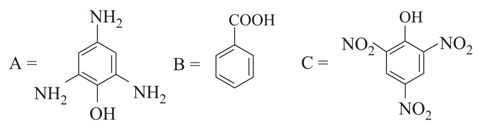
To liberate carbon dioxide ($$CO_2$$) from sodium bicarbonate ($$NaHCO_3$$), an organic molecule must be a stronger acid than carbonic acid ($$H_2CO_3$$). If the compound is a weaker acid than carbonic acid, no reaction will take place.
Compound A: 2,4,6-Triaminophenol (Does Not React)
Compound A fails this test. Standard, unsubstituted phenol is already a weaker acid than carbonic acid. In Compound A, the three amine ($$-NH_2$$) groups attached to the ring are strongly electron-donating due to the resonance (+R) effect of their nitrogen lone pairs. They push electron density into the benzene ring, which severely repels and destabilizes the negatively charged phenoxide oxygen that would form if it lost a proton. This makes Compound A an extremely weak acid that cannot react with bicarbonate.
Compound B: Benzoic Acid (Reacts)
Compound B successfully reacts. It contains a standard carboxylic acid group ($$-COOH$$). As a general rule, almost all carboxylic acids are inherently stronger acids than carbonic acid. Therefore, Compound B easily reacts with sodium bicarbonate to release carbon dioxide gas.
Compound C: Picric Acid / 2,4,6-Trinitrophenol (Reacts)
Compound C also successfully reacts. Although it belongs to the phenol family (which typically fails this test), the presence of three strongly electron-withdrawing nitro
($$-NO_2$$) groups completely changes its behavior. These groups pull electron density away from the oxygen atom, powerfully stabilizing the phenoxide conjugate base. This makes picric acid exceptionally acidic—actually more acidic than some carboxylic acids—allowing it to easily liberate $$CO_2$$.
Final Conclusion
Because only the carboxylic acid and the highly deactivated phenol possess the required acid strength, Compounds B and C only will liberate carbon dioxide with sodium bicarbonate solution. Thus, the right option is B.
Was this solution helpful?
Click on the Email ☝️ to Watch the Video Solution
Create a FREE account and get:
_1.webp)

Educational materials for JEE preparation

Ask our AI anything

AI can make mistakes. Please verify important information.
AI can make mistakes. Please verify important information.
