Join WhatsApp Icon JEE WhatsApp Group
Question 35

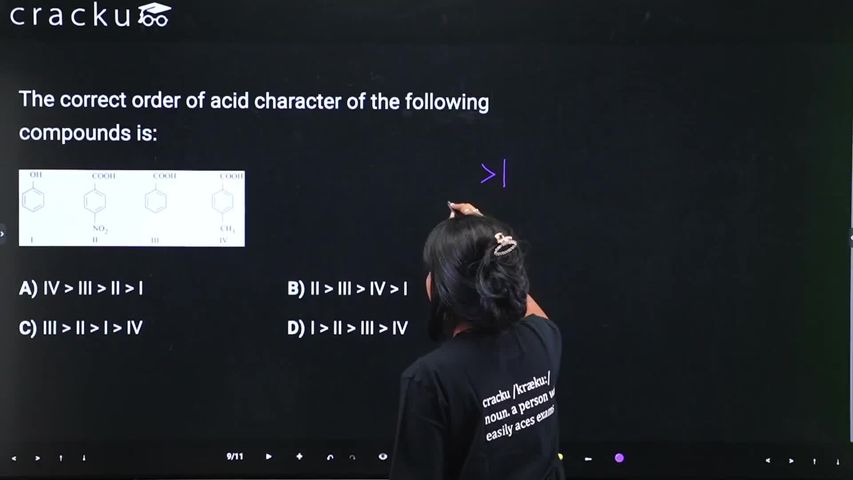
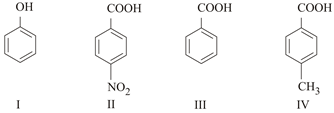
The correct order of acid character of the following compounds is:

  • Compound I (Phenol): Phenol is inherently a much weaker acid than any carboxylic acid. When it loses a proton, its conjugate base (the phenoxide ion) must disperse its negative charge into the carbon ring. This is far less stable than a carboxylate ion, which perfectly distributes its negative charge across two highly electronegative oxygen atoms. Therefore, this is the weakest acid of the group.
  • Compound II (p-Nitrobenzoic acid): This molecule features a nitro group ($$-NO_2$$), which is powerfully electron-withdrawing due to both the resonance (-R) and inductive (-I) effects. It continuously pulls electron density away from the carboxylate group, which deeply stabilizes the negative charge of the resulting conjugate base. This intense stabilization makes it the strongest acid in the lineup.
  • Compound III (Benzoic acid): This is the standard, unsubstituted aromatic carboxylic acid. It possesses no extra groups to push or pull electrons, making it the perfect neutral baseline to compare against the other carboxylic acids.
  • Compound IV (p-Methylbenzoic acid): This molecule features a methyl group ($$-CH_3$$), which is an electron-donating group through hyperconjugation and the positive inductive (+I) effect. It pushes excess electron density into the ring and toward the carboxylate group. This extra negative charge severely destabilizes the conjugate base, making it a weaker acid than the neutral baseline (Compound III).

Thus, the electron-withdrawing group makes II the strongest, III serves as the neutral baseline in the middle, the electron-donating group makes IV weaker than the baseline, and the phenol I is the weakest functional group overall.

Therefore, the correct decreasing order of acid character is:

$$II > III > IV > I$$

Get AI Help

Video Solution

video

Create a FREE account and get:

  • Free JEE Mains Previous Papers PDF
  • Take JEE Mains paper tests

JEE Quant Questions | JEE Quantitative Ability

JEE DILR Questions | LRDI Questions For JEE

JEE Verbal Ability Questions | VARC Questions For JEE

Free JEE Topicwise Questions

JEE Rotational MotionJEE Units & MeasurementsJEE Atomic StructureJEE GravitationJEE Periodic Table & PeriodicityJEE StatisticsJEE Inverse Trigonometric FunctionsJEE Magnetism & Magnetic MaterialsJEE Sequences & SeriesJEE MatricesJEE Alternating CurrentsJEE Carboxylic AcidsJEE Permutations & CombinationsJEE Work, Energy & PowerJEE Electromagnetic InductionJEE Electronic DevicesJEE d and f-Block ElementsJEE Chemical KineticsJEE Heat TransferJEE Three Dimensional GeometryJEE Magnetic Effects of CurrentJEE Hydrocarbons - AromaticJEE Electromagnetic WavesJEE Aldehydes & KetonesJEE Hydrocarbons - AlkanesJEE Applications of DerivativesJEE EquilibriumJEE Indefinite IntegrationJEE Chemical ThermodynamicsJEE ElectrochemistryJEE ProbabilityJEE BiomoleculesJEE Continuity & DifferentiabilityJEE Kinetic Theory of GasesJEE Vector AlgebraJEE Hydrocarbons - AlkynesJEE Differential EquationsJEE Current & ResistanceJEE Straight LinesJEE WavesJEE Redox ReactionsJEE Hydrocarbons - AlkenesJEE DeterminantsJEE SolutionsJEE Ray OpticsJEE Dual Nature of Matter & RadiationJEE Chemical Bonding & Molecular StructureJEE Complex NumbersJEE Sets, Relations & FunctionsJEE Electric Charges & FieldsJEE Laws of MotionJEE Fluid MechanicsJEE Basic Concepts in ChemistryJEE Trigonometric FunctionsJEE LimitsJEE Laws of ThermodynamicsJEE Kinematics - 2D MotionJEE p-Block Elements (Groups 13-18)JEE Simple Harmonic MotionJEE Electric Potential & CapacitanceJEE Coordination CompoundsJEE JEE 2D GeometryJEE CirclesJEE Definite IntegrationJEE EMF & Circuit AnalysisJEE Surface TensionJEE Atoms & NucleiJEE Laboratory Experiments - XIJEE Number SystemJEE Basic Principles of Organic ChemistryJEE Wave OpticsJEE Quadratic EquationsJEE Alcohols, Phenols & EthersJEE Organic Compounds with HalogensJEE DifferentiationJEE Conic SectionsJEE Nitrogen-Containing CompoundsJEE ElasticityJEE Practical Organic ChemistryJEE Kinematics - 1D MotionJEE Purification & CharacterisationJEE Binomial Theorem
Ask AI