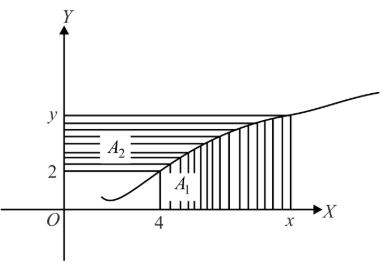
We start with the given differential equation
$$x^{3}\,dy + x\,y \,dx \;=\; x^{2}\,dy + 2\,y \,dx.$$
First, we collect the $$dy$$ terms on one side and the $$dx$$ terms on the other. Subtracting $$x^{2}dy$$ and $$2y\,dx$$ from both sides gives
$$x^{3}\,dy - x^{2}\,dy + x\,y\,dx - 2\,y\,dx \;=\; 0.$$
Factoring $$dy$$ from the first two terms and $$y\,dx$$ from the last two terms, we get
$$\bigl(x^{3}-x^{2}\bigr)\,dy + y\bigl(x-2\bigr)\,dx \;=\; 0.$$
Taking common factors, observe that $$x^{3}-x^{2}=x^{2}(x-1).$$ Hence
$$x^{2}(x-1)\,dy + y(x-2)\,dx \;=\; 0.$$
We now isolate $$dy/dx$$:
$$x^{2}(x-1)\,dy \;=\; -\,y(x-2)\,dx,$$
so
$$\frac{dy}{dx} \;=\; -\,\frac{y(x-2)}{x^{2}(x-1)}.$$
This is a first-order separable differential equation. We separate the variables $$y$$ and $$x$$:
$$\frac{dy}{y} \;=\; -\,\frac{x-2}{x^{2}(x-1)}\,dx.$$
Next, we integrate both sides. The left side integrates immediately:
$$\int \frac{dy}{y} \;=\; \ln y + C_{1}.$$
For the right side we need to integrate
$$\int \frac{x-2}{x^{2}(x-1)}\,dx.$$
To do this, we express the integrand in partial fractions. We write
$$\frac{x-2}{x^{2}(x-1)} \;=\; \frac{A}{x} + \frac{B}{x^{2}} + \frac{C}{x-1}.$$
Multiplying both sides by $$x^{2}(x-1)$$ gives the identity
$$x-2 \;=\; A\,x(x-1) + B(x-1) + Cx^{2}.$$
Expanding the right side,
$$A\,x(x-1) = A(x^{2}-x)=A\,x^{2}-A\,x,$$
so
$$A\,x^{2}-A\,x + B\,x - B + C\,x^{2}.$$
Grouping like powers of $$x$$:
$$\bigl(A+C\bigr)x^{2} + \bigl(-A+B\bigr)x - B.$$
Equating coefficients with the left side $$x-2$$ (which is $$0\cdot x^{2} + 1\cdot x - 2$$), we obtain
$$A + C = 0, \qquad -A + B = 1, \qquad -B = -2.$$
From $$-B=-2$$ we get $$B=2.$$ Substituting this into $$-A+B=1$$ gives $$-A+2=1,$$ so $$A=1.$$ Finally, $$A+C=0$$ implies $$C=-1.$$
Thus
$$\frac{x-2}{x^{2}(x-1)} = \frac{1}{x} + \frac{2}{x^{2}} - \frac{1}{x-1}.$$
We can now integrate term by term:
$$\int\frac{x-2}{x^{2}(x-1)}\,dx = \int\Bigl(\frac{1}{x} + \frac{2}{x^{2}} - \frac{1}{x-1}\Bigr)\,dx.$$
Using the standard integrals $$\int\frac{1}{x}\,dx=\ln x,$$ $$\int x^{-2}\,dx=-x^{-1},$$ and $$\int\frac{1}{x-1}\,dx=\ln|x-1|,$$ we get
$$\ln x - \frac{2}{x} - \ln|x-1| + C_{2}.$$
Therefore,
$$\int \frac{dy}{y} = -\Bigl[\ln x - \frac{2}{x} - \ln|x-1|\Bigr] + C_{3}.$$
Combining constants on the two sides into one constant $$C,$$ we write
$$\ln y = -\ln x + \frac{2}{x} + \ln|x-1| + C.$$
Since the problem states $$x>1,$$ we have $$|x-1|=x-1,$$ so
$$\ln y = \ln(x-1) - \ln x + \frac{2}{x} + C.$$
Exponentiating both sides, we obtain
$$y = e^{C}\,\frac{x-1}{x}\,e^{2/x}.$$
Letting $$K=e^{C},$$ the general solution becomes
$$y(x) = K\,\frac{x-1}{x}\,e^{2/x}.$$
To find the constant $$K,$$ we use the initial condition $$y(2)=e.$$ Substituting $$x=2$$ and $$y=e$$ gives
$$e = K\,\frac{2-1}{2}\,e^{2/2}
= K\,\frac{1}{2}\,e^{1}
= K\,\frac{e}{2}.$$
Dividing both sides by $$e/2$$ yields
$$K = 2.$$
Thus the particular solution is
$$y(x) = 2\,\frac{x-1}{x}\,e^{2/x}.$$
Now we evaluate $$y(4).$$ Substituting $$x=4$$ into the formula, we have
$$y(4) = 2\,\frac{4-1}{4}\,e^{2/4}
= 2\,\frac{3}{4}\,e^{1/2}
= \frac{6}{4}\,e^{1/2}
= \frac{3}{2}\,\sqrt{e}.$$
Hence, the correct answer is Option C.
 JEE WhatsApp Group