
Join Our JEE Preparation Group
Prep with like-minded aspirants; Get access to free daily tests and study material.
Sign in
Please select an account to continue using cracku.in
↓ →
Join Our JEE Preparation Group
Prep with like-minded aspirants; Get access to free daily tests and study material.
Let $$y = y(x)$$ be the solution of the differential equation $$x\sin\left(\frac{y}{x}\right)dy = \left(y\sin\left(\frac{y}{x}\right) - x\right)dx$$, $$y(1) = \frac{\pi}{2}$$ and let $$\alpha = \cos\left(\frac{y(e^{12})}{e^{12}}\right)$$. The number of integral values of $$p$$ for which the equation $$x^2 + y^2 - 2px + 2py + \alpha + 2 = 0$$ represents a circle of radius $$r \leq 6$$ is :
Correct Answer: 6
This is a two-part problem. First, we solve the homogeneous differential equation to find $$\alpha$$, and then we use the circle equation properties to find the integral values of $$p$$.
1. Solve the Differential Equation
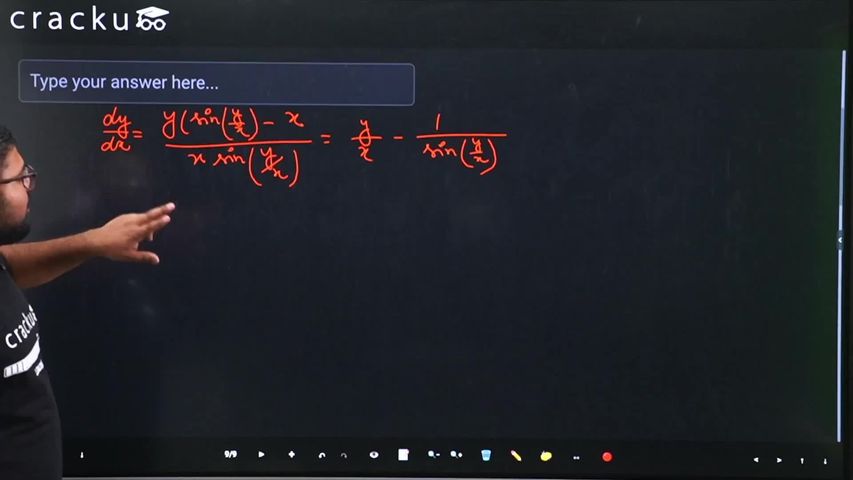
The given equation is: $$x \sin(\frac{y}{x}) dy = (y \sin(\frac{y}{x}) - x) dx$$ Rearrange to $$\frac{dy}{dx}$$:
$$\frac{dy}{dx} = \frac{y \sin(\frac{y}{x}) - x}{x \sin(\frac{y}{x})} = \frac{y}{x} - \frac{1}{\sin(\frac{y}{x})}$$
This is a homogeneous equation. Let $$y = vx$$, then $$\frac{dy}{dx} = v + x\frac{dv}{dx}$$:
$$v + x\frac{dv}{dx} = v - \frac{1}{\sin v}$$
$$x\frac{dv}{dx} = -\frac{1}{\sin v} \implies \sin v \, dv = -\frac{dx}{x}$$
Integrating both sides:
$$-\cos v = -\ln|x| + C \implies \cos(\frac{y}{x}) = \ln|x| + k$$
Using the initial condition $$y(1) = \frac{\pi}{2}$$:
$$\cos(\frac{\pi/2}{1}) = \ln(1) + k \implies 0 = 0 + k \implies k = 0$$
So, the solution is $$\cos(\frac{y}{x}) = \ln|x|$$.
2. Find the value of $$\alpha$$
We are given $$\alpha = \cos \left( \frac{y(e^{12})}{e^{12}} \right)$$. From our solution $$\cos(\frac{y}{x}) = \ln|x|$$, substitute $$x = e^{12}$$:
$$\alpha = \ln(e^{12}) = 12$$
3. Analyze the Circle Equation
The equation is $$x^2 + y^2 - 2px + 2py + \alpha + 2 = 0$$. Substitute $$\alpha = 12$$:
$$x^2 + y^2 - 2px + 2py + 14 = 0$$
For a circle $$x^2 + y^2 + 2gx + 2fy + c = 0$$, the radius is $$r = \sqrt{g^2 + f^2 - c}$$. Here, $$g = -p$$, $$f = p$$, and $$c = 14$$:
$$r = \sqrt{(-p)^2 + p^2 - 14} = \sqrt{2p^2 - 14}$$
We are given the condition $$0 < r \le 6$$:
Combining these: $$7 < p^2 \le 25$$
4. Find Integral Values of $$p$$
Possible values for $$p^2$$ are $$\{9, 16, 25\}$$.
The integral values are $$\{3, -3, 4, -4, 5, -5\}$$.
Total number of integral values = 6
Was this solution helpful?
Click on the Email ☝️ to Watch the Video Solution
Create a FREE account and get:
_1.webp)

Educational materials for JEE preparation

Ask our AI anything

AI can make mistakes. Please verify important information.
AI can make mistakes. Please verify important information.


