
Join Our JEE Preparation Group
Prep with like-minded aspirants; Get access to free daily tests and study material.
Sign in
Please select an account to continue using cracku.in
↓ →
Join Our JEE Preparation Group
Prep with like-minded aspirants; Get access to free daily tests and study material.
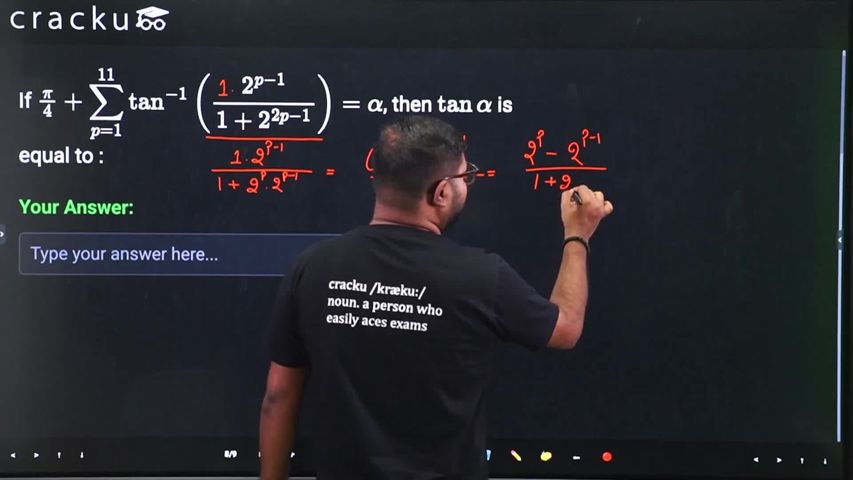
If $$\frac{\pi}{4} + \displaystyle\sum_{p=1}^{11} \tan^{-1}\left(\frac{2^{p-1}}{1 + 2^{2p-1}}\right) = \alpha$$, then $$\tan \alpha$$ is equal to :
Correct Answer: 2048
The key to solving this problem is to use the Method of Differences (Telescoping Series) by applying the identity:
$$\tan^{-1} x - \tan^{-1} y = \tan^{-1} \left( \frac{x - y}{1 + xy} \right)$$
The general term in the summation is $$T_p = \tan^{-1} \left( \frac{2^{p-1}}{1 + 2^{2p-1}} \right)$$.
We can rewrite the numerator and denominator to fit the identity:
So, $$T_p = \tan^{-1} \left( \frac{2^p - 2^{p-1}}{1 + 2^p \cdot 2^{p-1}} \right) = \tan^{-1}(2^p) - \tan^{-1}(2^{p-1})$$.
Now, let's expand the sum from $$p=1$$ to $$11$$:
$$\sum_{p=1}^{11} [ \tan^{-1}(2^p) - \tan^{-1}(2^{p-1}) ]$$
Expanding the terms:
Notice that all intermediate terms cancel out (telescope), leaving only:
$$\tan^{-1}(2^{11}) - \tan^{-1}(2^0) = \tan^{-1}(2048) - \tan^{-1}(1)$$
Since $$\tan^{-1}(1) = \frac{\pi}{4}$$, the sum is $$\tan^{-1}(2048) - \frac{\pi}{4}$$.
The full equation is:
$$\frac{\pi}{4} + \left( \tan^{-1}(2048) - \frac{\pi}{4} \right) = \alpha$$
$$\tan^{-1}(2048) = \alpha$$
Taking the tangent of both sides:
$$\tan(\tan^{-1}(2048)) = \tan \alpha$$
$$2048 = \tan \alpha$$
Final Answer: 2048
Was this solution helpful?
Click on the Email ☝️ to Watch the Video Solution
Create a FREE account and get:
_1.webp)

Educational materials for JEE preparation

Ask our AI anything

AI can make mistakes. Please verify important information.
AI can make mistakes. Please verify important information.


