
Join Our JEE Preparation Group
Prep with like-minded aspirants; Get access to free daily tests and study material.
Sign in
Please select an account to continue using cracku.in
↓ →
Join Our JEE Preparation Group
Prep with like-minded aspirants; Get access to free daily tests and study material.
A biconvex lens is formed by using two thin planoconvex lenses, as shown in the figure. The refractive index and radius of curved surfaces are also mentioned in figure. When an object is placed on the left side of lens at a distance of 30 cm from the biconvex lens, the magnification of the image will be:
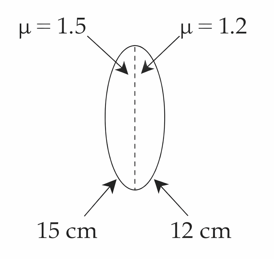
For the first planoconvex lens:
$$\mu_1 = 1.5, \quad R_1 = 15\text{ cm}, \quad R_2 = \infty$$
$$P_1 = \frac{1}{f_1} = (\mu_1 - 1)\left(\frac{1}{R_1} - \frac{1}{R_2}\right) \implies P_1 = (1.5 - 1)\left(\frac{1}{15} - \frac{1}{\infty}\right) = \frac{1}{30}\text{ cm}^{-1}$$
For the second planoconvex lens:
$$\mu_2 = 1.2, \quad R_3 = \infty, \quad R_4 = -12\text{ cm}$$
$$P_2 = \frac{1}{f_2} = (\mu_2 - 1)\left(\frac{1}{R_3} - \frac{1}{R_4}\right) \implies P_2 = (1.2 - 1)\left(\frac{1}{\infty} - \frac{1}{-12}\right) = \frac{1}{60}\text{ cm}^{-1}$$
Equivalent focal length of the combination:
$$P_{\text{eq}} = P_1 + P_2 \implies \frac{1}{f_{\text{eq}}} = \frac{1}{30} + \frac{1}{60} = \frac{1}{20}\text{ cm}^{-1} \implies f_{\text{eq}} = 20\text{ cm}$$
Using thin lens formula:
$$u = -30\text{ cm}$$
$$\frac{1}{v} - \frac{1}{u} = \frac{1}{f_{\text{eq}}} \implies \frac{1}{v} - \frac{1}{-30} = \frac{1}{20} \implies \frac{1}{v} = \frac{1}{20} - \frac{1}{30} = \frac{1}{60} \implies v = 60\text{ cm}$$
Magnification: $$m = \frac{v}{u} \implies m = \frac{60}{-30} = -2$$
Was this solution helpful?
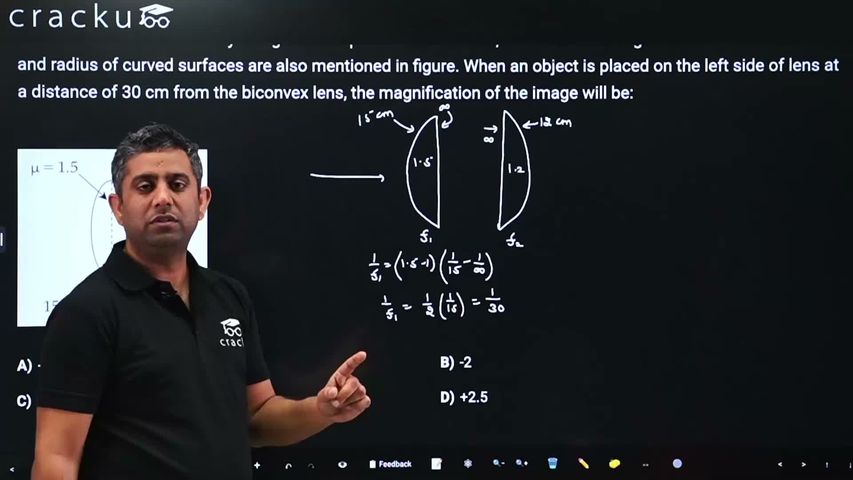
Click on the Email ☝️ to Watch the Video Solution
Create a FREE account and get:
_1.webp)

Educational materials for JEE preparation

Ask our AI anything

AI can make mistakes. Please verify important information.
AI can make mistakes. Please verify important information.
