
Join Our JEE Preparation Group
Prep with like-minded aspirants; Get access to free daily tests and study material.
Sign in
Please select an account to continue using cracku.in
↓ →
Join Our JEE Preparation Group
Prep with like-minded aspirants; Get access to free daily tests and study material.
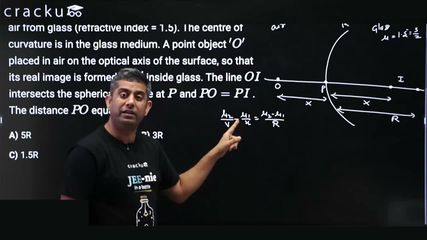
A spherical surface of radius of curvature R, separates air from glass (refractive index = 1.5). The centre of curvature is in the glass medium. A point object $$'O'$$ placed in air on the optical axis of the surface, so that its real image is formed at $$'I'$$ inside glass. The line $$OI$$ intersects the spherical surface at $$P$$ and $$PO=PI$$ . The distance $$PO$$ equals to
Let the spherical surface have its vertex at point $$V$$ on the optic axis, with the centre of curvature $$C$$ lying inside the glass medium at a distance $$R$$ from $$V$$.
Choose the Cartesian sign convention: light travels from left (air) to right (glass).
Hence, distances measured to the right of $$V$$ are taken as positive.
Given data
• Refractive index in air, $$n_1 = 1$$
• Refractive index in glass, $$n_2 = 1.5$$
• Radius of curvature, $$R$$, is positive (centre is on the image side).
The object $$O$$ is in air (left side), so its distance from the vertex is $$u = -PO$$ (negative).
The real image $$I$$ is in glass (right side), so its distance from the vertex is $$v = PI$$ (positive).
It is given that $$PO = PI$$, therefore the magnitudes of the object and image distances are equal:
$$|u| = v \quad\Longrightarrow\quad v = -u$$ $$-(1)$$
The refraction at a spherical surface is governed by the formula
$$\frac{n_2}{v} - \frac{n_1}{u} = \frac{n_2 - n_1}{R}$$ $$-(2)$$
Substitute $$n_1 = 1$$, $$n_2 = 1.5$$ and use $$(1)$$, i.e. $$u = -v$$:
$$\frac{1.5}{v} - \frac{1}{-v} = \frac{1.5 - 1}{R}$$
Simplify the left-hand side:
$$\frac{1.5}{v} + \frac{1}{v} = \frac{2.5}{v}$$
Thus
$$\frac{2.5}{v} = \frac{0.5}{R}$$
Solving for $$v$$:
$$v = \frac{2.5}{0.5}\,R = 5R$$
The distance asked in the problem is $$PO$$, and $$PO = v = 5R$$.
Therefore, the correct option is Option A: $$5R$$.
Was this solution helpful?
Click on the Email ☝️ to Watch the Video Solution
Create a FREE account and get:
_1.webp)

Educational materials for JEE preparation

Ask our AI anything

AI can make mistakes. Please verify important information.
AI can make mistakes. Please verify important information.
