
Join Our JEE Preparation Group
Prep with like-minded aspirants; Get access to free daily tests and study material.
Sign in
Please select an account to continue using cracku.in
↓ →
Join Our JEE Preparation Group
Prep with like-minded aspirants; Get access to free daily tests and study material.
A point particle of charge Q is located at P along the axis of an electric dipole 1 at a distance r as shown in the figure. The point P is also on the equatorial plane of a second electric dipole 2 at a distance r . The dipoles are made of opposite charge q separated by a distance 2a. For the charge particle at P not to experience any net
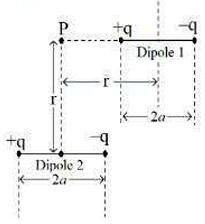
force, which of the following correctly describes the situation?
AtPP, force on charge Q is zero if net electric field is zero.
Field due to dipole 1 (axial point):
$$E_1=\frac{1}{4\pi\epsilon_0}\frac{2pr}{(r^2-a^2)^2}$$
where
p=2aq
Direction is leftward (toward −q).
Field due to dipole 2 (equatorial point):
$$E_2=\frac{1}{4\pi\epsilon_0}\frac{p}{(r^2+a^2)^{3/2}}$$
Direction is rightward (opposite to dipole moment).
For zero net force,
$$E_1=E_2$$
So,
$$\frac{2r}{(r^2-a^2)^2}=\frac{1}{(r^2+a^2)^{3/2}}$$
Let
$$x=\frac{a}{r}$$
Then
$$r^2-a^2=r^2(1-x^2)$$
$$r^2+a^2=r^2(1+x^2)$$
Substitute:
$$\frac{2}{(1-x^2)^2}=\frac{1}{(1+x^2)^{3/2}}$$
Solving,
$$x=\sqrt{5}-2$$
Was this solution helpful?
Create a FREE account and get:
_1.webp)

Educational materials for JEE preparation

Ask our AI anything

AI can make mistakes. Please verify important information.
AI can make mistakes. Please verify important information.
