
Join Our JEE Preparation Group
Prep with like-minded aspirants; Get access to free daily tests and study material.
Sign in
Please select an account to continue using cracku.in
↓ →
Join Our JEE Preparation Group
Prep with like-minded aspirants; Get access to free daily tests and study material.
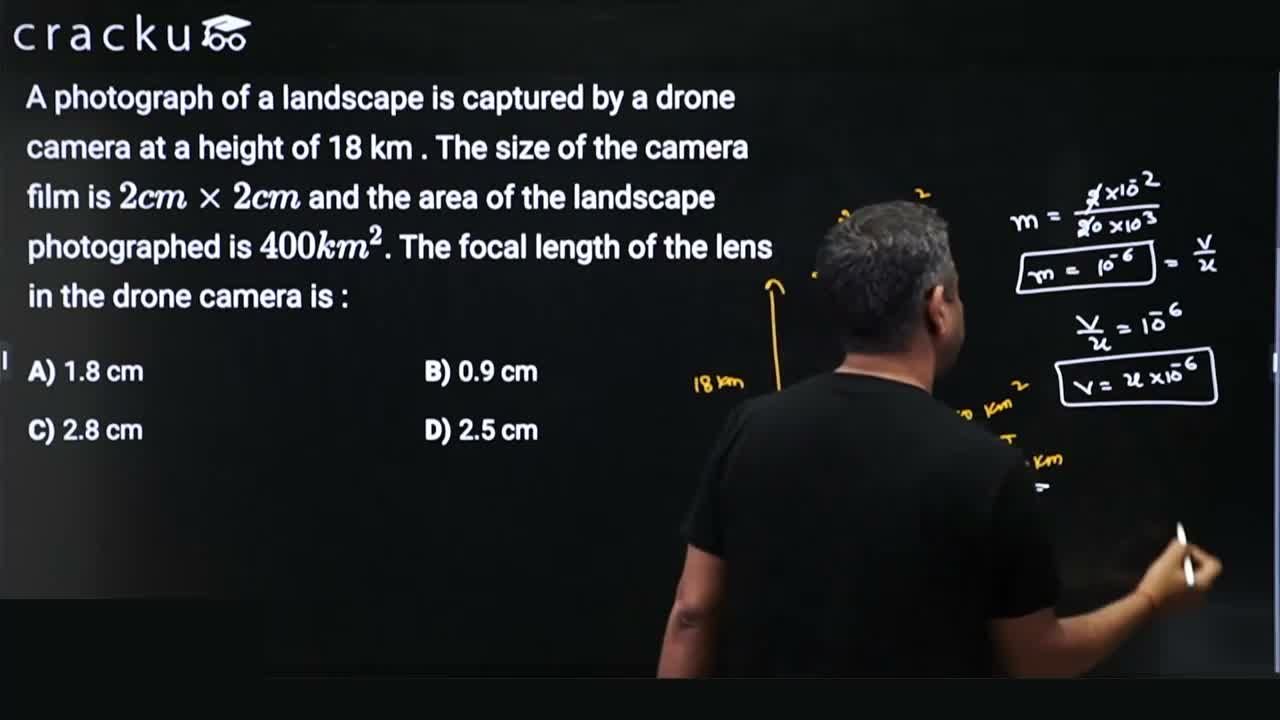
A photograph of a landscape is captured by a drone camera at a height of 18 km . The size of the camera film is $$ 2 cm \times 2 cm $$ and the area of the landscape photographed is $$ 400 km^{2} $$. The focal length of the lens in the drone camera is :
The photograph shows an area of $$400\;{\rm km^{2}}$$ on the ground. If this area is square, its side is the square-root of its area.
Side of landscape, $$L = \sqrt{400\;{\rm km^{2}}} = 20\;{\rm km}$$.
The film is a square of side $$l = 2\;{\rm cm} = 0.02\;{\rm m}$$.
Linear magnification of a lens is $$m = \frac{\text{image size}}{\text{object size}} = \frac{l}{L}$$
Substituting the sizes, $$m = \frac{0.02\;{\rm m}}{20\,000\;{\rm m}} = 1 \times 10^{-6}$$.
Magnification is also $$m = \frac{v}{u}$$, where $$u$$ = object distance = height of drone $$= 18\;{\rm km}=18\,000\;{\rm m}$$, $$v$$ = image distance (distance of film from lens).
Therefore $$v = m\,u = 1\times10^{-6}\times 18\,000 = 0.018\;{\rm m}=1.8\;{\rm cm}$$.
For a very distant object ($$u \gg f$$), the lens formula $$\frac{1}{f} = \frac{1}{v} + \frac{1}{u}$$ gives $$v \approx f$$ because $$\frac{1}{u}$$ is negligible compared with $$\frac{1}{v}$$.
Hence focal length, $$f \approx v = 1.8\;{\rm cm}$$.
Answer: $$1.8\;{\rm cm}$$ (Option A)
Was this solution helpful?
Click on the Email ☝️ to Watch the Video Solution
Create a FREE account and get:
_1.webp)

Educational materials for JEE preparation

Ask our AI anything

AI can make mistakes. Please verify important information.
AI can make mistakes. Please verify important information.
