
Join Our JEE Preparation Group
Prep with like-minded aspirants; Get access to free daily tests and study material.
Sign in
Please select an account to continue using cracku.in
↓ →
Join Our JEE Preparation Group
Prep with like-minded aspirants; Get access to free daily tests and study material.
When the position vector $$\overrightarrow{r}=x\widehat{i}+y\widehat{j}+z\widehat{k}$$ changes sign as $$-\overrightarrow{r}$$, which one of the following vector will not flip under sign change?
When the position vector $$\vec{r}$$ changes sign to $$-\vec{r}$$, we need to find which vector does NOT flip.
Under $$\vec{r} \to -\vec{r}$$ (parity transformation / spatial inversion), each position coordinate changes sign: $$x \to -x, y \to -y, z \to -z$$.
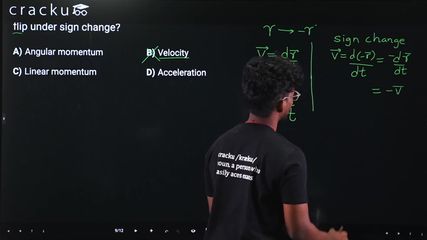
Velocity: $$\vec{v} = \frac{d\vec{r}}{dt}$$. Since $$\vec{r} \to -\vec{r}$$, we get $$\vec{v} \to -\vec{v}$$. Velocity flips.
Linear momentum: $$\vec{p} = m\vec{v}$$. Since $$\vec{v} \to -\vec{v}$$, we get $$\vec{p} \to -\vec{p}$$. Linear momentum flips.
Acceleration: $$\vec{a} = \frac{d\vec{v}}{dt}$$. Since $$\vec{v} \to -\vec{v}$$, we get $$\vec{a} \to -\vec{a}$$. Acceleration flips.
Angular momentum: $$\vec{L} = \vec{r} \times \vec{p}$$. Since $$\vec{r} \to -\vec{r}$$ and $$\vec{p} \to -\vec{p}$$:
$$\vec{L} \to (-\vec{r}) \times (-\vec{p}) = \vec{r} \times \vec{p} = \vec{L}$$
Angular momentum does NOT flip. It is an axial vector (pseudovector).
Angular momentum remains unchanged under $$\vec{r} \to -\vec{r}$$.
The answer is Option A: Angular momentum.
Was this solution helpful?
Click on the Email ☝️ to Watch the Video Solution
Create a FREE account and get:
_1.webp)

Educational materials for JEE preparation

Ask our AI anything

AI can make mistakes. Please verify important information.
AI can make mistakes. Please verify important information.
