
Join Our JEE Preparation Group
Prep with like-minded aspirants; Get access to free daily tests and study material.
Sign in
Please select an account to continue using cracku.in
↓ →
Join Our JEE Preparation Group
Prep with like-minded aspirants; Get access to free daily tests and study material.
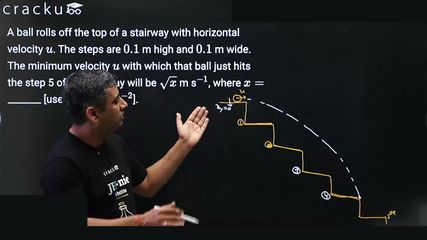
A ball rolls off the top of a stairway with horizontal velocity $$u$$. The steps are $$0.1$$ m high and $$0.1$$ m wide. The minimum velocity $$u$$ with which that ball just hits the step 5 of the stairway will be $$\sqrt{x}$$ m s$$^{-1}$$, where $$x =$$ _______ [use $$g = 10$$ m s$$^{-2}$$].
Correct Answer: 2
Let the ball leave the edge of the topmost step with only a horizontal velocity $$u$$. Choose origin at this edge: horizontal forward direction is $$+x$$, vertical downward is $$+y$$.
The riser (height) and tread (width) of every step are each $$h = 0.1\text{ m}$$. Hence the corner (outer edge) of step $$n$$ is located at $$x_n = n\,h$$ and $$y_n = n\,h$$ for $$n = 1,2,3,\dots$$
For horizontal projection, the co-ordinates of the projectile after time $$t$$ are $$x = u\,t$$, $$y = \tfrac12 g t^{2}$$. Eliminating $$t$$ gives the trajectory equation
$$y = \frac{g\,x^{2}}{2u^{2}} \qquad -(1)$$
The problem asks for the minimum $$u$$ such that the ball clears steps 1 to 4 and first lands on step 5. Step 5 has
vertical drop $$y_5 = 5h = 0.5\text{ m}$$, horizontal range $$0.4\text{ m} \le x \le 0.5\text{ m}$$.
Condition at landing (step 5)
Let the ball meet step 5 at some $$x = a$$, where $$0.4 \le a \le 0.5$$.
Substitute $$y = 0.5$$ and $$x = a$$ into (1):
$$0.5 = \frac{g\,a^{2}}{2u^{2}}$$ $$\Rightarrow \; u^{2} = g\,a^{2} \qquad -(2)$$ $$\Rightarrow \; u = a\,\sqrt{g}$$
Clearance over the earlier steps
At the corner of step $$n$$ (for $$n = 1,2,3,4$$) the co-ordinates are
$$(x_n , y_n) = (nh , nh).$$
The ball must be above each such corner, i.e.
$$y(x_n) < y_n$$ $$\Longrightarrow \frac{g\,x_n^{2}}{2u^{2}} < nh$$ Using $$(2)$$ (replace $$u^{2}$$ by $$g\,a^{2}$$) and $$x_n = nh$$:
$$\frac{g\,(nh)^{2}}{2g\,a^{2}} < nh$$ $$\Rightarrow \frac{n^{2}h^{2}}{2a^{2}} < nh$$ $$\Rightarrow \frac{nh}{2a^{2}} < 1$$ $$\Rightarrow a^{2} > \frac{nh}{2} \qquad -(3)$$
Compute the right-hand side of (3) for $$h = 0.1\text{ m}$$:
n = 1: $$a^{2} > 0.05$$ → $$a > 0.223$$
n = 2: $$a^{2} > 0.10$$ → $$a > 0.316$$
n = 3: $$a^{2} > 0.15$$ → $$a > 0.387$$
n = 4: $$a^{2} > 0.20$$ → $$a > 0.447$$
The most stringent requirement comes from step 4: $$a \ge \sqrt{0.20} = 0.447\text{ m}$$.
Choosing the landing point for minimum $$u$$
Equation (2) shows $$u = a\sqrt{g}$$, so smaller $$a$$ means smaller $$u$$.
Subject to both conditions $$0.4 \le a \le 0.5$$ (must be on step 5) and
$$a \ge 0.447\text{ m}$$ (must clear step 4),
the minimum admissible value is
$$a_{\min} = \sqrt{0.20}\text{ m} = 0.447\text{ m}$$.
Insert this $$a_{\min}$$ into (2):
$$u_{\min} = a_{\min}\sqrt{g} = \sqrt{0.20\,g}$$ With $$g = 10\text{ m s}^{-2}$$,
$$u_{\min} = \sqrt{0.20 \times 10} = \sqrt{2}\text{ m s}^{-1}$$.
Thus the minimum horizontal velocity is $$\sqrt{2}\text{ m s}^{-1}$$, which corresponds to $$x = 2$$ in the given form $$\sqrt{x}$$.
Answer: $$x = 2$$
Was this solution helpful?
Click on the Email ☝️ to Watch the Video Solution
Create a FREE account and get:
_1.webp)

Educational materials for JEE preparation

Ask our AI anything

AI can make mistakes. Please verify important information.
AI can make mistakes. Please verify important information.
