
Join Our JEE Preparation Group
Prep with like-minded aspirants; Get access to free daily tests and study material.
Sign in
Please select an account to continue using cracku.in
↓ →
Join Our JEE Preparation Group
Prep with like-minded aspirants; Get access to free daily tests and study material.
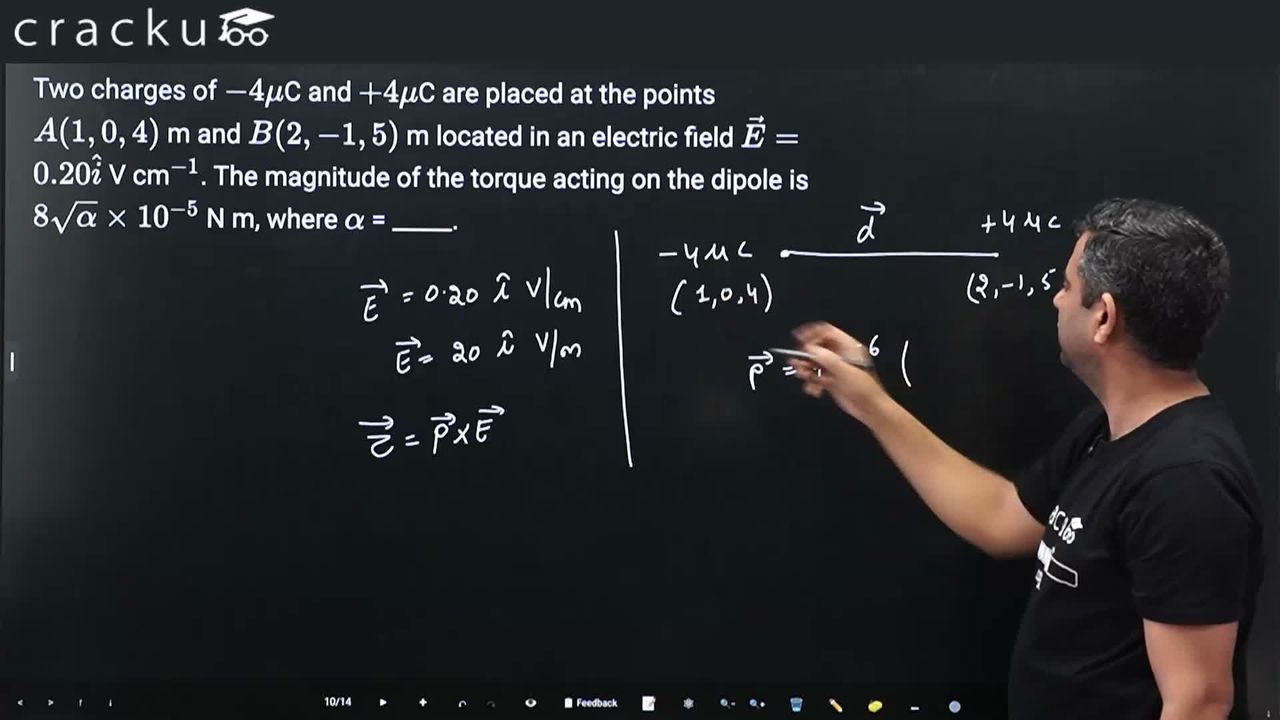
Two charges of $$-4 \mu$$C and $$+4 \mu$$C are placed at the points $$A(1, 0, 4)$$ m and $$B(2, -1, 5)$$ m located in an electric field $$\vec{E} = 0.20\hat{i}$$ V cm$$^{-1}$$. The magnitude of the torque acting on the dipole is $$8\sqrt{\alpha} \times 10^{-5}$$ N m, where $$\alpha$$ = _____.
Correct Answer: 2
Dipole moment
$$⃗\vec{p}=q\vec{d}$$
Position vector from −4μC to 4μC:
$$\vec{d}=(2-1)i+(-1-0)j+(5-4)k$$
$$=i−j+k$$
Charge
$$q=4\times10^{-6}C$$
So
$$\vec{p}=4\times10^{-6}(i-j+k)$$
Electric field:
$$E⃗=0.20iV/cm$$
Convert to SI:
$$0.20V/cm=20N/C$$
Torque:
$$τ=\vec{p}\times\vec{E}$$
Magnitude
$$\tau=pE\sin\theta$$
Only components perpendicular to i contribute:
$$p_{\perp}=4\times10^{-6}\sqrt{(-1)^2+1^2}$$
$$=4\sqrt{2}\times10^{-6}$$
Thus
$$\tau=(4\sqrt{2}\times10^{-6})(20)$$
$$=8\sqrt{2}\times10^{-5}$$
Was this solution helpful?
Click on the Email ☝️ to Watch the Video Solution
Create a FREE account and get:
_1.webp)

Educational materials for JEE preparation

Ask our AI anything

AI can make mistakes. Please verify important information.
AI can make mistakes. Please verify important information.
